1930s Comedy

The Talkies come to Kennington…

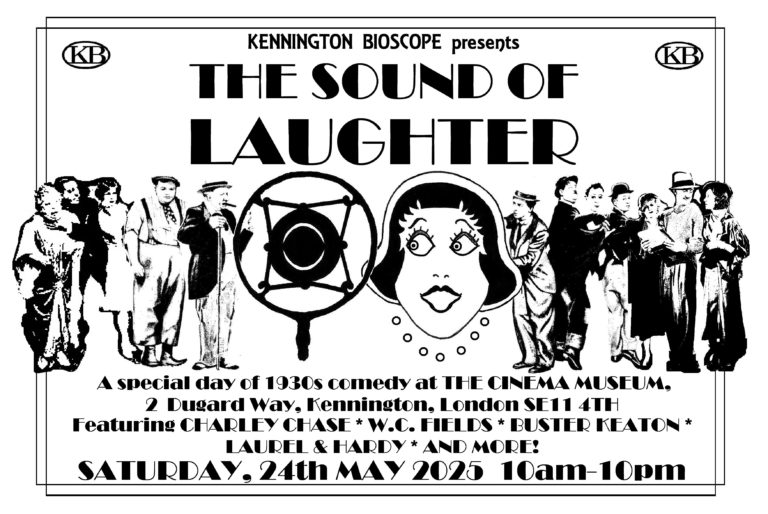
Coming next month at The Cinema Museum! After years of celebrating silent comedy, we thought it was high time we did a spin-off event to celebrate the best sound comedy.  From favourites like Laurel & Hardy, Charley Chase and W.C. Fields, to forgotten funnies like Harry Gribbon, Lloyd Hamilton and Tom Walls, we think we’ve got a great programme. But it’s your laughter that will bring the films to life… so we hope to see you there.

Here’s the link to the event page, and to buy tickets. You can also find the full programme below, but this great little video by Dave Glass gives a nice flavour of what it’s all about…


Kennington Bioscope present a fun-packed day of vintage film comedies from the 1930s, on the big screen. A spin-off from the ever-popular Silent Laughter events, this all-dayer will feature some of the very best talking comedians in a hilarious selection of shorts, features and rarities. We’ll also be spotlighting the work of silent comedians who transitioned to sound, with classic shorts from Laurel & Hardy, Charley Chase and W.C. Fields, plus the rare chance to see a fantastic Buster Keaton feature that captures the essence of his silent work. All this, plus some choice rarities from the British Film Institute, Library of Congress and private collections. Introductions and presentations by film comedy experts will spotlight the work of key performers and studios, and there will be plenty of screenings on celluloid! So come along and enjoy the sound of laughter as we celebrate one of film comedy’s greatest decades.

The full programme is below. All films subject to confirmation.


10.00 SOUND BEGINNINGS

The coming of sound brought new opportunities in cinema for comedians specialising in verbal humour, nonsense patter and musical comedy. From the zany antics of the Marx Brothers and The Three Stooges to the sly humour of Mae West, or songs and patter of Eddie Cantor, there was a dazzling array of fresh talent. This programme will showcase the best of the new guard, through short films and excerpts. Among the gems we’ll be showing complete are Robert Benchley’s witty, Academy Award winning How To Sleep and The Druggist’s Dilemma, featuring the hilarious comedy team Clark & McCullough with James Finlayson. Presented by Matthew Ross.


11.30 ROOKERY NOOK (1930)

Ben Travers’ series of Aldwych Farces were some of the most popular British films of the 30s. Featuring the wonderful dynamic between disreputable Tom Walls, silly-ass Ralph Lynn and nervous Robertson Hare, the films set a benchmark for situation comedy. The first of the farces to be filmed, Rookery Nook was voted the best comedy of 1930, but has rarely been screened since. This is a rare chance to see the farceurs at the top of their game in one of their classic films. Rookery Nook will be screened on 35mm, in a copy from the BFI National Archive and introduced by film historian Geoff Brown.


14.00 THE TALKIE FUN FACTORIES

The comedy two-reeler was a mainstay of cinema programmes throughout the 1930, and here we spotlight the efforts from specialist comedy studios. From the Mack Sennett Studios comes a terrific spoof of early musicals, A Hollywood Theme Song, with Harry Gribbon; we’ll be screening this on 16mm. The same studio also made some of W.C. Fields’ funniest films, including The Dentist, which we’ll be showing in its rarely seen, complete and uncensored version! Other films include a very rare – and very funny – RKO short starring Harry Sweet, Firehouse Honeymoon. Presented by Glenn Mitchell and Dave Glass.


15.30 LE ROI DES CHAMPS-ÉLYSÉES (1934)

Legend has it that Buster Keaton’s sound films are all horrors that allowed him no creative control, but that’s not completely true. While MGM may have mis-used his talents, independent studios gave him much better opportunities – albeit on a low-budget. In 1934, Keaton travelled to France to make this indie feature for producer Max Nosseck. Within the story of an amateur actor who gets mixed up with gangsters, Keaton creates new silent comedy routines and shows off his acting chops in a dual role – all set against great location backdrops of Paris in the 1930s. A rare chance to see this charming and funny film on the big screen. In French, with English subtitles. Introduced by Keaton expert David MacLeod.


17.00 SILENT SURVIVORS

Another film comedy myth is that the lion’s share of silent comedians were out of work when sound came in. Actually, many of them remained busy and continued to produce some great comedy. Glenn Mitchell and Matthew Ross present a selection of the funniest and most fascinating sound appearances by silent comics, including excerpts featuring Harold Lloyd, Roscoe Arbuckle and Lupino Lane. The programme will also feature complete screenings of Lloyd Hamilton’s Good Morning Sheriff (courtesy of The Library of Congress), Harry Langdon’s charming A Dog-Gone Mix-Up and Laurel & Hardy’s Our Wife, in which the duo meet silent comics Babe London and Ben Turpin! The last two of these films will be screened on 16mm.


20.00 THE LOT OF FUN: LAUREL & HARDY & CO

The Hal Roach studios were the gold standard for comedy studios in the 1930s, turning out wonderful and charming short films. This programme will show some of the finest comedies made on ‘The Lot of Fun’! The female comedy team of Thelma Todd & Zasu Pitts crash society in The Pajama Party, while Charley Chase brings his talent for farce into the sound era in Looser Than Loose. The programme will conclude with Laurel & Hardy’s Academy Award winning classic The Music Box (the one with the piano!), which will be shown on 35mm. A fitting end to a day filled with the sound of laughter!
Missing Jewels & a Rhapsody in Pink

After returning to Britain in 1930, Lupino Lane managed the starring career in feature films that eluded him in Hollywood. One of his final Hollywood films, FIRE PROOF, had shown that he could successfully make a slapstick film in his old style with sound. In Britain, he achieved this again with 1931’s NO LADY, a great little film that features some of his best pantomime routines, revisited. But by the mid-1930s, this sort of comedy was going out of fashion, and light musical comedies were in. As a comedy all-rounder, this was a medium that Lane also enjoyed, and he had alternated much of his film career with appearances in stage plays.

In the mid 30s, British film exhibitors were beholden to exhibiting a quota of home-grown films, in an attempt by the industry to limit the dominance of Hollywood. This set up a boom of production, with many small companies deciding to have a go: quantity did not mean quality of course, and many of these films gained the derogatory term “quota quickies”. Still, with a guaranteed market for their product, it was a good time for filmmakers to launch a new venture, and Lane decided to get in on the game. He set up his own production company, ‘St George’s Pictures’, in 1935, with the intention of making independent comedy features. Most of these are lost, but THE DEPUTY DRUMMER survives, and shows him moving more in the light comedy direction. In it, he plays struggling composer Adolphus Miggs, who joins a band as drummer to attend a party at a stately home, but is mistaken for Lord Miggs. Subsequently, he’s mixed up witha jewel theft, but manages to both catch the thieves, and find a patron for his rhapsody. It’s easy to imagine this concotion as a stage play, and it’s similar to the vehicles that Lane’s cousin Stanley Lupino was making: a light, farcical comedy with some dialogue routines, songs, romance, and the odd bit of visual comedy.

The low budget, “quota quickie” status of THE DEPUTY DRUMMER shows through; it has a slightly slapdash feel to it, with a few half-burning dialogue routines. There’s much less visual comedy than usual for Lane, and a sequence of him let loose on a rare collection of china vases (I bet you can’t guess what’s going to happen…) is pretty predictable. Nevertheless, a running gag of a missing necklace seeming to follow him around comes off much better, and as with every Lane film, there’s at least one spectacular pratfall. Here, he misses the top step of a flight, and somersaults right down to the bottom. It’s over in a few seconds, but is a reminder of the absolute physical mastery of this unique comedian.

Elsewhere, the musical comedy format permits some charming musical numbers, especially a wonderfully understated dance number with Brutus the dog, ‘Dear Old Pal’. Oh, and look out for the always reliable Wallace Lupino and Syd Crossley as two villains, plus George Formby’s regular foil Hal Gordon.

So, overall, a mixed bag, but an interesting one. If you see the film for what it is, a 30s British musical comedy with low ambitions but some great assets, then it’s a pleasant way to spend an hour or so. Lane would make one more film with St George’s Pictures, TRUST THE NAVY – now lost – before the venture fizzled, but still had one more great film in him: 1939’s THE LAMBETH WALK. But that’s another story. Here’s THE DEPUTY DRUMMER…

Cooking up Laughs

it’s amazing what keeps turning up on YouTube. I was especially pleased to see a couple of rare shorts starring Joe Cook appear recently, in lovely transfers from the Library of Congress archives.

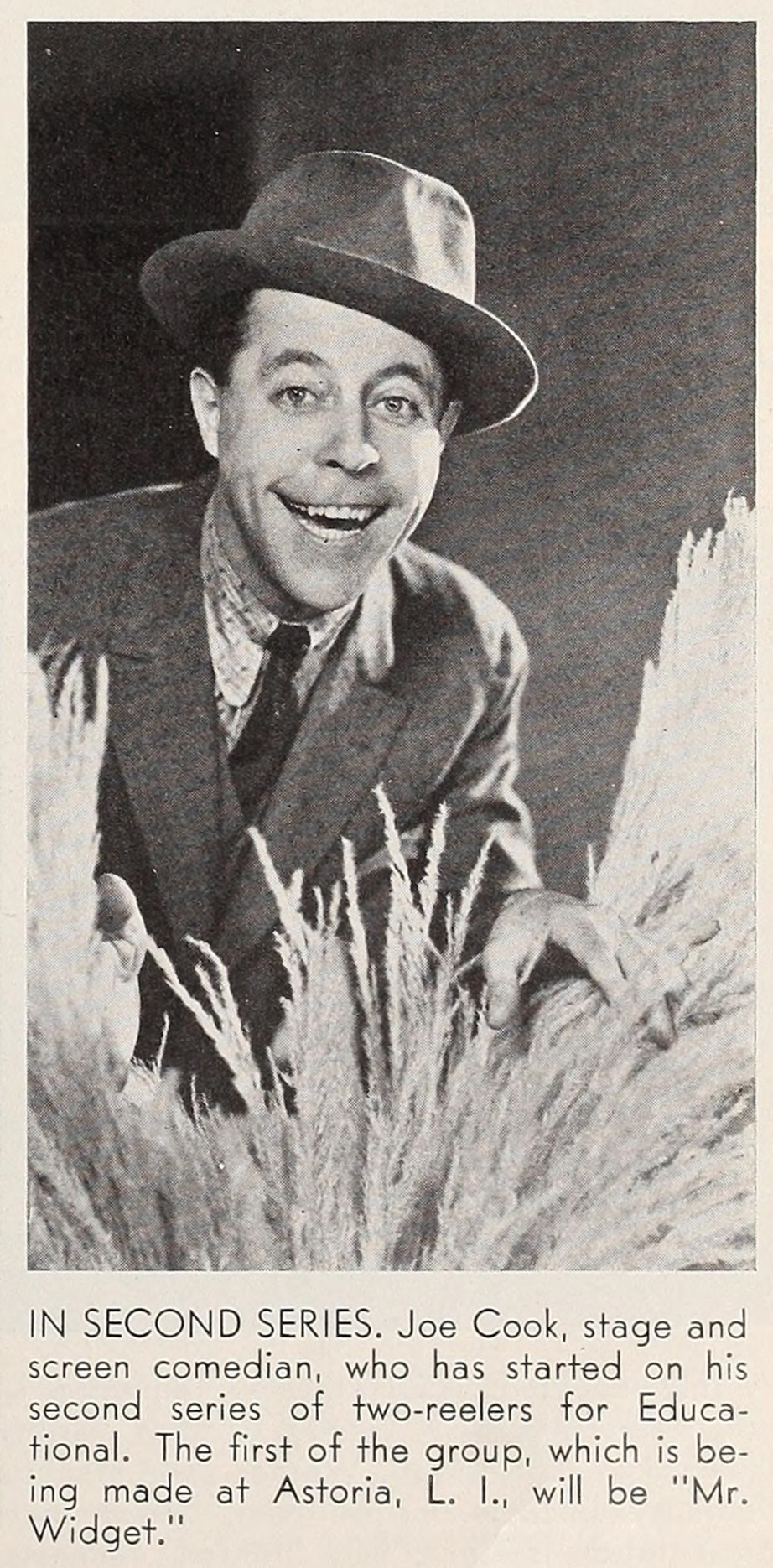
I’ve wanted to see these films for ages, as the few bits of Cook I’ve seen show him to be a unique and undeservedly forgotten comedian. With upturned nose, pointy chin and an enormous grin, he was was a caricaturist’s dream. He was also one of the very best and most versatile comic performers to come out of vaudeville.

Cook combined the best of many other Vaudeville characteristics that we now associate with better remembered performers. He combined traits of all three key Marxes (sorry, Zeppo): Groucho’s fondness for circular, nonsensical double talk, Chico’s sly conning and Harpo’s ‘White Magic’ all featured in his schtick. Like W.C. Fields, he was an incredible eccentric juggler, while his broad grin and amiable nature were reminiscent of Joe E Brown.

Yet Cook was unique, a force of nature all by himself. With that sunny smile, a symbol of his indefatigable attitude, he was perhaps more purely likeable than any of his contemporaries.

This quality was born out of adversity, and probably of necessity. Born Joseph Lopez of Spanish and Irish parents, he was orphaned at three, adopted, and left home early in his teens to join a medicine show. There, he played a comic sidekick helping sell ‘Doctor Dunham’s Cure-all Tonic’; the winning smile and fast-talking manner he developed surely began here as part of his salesman’s pitch.

Medicine show performers were expected to be endlessly versatile to provide a full show. In addition to his juggling, Cook learned to walk a slackwire, played guitar and ukulele and did a sharpshooting act. He became known as ‘A One-man Circus’ when he took his act into Vaudeville, and on to Carroll’s Vanities. Around this time, his juggling act was preserved as part of an interest reel for Educational Pictures:

Pretty nifty, but not a patch on his slackline routine, with added hoops!

The terrific clip above is from Cook’s first starring feature, RAIN OR SHINE. He was the perfect star for this circus-themed musical comedy, which was converted from stage to film by a young Frank Capra in 1930. The film shows Cook in excellent form, with plenty of chances to show off his multiple talents. Here’s a fun example of one of his breathless double talk routines, which circles around itself to become utterly meaningless, a Joe Cook trademark. (His stooge here is the estimable Tom Howard, also a performer who should be better remembered).

Cook flirted with a career in films, but RAIN OR SHINE failed to launch him in the way it should have done. Curious, when Hollywood was falling over itself to snap up Broadway stars in the early 30s. Cook would try again for Fox in 1933/4, starring in a handful of other features such as HOLD YOUR HORSES and FINE AND DANDY, but after this he primarily focused on stage and radio. like Clark & McCullough, he was largely content to keep his film work to shorts made quickly between other engagements. To this end, he signed with Educational Pictures in 1935, and made five shorts for them: MR WIDGET, NOSE FOR NEWS, THE WHITE HOPE, PENNY WISE and GIV ‘IM AIR.

Educational were clearly chuffed with their signing, featuring him prominently in publicity alongside their other big catch, Buster Keaton. Cook was given his head to contribute stories and screenplays, and the films feature a great collection of sight gags, double talk and wonderful nonsense. Special effort seems to have gone into the first, MR WIDGET. Cook plays a hapless salesman, but that’s really just a loose excuse for him to show off some of his goofy inventions, get involved in some crosstalk acts and indulge in some wonderfully surreal goings on. We first see him giving a nonsensical speech after receiving an award. This turns out to be just a dream as he wakes up in his mechanised bed, an appliance straight out of the Snub Pollard School of Classic Comedy Inventions (TM). There’s a white magic routine with a drinking fountain that Stan Laurel surely would have approved of, and a funny scene of Joe trying to buy an overcoat that has a superbly understated payoff as he arrives at his office.

Generally the supporting casts in Educational talkies are pretty wooden, but the exception here is an appearance by venerable, snarling baddie Dick Cramer. Cramer is out to get Cook, who distracts him by reading him a children’s story. It sounds ridiculous, and it is, but the warmth with which Cook adopts the role of storyteller, and the slow thawing of Cramer’s thug, make it really funny. All in all, a great little short which augured well for Cook’s tenure at Educational. The only thing that lets the short down is an unfortunate bit of racial material at the end, other than that it’s a joyous two reels. Here it is, by kind courtesy of Joseph Blough’s excellent YouTube channel:

Almost as good is A NOSE FOR NEWS, a tale of breezy reporter Cook being held in jail after an opportunistic criminal (Dick Cramer again) swaps places with him. The highlight is a sequence of Cook’s attempts to escape from his cell, each time managing to destroy the wall, but being caught in the act by Cramer, who forces him to return. Lots of fun again:

I hope to catch up with the otehr three Joe Cook shorts one day. It’s just a shame that he didn’t make more. His last film was a Zane Grey B-Western comedy, ARIZONA MAHONEY, made in 1936. Apparently he was able to work in a fair bit of his medicine show/One-Man-Circus act into the old-time setting, but it was hardly a prestigious film. He turned his attention to radio, before early-onset Parkinsons sadly curtailed his career.

Joe Cook passed away in 1959. While it’s a shame that he didn’t leave more lasting relics for us to remember him by, the scraps that remain show a truly gifted, multitalented performer with bags of charisma. How many performers today could describe themselves as a One Man Circus?

Lessons in punctuation with Stainless Stephen (open brackets, exclamation mark,close brackets)

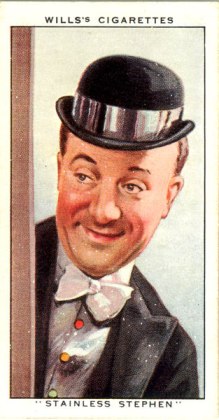
StainlessstephenIn the hectic world of variety, performers needed a niche to stand out from the crowd. ‘Stainless Stephen’ found an especially idiosyncratic one. Taking his moniker from his Sheffield origins (then centre of the U.K.’s stainless steel industry), he continued the gimmick by  wearing a stainless steel waistcoat and steel-rimmed bowler hat.

Such gimmickry was ‘Stephen’s forte; in addition to his costume, the core of his act was to soliloquize in a whistling Robb Wilton deadpan, speaking all the punctuation, and adding in other asides:

“What a wonderful year 1930 was, semi-colon, said Stainless Stephen, semi-conscious. Thousands of new motorists took to the road, comma, and as a result thousands of pedestrians took to the pavements”

A little of this obviously goes quite a long way, and its no surprise that he never carried full films or shows on his own, but as a short turn on the radio, or on a 78, he was good fun. He made but one film appearance, in the all-star extravaganza RADIO PARADE (1933). While it sadly presents him out of his bizarre regalia, his 3 minute routine playing a railway guard is really quite funny and one of the highlights of the film.

Stephen’s real name was Arthur Baynes and his day job was as a school teacher, a job he continued for some time after finding success, meaning he could only make appearances at weekends and during school holidays!

crookes

Stainless Stephen’s day job was at the former Crookes Endowed School in Sheffield. Coincidentally, it’s about a mile from my home.


Legend has it that Stainless’ lessons on Friday were always a bit light on the ground, as he spent most of the time leaving his classes to it whilst he wrote his radio material for the weekend! Baynes retired in 1952 to become a gentleman farmer in Kent, describing himself as “stainless, painless, brainless, shameless, aimless, semi-conscious and approaching semi dotage.” He died in 1957.

(On a teacher’s note, there is currently much panic over the introduction of a new punctuation and grammar test for primary school children. This would surely have been a breeze for Stainless Stephen’s classes!)