Silent Comedy Lover & editor of blog and e-zine The Lost Laugh www.thelostlaugh.com. Tentatively working on a book about great clown Lupino Lane.
National Park Ranger, Nature lover and occasional nature writer.
Guitarist & songwriter; half of Landscape Pop duo Mr Magpie: mrmagpieband.bandcamp.com
Charley Chase at Hal Roach. The Late Silents: 1927 features fifteen great Chase shorts, most of them unseen for years.Here’s the trailer, and read on for a review. Spoiler alert: it’s insanely good, and you should buy it.
There’s a – quite possibly apochryphal – legend that Charley Chase buried a boxcar full of his old film prints and personal memorabilia somewhere in the San Jacinto desert. That rumour may never be verified, but this latest DVD/BluRay collection from The Sprocket Vault gets us close in spirit to unveiling such a Chase treasure trove. The films here have been largely unseen for decades; some were considered lost, others locked away in archives, or withheld due to copyright restrictions. When The Sprocket Vault began their series of Chase DVDs a few years ago with his talkie shorts, this already seemed like an unlikely and amazing bonus; when they moved on to his uber-rare (and hilarious) 1929 films, I thought I’d seen everything. But this set is the culmination of everything that Richard M Roberts and Kit Parker have been working towards in the series so far. It’s yet another release I never thought I’d see, and it presents some of the greatest silent short comedies ever made, rescued from the void. Quite simply, this is one of the most important silent comedy DVD/Blu Ray releases ever.
Why? Well, it represents the biggest release of “new” (ie. largely unseen) Chase films in years, and they capture him at the peak of his powers. 1927 was maybe Charley’s annus mirabilis. He made many of his best films, and was Roach’s biggest star. A reminder of his status is that both Stan Laurel and Oliver Hardy appear as supporting actors to him in that year’s Now I’ll Tell One, the remaining footage of which is included here. Within a year, the Laurel & Hardy team would supplant him as the big news from Culver City, and Chase would forever play second, or third, fiddle to them.
However, the work presented here is compelling evidence – perhaps the most compelling yet? – for Chase’s status in the top echelon of silent film comedians. There’s a dazzling array of comedy techniques on display – from farce (Assistant Wives, A One Mama Man) to topical humour (Us), and adroitly handled slapstick and sight gags (The Way of All Pants, Are Brunettes Safe?).
A couple of the films have been seen before, but scattered across a variety of releases, often in poor quality. They look much improved here, courtesy of the restorations by Paul Gierucki at CineMuseum, and its great to have films like Forgotten Sweeties and There Ain’t No Santa Claus available as part of a cohesive Chase collection. The most familiar film here is Fluttering Hearts, which is so good that I’m sure no-one would begrudge owning another copy. After that, almost everything is new to Chase fans. And what joys there are to experience. I don’t want to give everything away in this review, but here are a few samplers:
Are Brunettes Safe is a wonderful comedy featuring Chase standing in for his doppleganger, who turns out to be a dangerous bandit. There’s some terrific physical comedy here as he has to incorporate the villain’s distinctive limp into his impersonation. This climaxes in another one of his fantastic eccentric dances, with Polly Moran.
A One Mama Man has great performances from both Gale Henry and Vernon Dent (rarely spotted at Roach) to add to the fun. This film was remade by Chase as the talkie Skip The Maloo! In 1931, but this version is much superior.
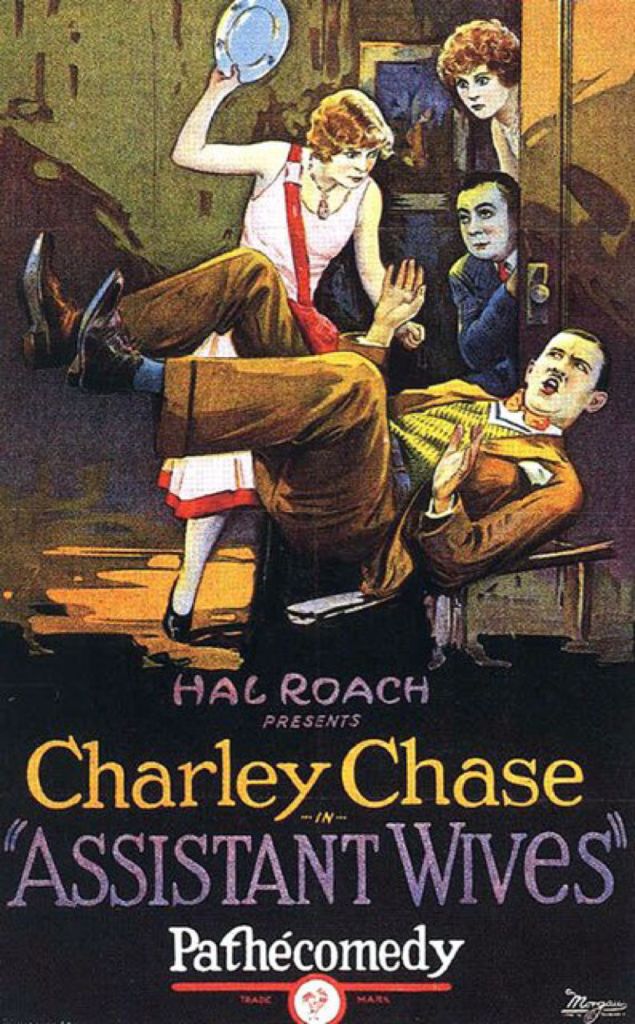
Assistant Wives is one of his best farces – another ridiculous premise, made believable by Chase’s perfect characterization and storytelling. A terrific cast here, too: Anita Garvin, Noah Young, Eugene Pallette and Edna Marian all add to the fun as Charley has to hire a stand-in wife when the boss invites himself to dinner. Some beautiful, original gags as well; Charley trying to carry three bowls of soup backwards up a fire escape is a particular highlight.
The jewels in the crown are the long-unseen, complete versions of two films sampled in Robert Youngson’s comedy compilations. A brief section of the Lindbergh-baiting Us was seen in Four Clowns. Alongside the other Chase excerpts showcased there, I’d always been a little underwhelmed by this one, but the whole film is an absolute delight. While there are quite a few silent comedies featuring aerobatic finales, Us is a winner by virtue of relying on Chase’s character to provide the comedy. A nervous would-be flyer afraid to leave the ground, he presents himself as an aviator to impress Margaret Quimby, then has to constantly find new excuses to weasel out of actually going up in an aeroplane. This makes for some really funny sequences, and the film looks beautiful too.
The Way of All Pants was, for many years, thought to only exist in the cut-down excerpt featured in The Further Perils of Laurel & Hardy. Even in that truncated format, it was an absolute barnstormer of a comedy, but happily the full version was rediscovered a few years ago. The extra space of the full version really sets up the characters, and provides plenty of wonderful new gags (not forgetting the witty original intertitles). While losing trousers for comedy purposes can seem like a hackneyed idea, Chase’s absolutely mastery of how to provide variations on a running gag, expertly paced, make this one of the best of all his films, and among the top tier of Hal Roach comedies. We were privileged to showcase this new restoration at the 2023 Silent Laughter Weekend, and many people said it was their favourite film of the entire weekend!
The Way of All Pants is also a great example of how Chase’s silent films have such perfect rhythm, not just the way they are directed and edited, but in Chase’s own pitch-perfect timing and body control. I was really struck by this when watching all the shorts on this set.
This set ranks along with All Day Entertainment’s Harry Langdon: Lost & Found set, Lobster’s Charley Bowers collection, Dave Glass’ Monty Banks restorations and Undercrank’s Edward Everett Horton set as a major, game-changing showcase for a silent comedy talent. And, if the films themselves weren’t enough, you get great musical scores from Dr Andrew Simpson, and information-packed commentaries from Richard M Roberts, which really put the films into their historical context. Massive thanks and congratulations to everyone involved in making this release happen. It puts Chase at the forefront of the silent comedians, where he belongs. Now, what are you waiting for? Go buy it!
Well, here we are. Somehow it’s November, and it’s almost time for the Silent Laughter Weekend at London’s Cinema Museum. We think it’s a great lineup, from classics with Chaplin, Keaton, Lloyd and Laurel and Hardy, through to obscurities and rediscoveries starring everyone from Dorothy Devore, Monty Banks and Charley Bowers to Marion Davies and Pat & Patachon. Plus the UK re-premieres of long unseen films with Charley Chase, Syd Chaplin, Charlie Murray and Clara Bow.
The trailer above gives a good flavour of what’s to come, but if you want to know more, here are the full programme notes for the weekend:
(And if that doesn’t convince you, we’ve got a whole load of “Easter Egg” extras to add in. AND some of the most talented silent film accompanists playing for each show!) Here’s the link to buy tickets, if you haven’t already:
It’s back! Mark your diaries for giggles, chuckles and belly laughs! On November 9th & 10th, Kennington Bioscope present another Silent Laughter Weekend: two days of live silent cinema showcasing the cream of silent comedy films.
This year features one of our most packed programmes ever, a wide-ranging and eclectic selection of the funniest, rarest and most unusual gems from comedy’s greatest era. From the best-loved comedians to the most obscure; from wild slapstick to the subtle and sophisticated; from surreal stop-motion animation to European clowns, there’s a smorgasbord of silent hilarity spread over twelve programmes.
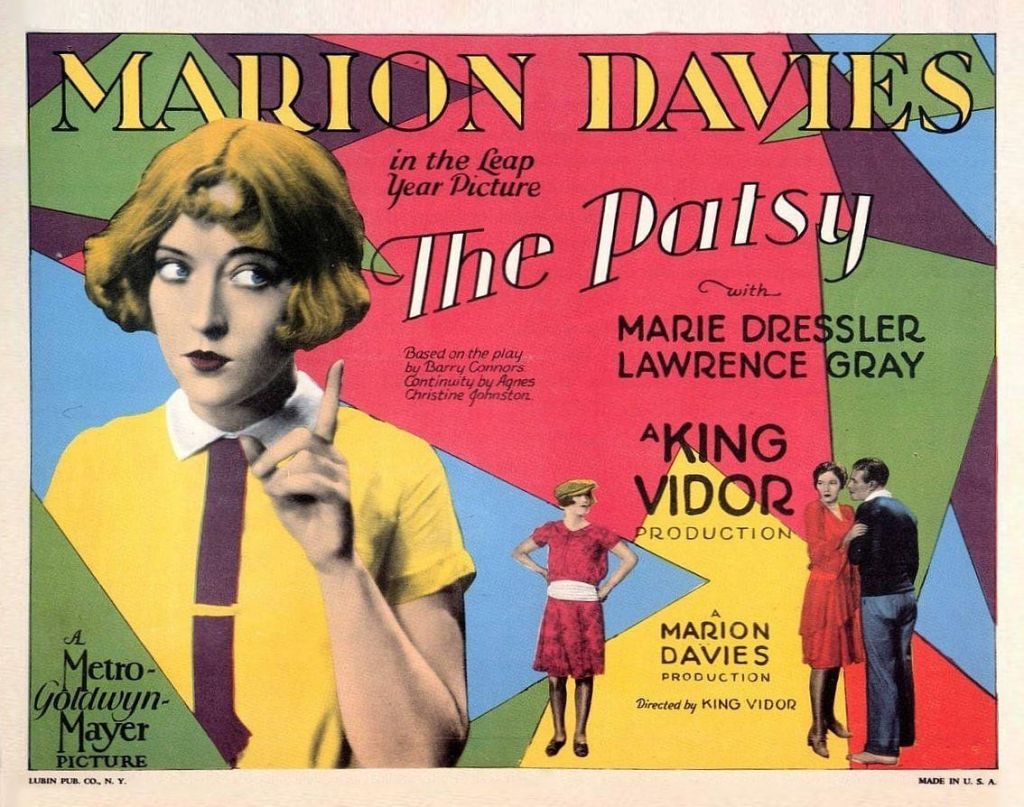
You’ll find plenty of familiar favourites, including classic shorts starring Charlie Chaplin, Buster Keaton, Harold Lloyd and Laurel & Hardy. But there’s so much more to silent comedy than the well-known stars, and as always we also spotlight the undeservedly forgotten comedy talents, such as Marion Davies (in The Patsy), Danish comedy team Pat & Patachon, Richard Dix, Charlie Murray and Charley Chase.
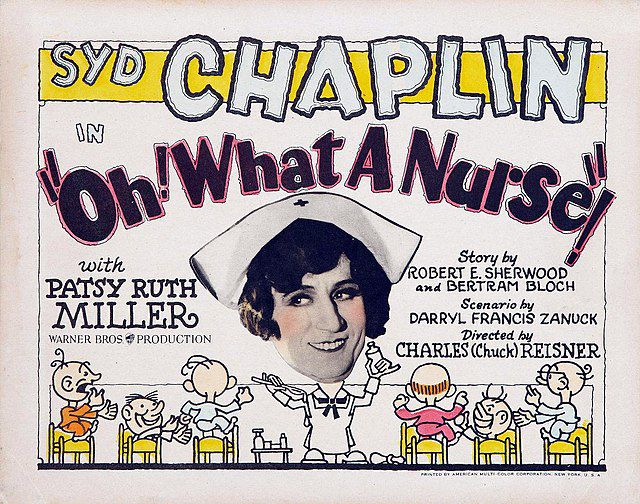
Regular attendees will know that we always pull some real rarities out of the hat. This year is no exception, as we’ll be hosting the U.K. premieres of several recently rediscovered films. On Saturday evening, Charlie Chaplin’s brother Syd stars in Oh! What a Nurse! one of the big hits of last year’s Pordenone, it hasn’t been seen in this country for almost 100 years! We’re also thrilled to be showing the newly rediscovered spooky comedy thriller The Gorilla, starring comedy stalwart Charlie Murray. Murray also features alongside Clara Bow in another previously lost film, The Pill-Pounder. Bioscope favourite Charley Chase will feature in a programme of newly restored short comedies that have been unseen in many, many years and we’ll also be showing some incredibly rare films starring the likes of Monty Banks, Harold Lloyd and Dorothy Devore.
There is also a spotlight on the iconic Keystone Kops, as well as the work of Vitagraph Studios. An ‘Animations and Illusions’ programme will feature camera trickery, from Meliés’ experiments to the mind-blowing madness of Charley Bowers. You won’t want to miss a very special presentation of 9.5mm rarities by Christopher Bird, shown on film using amazing vintage projectors. Bioscope favourite Charley Chase will feature in some of his rarest comedies, newly restored and presented by Hal Roach expert Richard M Roberts.
We’ve even got a silent film appearance of a Marx Brother! There’s a rare screening of Too Many Kisses, a 1925 comedy featuring a supporting role from none other than Harpo Marx.
Every programme features live musical accompaniment from London’s finest silent film pianists. A roll call of comedy film authors, enthusiasts and collectors will contextualise the films, and share stories of the filmmakers. And it all takes place in the wonderful surroundings of London’s Cinema Museum. Oh, and it’s just £30 for the whole weekend!
So come and join us on the 9th-10th November for a lafftastic weekend of live silent cinema. It’s the best selection of rare and classic silent comedy you’ll find anywhere!
Here’s the link to the full programme, and to buy tickets:
Here’s another film I never thought I’d see: one of only two starring talkies featuring Raymond Griffith.
Griffith was a real original among the silent comedians. He was suave and debonair, a bit like Max Linder, but added a jazz-age slyness and visual wit that were entirely his own. His starring features in the mid-late 1920s were big hits, but few are available for viewing today. Still, surviving entries like HANDS UP!, YOU’D BE SURPRISED and PATHS TO PARADISE are enough to confirm he was a major talent.
The coming of sound was enough to give even the funniest silent clown the jitters, but Griffith had more reason to worry than most. It wasn’t a case of simply not having a voice to fit his character, but rather his barely having a voice at all. An illness in his younger days had left him with little more than a hoarse whisper. Despite this, he gamely gave it a try in a pair of two-reelers made for Al Christie in 1929: POST MORTEMS and THE SLEEPING PORCH.
Each time, an excuse was found in the plot to justify his hoarseness; in THE SLEEPING PORCH, he’s supposed to be suffering from a bad cold. Despite the massive handicap he was facing, Griffith actually acquits himself rather well here. He’s still funny visually, with chance to make some great reactions (including an especially great double take incorporating a whole-body spin) and actually handles the dialogue very well considering, delivering some funny lines effectively. Certainly, for a 1929 talkie, this could be a lot worse. See for yourself, courtesy of Geno’s House of Rare Films on YouTube:
Clearly, there was a limit to how long the scriptwriters could keep coming up with variations on working Griffith’s hoarseness into the plot, and unsurprisingly, he didn’t sustain a career in talkies. His last role was as a dying soldier in ALL QUIET ON THE WESTERN FRONT. Happily for Griffith, he went on to a successful career behind the scenes at Fox.
As for THE SLEEPING PORCH, it’s an interesting little curio with some amusing moments. Thanks for sharing, Geno!
Another treat from the excellent Joseph Blough YouTube channel: an extremely rare fragment of an otherwise lost Charley Bowers film. Bowers made some of my favourite silent comedies: truly surreal shorts featuring a pioneering mixture of action and stop-motion animation.
HOP OFF is from his second series of films, made for Educational Pictures in 1928. In common with many of Bowers’ shorts, it gives him some cute animated sidekicks: in this case, a pair of fleas he is training. Studio publicity tried claiming them as “the two smallest actors in the world”! The extant footage here is three minutes from near the end of the film; not much, but I didn’t realise that anything from this film existed at all, so anything is a bonus (it’s not included on the otherwise comprehensive Charley Bowers Blu-Ray set from a couple of years back). Anyway, a real treat to see, even if it is only brief. Now I’m itching to see the rest, though. (Sorry, I’ll get my coat…)
More on the enigmatic Mr Bowers in an article I wrote a few years back here: Charley Bowers
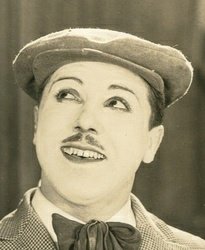
I’m midway through writing notes for the films in the new Monty Banks Kickstarter BluRay. If you’ve signed up for this one, you’re in for an absolute treat – the films are great and look fantastic! Anyway, while looking up a few bits and pieces about our Monty, I stumbled on an intriguing YouTube video. It’s an archival Czech/Yugoslavian TV documentary dedicated to Monty, from a series called ABECEDERA HUMORU, which roughly translates as ‘The Alphabet of Humour’. It seems like each episode presents a spotlight on a particular vintage comedian, with highlights from their films presented, narrated GOLDEN SILENTS style.
The interest here is that the clips chosen are big chunks of some really rare Monty films! This episode features excerpts from some of his short films, none of which I’d seen before. Some of the Banks shorts are downright obscure, so these are my best guesses for identification (this book was a big help on a couple of the films!). I’d love to be corrected, so all you silent comedy scholars lurking out there, do please chime in…
The first clip is certainly from PEACEFUL ALLEY, which has been called Monty’s version of Chaplin’s EASY STREET. (There’s perhaps more overlap with Larry Semon’s own version, THE RENT COLLECTOR, though). Some good scenes here as Monty tries to collect debts from the tough tenants, led by his very own Eric Campbell-style heavy, William Blaisdell.
Following this is a sequence where Monty, en route to his wedding, accidentally (and unknowingly) comes into possession of some bootleg booze. I haven’t got a clue which film this is from, but it’s loads of fun!
Monty unknowingly lures a crowd of drunkards through the streets. Is that Syd Crossley on the right?
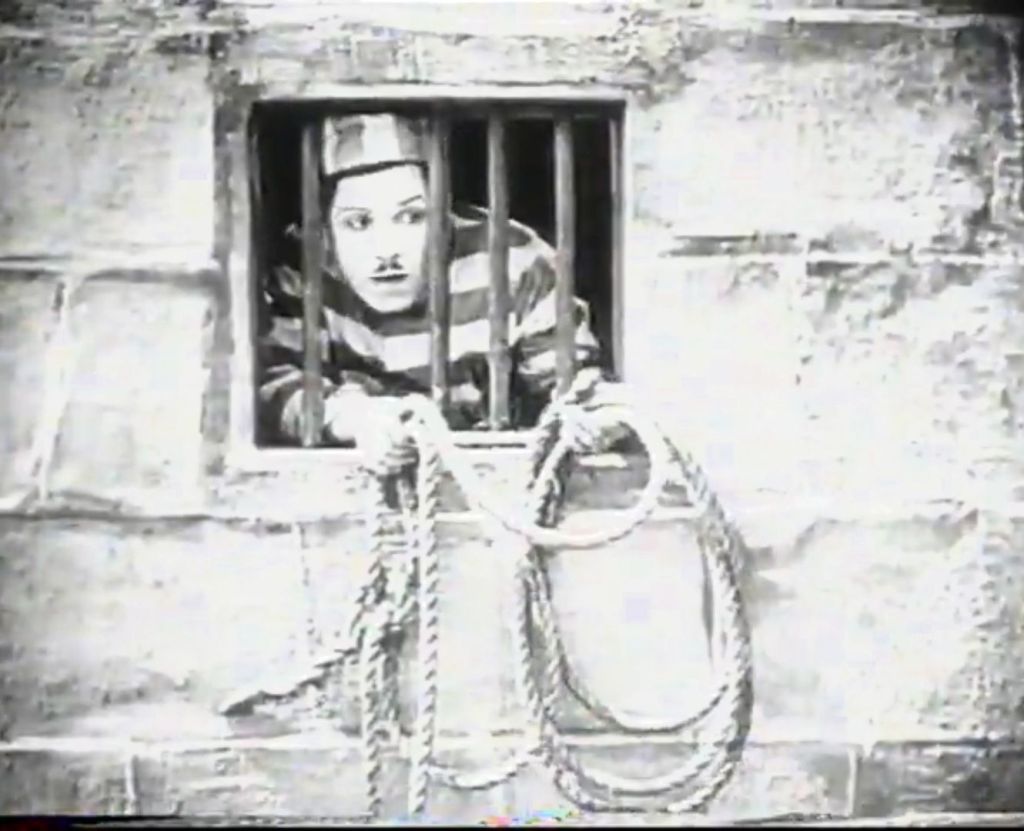
Next up, there’s another scene that echoes Chaplin, namely his ballet in SUNNYSIDE, as Monty frolics, Pan-like with some girls. This turns out to be a dream, and he’s rudely awakened in his prison cell, where an escape is in progress. He makes it out, and the rest is a series of fun chase gags, including a great one where Monty, in his prison garb, disguises himself against a striped tent. This film is SQUIRREL FOOD, from 1922. Incidentally, the lanky prison guard among his pursuants has been identified as Teddy Jefferson, younger brother of Stan Laurel.
A sequence featuring Monty trying to sneak in to a harem to rescue his girl from the clutches of a sheikh (Bill Blaisdell once more). It’s reminiscent of Lupino Lane’s MAID IN MOROCCO (though that film came after this one) I wonder if this might be EAST IS WORST? (1922)
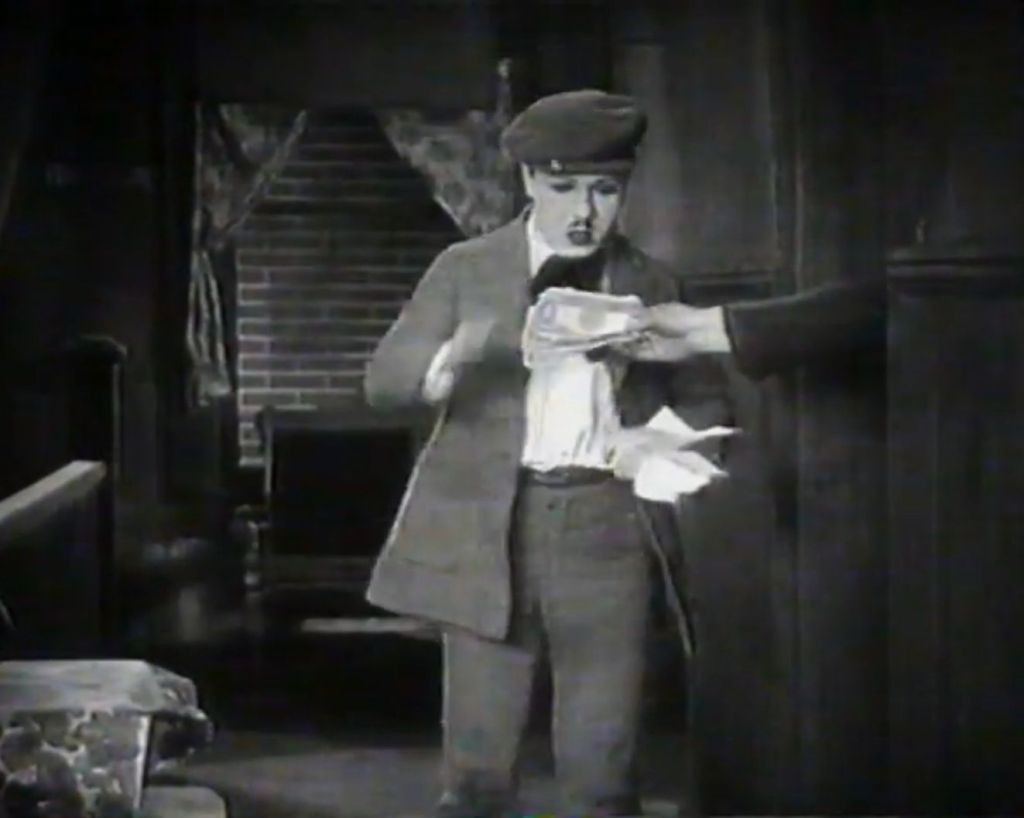
The last section is a wonderful little sequence of Monty trying to duck out of his apartment without paying his rent, then trying to evade a cop (you guessed it, Bill Blaisdell again). The more I see of Monty’s films, the more impressed I am at his ability to milk a gag to produce really well-structured comedy sequences, and this is a great example. I wonder if this might be from RENT DAY? (1922).
Here’s the video – enjoy some vintage, very rare Monty Banks!
Now, where did they get these clips and whatever happened to the original films? Perhaps they’re from the Czech archive, which definitely has some interesting silent comedies. I wonder if any more episodes from the series are out there. This opening credit sequence features shots of Larry Semon and Lupino Lane, among others. Who knows what rare gems might have been showcased in their episodes…?
From the archives, here’s an article that first appeared in issue #13 of The Lost Laugh, in 2021…
DOUBLE TROUBLE: THE SNUB POLLARD & MARVIN LOBACK FILMS
One of my earliest memories of silent comedy is of watching a ‘COMEDY CAPERS’ VHS when I was very young. One of the episodes on the tape, ‘BABY BACHELOR’ confused me: it was a virtual copy of Laurel and Hardy, but the Laurel character was wearing an enormous moustache. Who were these L & H wannabes? Years later, I learned that they were Snub Pollard and Marvin Loback, jumping on the bandwagon of fat-and-skinny comedy teams as Stan and Babe were at their zenith. I’ve always been intrigued by these copycat shorts, and endeavoured to find out more about them. Here’s the story…
It’s late 1927. Laurel & Hardy’s pairing has blossomed, and they’ve just produced their biggest hit to date, THE BATTLE OF THE CENTURY, for Hal Roach. For another ex-Roach employee, Snub Pollard, things are not going so well. Once one of the studio’s big stars in classics like IT’S A GIFT and SOLD AT AUCTION, he had been let go as the studio moved to more sophisticated comedy. A series of shorts at the low-budget Weiss Brothers studios was a step down the ladder; even further down was a return to vaudeville when that series ended.
While Snub was treading the boards, Laurel and Hardy’s meteoric rise gave someone at Weiss Brothers a brainwave: why not produce their own version of the team, with Snub as the thin half? Pollard was called back to Weiss Brothers in early 1928, and teamed with large comic Marvin Loback. Loback was a veteran of Sennett and Roach, and had even appeared with Snub a few times in small parts.
The films that resulted might charitably be called homages to Laurel & Hardy; less kindly, they could be called blatant rip-offs. To be fair, some of the films were more original than others, and there was always a certain amount of shared ground and gag-borrowing in silent comedy. However, the way that some of the Pollard-Lobacks like SOCK & RUN re-enact whole chunks of L & H films is particularly shameless. What particularly attracted attention is the one-time belief that these shorts were made before the Laurel & Hardy films they resemble. We now know this to be untrue. However, there do seem to be some examples where the Pollard films did a gag or routine simultaneously or before the Roach crews.
The films are an interesting sidelight in Snub’s career, and a fun curio for L & H fans. The Laurel & Hardy influence is obvious from the outset, but is painted broadly: the amount of nuance may be gauged from the fact that Loback’s character is called ‘Fat’. There’s none of Oliver Hardy’s quiet dignity in that! To be fair, Loback does a decent job throughout the series of replicating Hardy’s impatience, if not his charm. It’s his presence that really brings the L & H comparison. As for Snub, he hasn’t changed his appearance from his standard costume of bowler, moustache, striped shirts and spats. As far as his performance goes, he’s definitely gone a bit more passive, but his trademark moustache is a handicap in reproducing Stan’s blank innocence. He rarely does a complete rip-off of Laurel mannerisms (although he does a crude version of the cry in one film), but the intention is clear.
Though the first few films of the series mainly aped L & H in the comic’s appearance, soon more similarities began to creep in. Perhaps it was lack of inspiration for new material, but the intentional effort to piggyback on the team’s success soon becomes a bit more blatant by –ahem- borrowing their material. Sometimes the likenesses are vague – Snub and Marvin as two sailors in HERE COMES A SAILOR, or a hint of DOUBLE WHOOPEE in MITT THE PRNCE, for instance. At other times, the similarities constitute plagiarism pure and simple, as entire gags and plots are ripped from L & H films like FROM SOUP TO NUTS, PUTTING PANTS ON PHILLIP and SHOULD MARRIED MEN GO HOME!
The L & H connection has brought the Pollard-Loback films into focus now and again, particularly when one theory suggested the films actually pre-dated the Laurel & Hardy films! In the pre-Internet days, and before the onset of trade paper archives like the Media History Digital Library, States-Rights films made by companies like The Weiss Brothers were obscure and hard to trace. As a result, the films seem to have been confused with Pollard’s first (solo) Artclass series, which were made in 1926-27. We now know that the Pollard – Lobacks were released in two batches, six films in 1928-29, and a further four in 1929-30, disproving the claim that Laurel & Hardy were the ones doing the borrowing.
The trade magazines only gave light coverage to low-budget, indie two-reelers like these, but after sifting through, I’ve gathered a handful of more precise dates. British trades like The Bioscope and Kinematograph Weekly also came in handy – though the films generally hit the UK a little later, the release dates gives a rough indication of when they were made and registered for release. Below is the information I’ve been able to gather to pin down the dates and titles a bit more.
1928 -29
Variety reported that Snub was working for Artclass on May 2, 1928. By June 19, they note that both Pollard and Ben Turpin have finished filming their first shorts for the company (THICK & THIN and SHE SAID NO, respectively). By September 1st, 1928, Film Daily reports that an additional two films are ready: ONCE OVER & THE BIG SHOT. American mentions of the series are scant hereafter. However, the British Press picks up the slack. Louis Weiss visited London to trade-show the series in the Autumn and they were distributed by Gaumont from November 1928. The Films Act, article 6 required that all films must be registered for exhibition – these listings tells us that the other three films from the first series were SOCK & RUN, MEN ABOUT TOWN and HERE COMES A SAILOR.
1929-30
In May 1929 Film Daily reported that Snub listed four titles in production for 1929-30; however, the titles listed were actually ones from the previous season, presumably an error. Actually, the four films were DOUBLE TROUBLE, NO KIDDING, SPRINGTIME SAPS and MITT THE PRINCE. These were released with synchronised music tracks (but no dialogue) as a concession to the advancing sound revolution. Adverts exist for the reissue of these films, with soundtracks, in 1943.
All the films were filmed in the Spring of 1929, with Variety reporting that the series wrapped in the second week of May, 1929. DOUBLE TROUBLE was used to launch the second series, and was reviewed in Film Daily on August 18th, 1929. SPRINGTIME SAPS was reviewed on October 24th. In Britain at lease, MITT THE PRINCE was the last of the series to be released, in February 1930.
With the above in mind, here’s a run-down of these seldom-discussed films, in what I believe is the order of release.
THICK & THIN
THICK & THIN was definitely the first of the shorts to be released and sets the tone for the series, with Snub and Marvin as two penniless gents in a shabby boarding house, trying to cook a meal, and then sneaking their belongings out without paying the rent.
Of all the series, this is the one that most harks back to Snub’s Hal Roach films, the hidden devices that the pair use to cook their meal a bit like a less elaborate reminder of IT’S A GIFT, STRICTLY MODERN and other films featuring Snub gadgetry.
There’s also a bit of a Harry Langdon influence, both in Pollard’s subdued persona, and in a gag lifted from Langdon’s FIDDLESTICKS. THICK & THIN is undoubtedly derivative, but the gags flow nicely and it’s an entertaining little two-reeler.
2. ONCE OVER
Snub and Marvin roll into town on a freight train, riding in a boxcar of cows. There’s a funny scene featuring the atrociously fake cow heads they use as a disguise, confounding brakeman Tiny Lipson (even more so when one of the cows appears to smoke his cigar!). For a topper, they exit the boxcar under blankets that make them appear to be a strange, two-headed beast!
The bulk of the film centres around their attempts to filch some food, pursued by cop Harry Martell. Along the way, two Hal Roach gags are – *cough* – borrowed. The scene from THE FINISHING TOUCH with Stan Laurel on both ends of the same plank is used, and there’s also a gag with a mailbag and a fence lifted shot-for-shot from Max Davidson’s DUMB DADDIES
Then it’s on to the park, where they fail to steal a family’s picnic before Snub has a brainwave. Covering his hand with a long white sock, he hides in a bush and pretends to be a swan, stealing the sandwiches a lady is feeding to the birds. Unfortunately, he knocks her in the water, and the cop is on their trail again. To elude him they enter a restaurant and are put to work as waiters. A predictable level of competence ensues, and things wrap up with some pie-throwing. Though the finish is weak, ONCE OVER is maybe the best of the Pollard-Lobacks. The borrowing is less overt than in many of the other shorts, and the film rambles along happily from one gag situation to the next, with some nice original ones thrown into the mix.
3. THE BIG SHOT (Released October 1928, belatedly reviewed in Film daily, Feb 1929)
THE BIG SHOT is another one of the better Pollard-Lobacks, having some semblance of following the same story from start to finish. Snub and Marvin are reporters tasked with getting a photo of a camera-shy Scottish inventor. This involves Snub being coerced into wearing a kilt, and we’re into a semi re-run of PUTTING PANTS ON PHILIP. It doesn’t work on the same level of the L & H film – the sexual ambiguity surrounding the innocent Laurel character in PHILIP just cannot translate to a character wearing a huge moustache! To be fair, the gags don’t try to be a carbon copy and mainly just deal in the incongruity of Snub’s appearance. There are a few nice original variations, including Snub trying to change a tyre, with the draught from every passing car sending his kilt flying up. Snub and Marvin wind up following the inventor onto a boat and eventually corner him for a photo, but Snub is too generous with the flash powder and after a huge explosion, he is left clinging to the mast.
4. MEN ABOUT TOWN
After three films that borrowed from Laurel & Hardy but at least tried to have original plots, the Pollard unit pretty much gave up the pretence of trying to be original for the next few films.
MEN ABOUT TOWN is largely a re-run of SHOULD MARRIED MEN GO HOME set on the golf course, with added gags from YOU’RE DARN TOOTIN’. However, there are some occasional moments in the Weiss Bros films where they seem to foreshadow a later Laurel & Hardy moment. Here, Marvin’s attempts to contact Snub and sneak him out of the house include trying to contact him by phone, anticipate L & H’s BLOTTO of 1930. However, L &H knew how to milk the scene for all it was worth, whereas here it is just a quick throwaway gag. MEN ABOUT TOWN is definitely one of the weaker films in the series.
5. SOCK & RUN
Ok, now they’re really taking the Mickey. Not content with pinching the kilt material from PUTTING PANTS ON PHILIP, they basically re-film the entire first reel of that film, throwing in some soup gags from YOU’RE DARN TOOTIN’ and ending with a boxing match á la BATTLE OF THE CENTURY!
The PHILIP material is recreated gag for gag, from the laughter of the crowd as Snub arrives, to his medical examination, to Marvin’s attempts to keep him walking a few paces behind. Oh, but wait, it’s actually been changed – Snub is French, not Scottish, and people are laughing at his silly top hat instead of his kilt. That ought to avoid the copyright infringement lawsuit…
Of all the Pollard-Lobacks, SOCK & RUN is maybe the one that has most secured the reputation of the series as being mindless L & H rip-offs. In this sense, it’s the worst of the bunch. On its own terms, it’s not terrible, and if you’d never seen a Laurel & Hardy picture, you’d probably find it entertaining. But if you lived in a world without Laurel & Hardy, SOCK & RUN would be the least of your problems.
6. HERE COMES A SAILOR
HERE COMES A SAILOR starts out with the boys as sailors who hire a car, in the spirit of TWO TARS, but doesn’t get down to mass car destruction (something Weiss Bros surely didn’t have the budget for). Instead, it takes a left turn to become a clone of FROM SOUP TO NUTS as the pair get jobs at a dinner party, down to Snub serving the salad “undressed”.
There is one nice original gag, as Snub accidentally causes a cameraman’s tripod camera to collapse on top of him; bumbling around on all fours with the cloth over his back and the lens dangling out in front, the man resembles some strange elephantine creature!
7. DOUBLE TROUBLE
Snub and Marvin unsuccessfully rehearse and audition their terrible vaudeville act, then are hired as process servers to repossess their landlord’s piano. This second series of Pollard-Lobacks are where some of the confusion over their originality seems to have come from. While the first-series L & H rip-offs like SOCK & RUN are blatant steals, the second batch do actually contain some gags or situations used by Pollard & Loback before Laurel & Hardy. DOUBLE TROUBLE is a case in point; Snub and Marvin’s attempts at repossession anticipate BACON GRABBERS, not just in story, but also down to individual gags.
Held back until after L & H’s first few talkies, BACON GRABBERS wasn’t released until October 1929, but DOUBLE TROUBLE was filmed before May, and had already been released and previewed by August of 1929. Therefore, it couldn’t have been a simple case of Les Goodwins or other Weiss gagmen having been to see the latest L & H film at their local theatre and filling their notebooks with ideas.
However, while DOUBLE TROUBLE may have reached cinemas before BACON GRABBERS, the Laurel & Hardy film was almost certainly finished first. My theory is that a Roach gagman moved over to Weiss Brothers, probably during the time when the Roach studios were being fitted out for sound. Another possible ‘mole’ was Bert Ennis, Snub’s gag and title writer. Ennis doubled as a publicist, and had his own regular column in Motion Picture Classic, so was probably quite well connected with other studios.
8. NO KIDDING (September 1929)
NO KIDDING is a fun little short, featuring Snub and Marvin accidentally in charge of a toddler, and then having to hide him from the landlord of their bachelor apartment. The toddler is actually played by midget Billy Barty (incidentally, he played a similar role in the Laurel-Hardy SAILORS BEWARE). There are some amusing scenes as they disguise the toddler as an adult in a suit, complete with cigar, but the deception is undermined as he proceeds to make various noises and arouse the landlord’s suspicion.
Again, there’s a parallel situation of the Snub film seeming to pre-empt the Laurel & Hardy film. The central situation of the team hiding an unwanted guest in their apartment was also the basis of ANGORA LOVE, and one particular gag appears in both films. As the landlord lectures Snub & Marvin/Stan & Ollie that “this is a respectable boarding house”, a woman walks behind him towards her room, pursued by a sailor! NO KIDDING was filmed in early Summer 1929, and released in the Autumn, but ANGORA LOVE wasn’t released until December 1929. The Roach Mole seems to have been at work again…
(By the way, this is the short I saw on COMEDY CAPERS VHS, cut down and retitled…)
9. SPRINGTIME SAPS (October 1929)
SPRINGTIME SAPS is a ragbag effort that changes situations as the team run out of gags for each one. The best scenes are set in the park, with Snub and Marvin attempting to get 40 winks on a bench before being woken by a cop, and then trying to steal a man’s cigar.
When that’s milked for all the comedy they can manage, the pair get jobs as taxi drivers, mainly so that they can nab a gag from the Sennett film TAXI DOLLS. Then things peter out in some feeble haunted house comedy.
The most notable aspect of this film is a moment where a man angrily gives Snub the middle finger! It’s not a slip or even made to seem like one – it’s just blatantly there, in full shot! It shows how low under the radar these states-rights films must have flown, particularly at the tail end of the silent era.
10. MITT THE PRINCE (Release dates variously quoted as Dec 1929 and Feb 1930).
Snub and Fat are two incompetent handy men. Sent to deliver some parcels to the social-climbing Mrs Woodby-Noble (Ho Ho!), they write off the car on the way there with bit of L & H patent tit-for-tat. When the Prince who is supposed to attend fails to show, the hostess persuades Snub to take his place. There’s a vague hint of DOUBLE WHOOPEE in this premise, but no direct stealing of material.
The best thing about MITT THE PRINCE is a nice running gag of Snub accidentally getting his hand continually in others’ pockets; other than that, it’s a middling effort.
The series wrapped in May of 1929, and with it Snub’s career in silents. However. there was still one last gasp for his starring career, and his association with Weiss Brothers. In July 1929, Film Daily reported that the company was planning some talkie shorts, with Snub heading east to film some. Two shorts resulted, and the Pollard-Loback faux L & H vibe was dropped:
HERE WE ARE (filmed July 1929, released August 1929 )
Snub played a plumber’s assistant, who ends up pretending to be the plumber’s wife. Obviously, he didn’t wear his moustache in this one, or the deception wouldn’t have been very convincing!
PIPE DOWN (Trade shown September 1929)
Snub was teamed with Jack Kearney as a pair of sailors on shore leave who keep running afoul of tough guy Gunboat Smith, ending in a slapstick fight. After Kearney knocks smith unconscious, the pair light cigarettes, but an open gas lamp next to them causes a huge explosion. At least Snub’s starring career ended with a literal bang! Variety wasn’t impressed, calling PIPE DOWN “third-rate Vaude stuff passed off as film comedy”.
These two talkies were released in the UK in February, 1930.
And with that, the Snub Pollard Weiss Brothers series was over. The films were hardly his most glorious moment, but they helped keep his starring career afloat a little longer. Viewed today, the films range from good fun, to middling, to outrageous rip-offs (sometimes within the space of the same film!), but they show an interesting sidelight to how silent comedians could try to meet changing tastes and demand for particular styles of comedy. They are also a reminder of how special, and how hard to replicate, the chemistry between Stan Laurel and Oliver Hardy was.
You can enjoy some of Snub’s Weiss Brothers films (and a host of others from the studio, including Ben Turpin and Jimmy Aubrey) in the great DVD WEISS-O-RAMA
Great news for silent comedy fans in the U.K.: Kennington Bioscope’s Silent Laughter Weekend is returning to London’s Cinema Museum on November 4th – 5th. Once again there’s a fantastic programme of rare and classic shorts and features, with live accompaniments and guest introductions.
We’ve got films that haven’t been seen anywhere for almost a century, and premieres of recent restorations, including two classic Charley Chase comedies you won’t have seen before! There’s also an exclusive bit of ‘new’ Laurel & Hardy footage alongside some of their classic shorts, and the premiere of Dave Glass’ brand new restoration of Monty Banks’ PLAY SAFE! There are rarities that only survive via small gauge prints, plus wonderful and rarely screened features starring Edward Everett Horton, Mabel Normand and Max Linder.
Present via video introductions and presentations will be some of the most knowledgeable silent comedy experts in the world: Steve Massa and Richard M Roberts. We’ve also got plenty of surprises waiting…
Amidst all this fun and excitement, there is a bittersweet note as this will be the first Silent Laughter without its founding father, David Wyatt, who passed away last October. As well as one of the most knowledgeable film historians, DW was always generous with sharing rarities from his connection and passionately believed in making opportunities for silent comedies to be seen the way they were intended. He was a big supporter of The Lost Laugh, and a great friend. It was his enthusiasm that drove the Silent Laughter weekends, and the continuation of this happy, joy-filled event is one of his great legacies. We’ll be doing our best to honour that legacy, including a special tribute programme including his favourite clips and some of his own work.
Come and join us! Tickets on sale now – £30 for the whole weekend. With 12 shows in the programme, that’s just £2.50 per screening, an absolute steal! (there are also day and evening tickets available too)
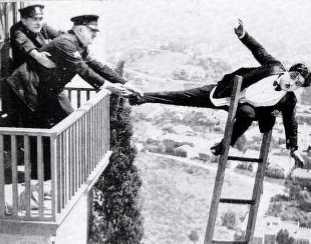
Monty Banks is one of the most underrated silent comedians, in my opinion. A likeable performer and great gagman, he made a string of shorts and, yes, features, that hold up very well but are rarely seen. One of those features, PLAY SAFE, is a bit of a classic in the silent thrill comedy genre, featuring an epic stunt-filled train chase that was excerpted by Robert Youngson in DAYS OF THRILLS AND LAUGHTER.
Now, Dave Glass has just launched his newest Kickstarter project, putting the spotlight on Monty. Included is the FULL version of PLAY SAFE, for the first time anywhere! There are also lots of other goodies, too – this is going to be an essential release. Take a look at the video below and head to the link to get your copy. But don’t delay, it’s only a 30-day window to pledge your support!



 The Lost Laugh