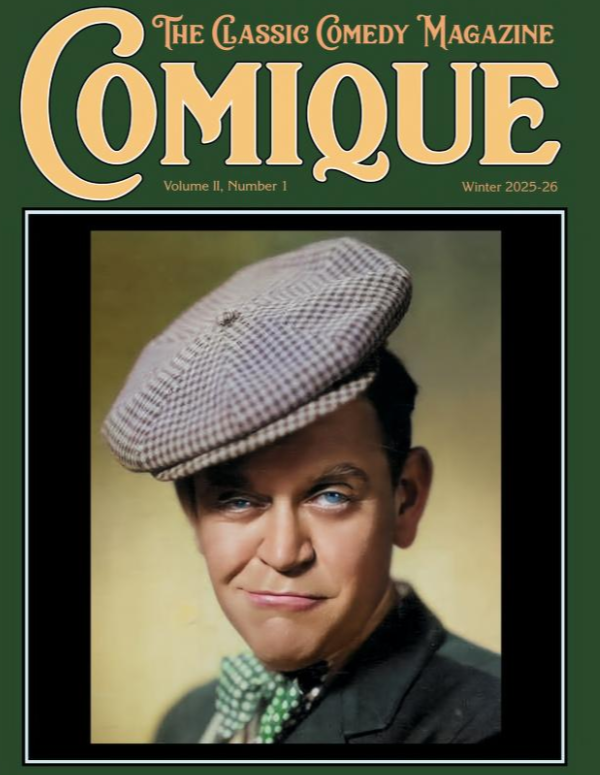
Want some more classic comedy reading? Well, in case you haven’t seen it yet, there’s a new – and wonderful – issue of Comique magazine out now, for free download. The magazine is a collaborative effort by some of the heavy hitters in the film comedy community: researchers, authors and experts like Paul Gierucki, David B Pearson, Richard M Roberts, Edward Watz, Lea Stans and more.
Well, actually, the word ‘magazine’ doesn’t really do this justice. At almost 250 pages, it’s longer than many books. Richard M. Roberts’ superb – and definitive – article on Lloyd Hamilton comes in at almost 100 pages, for instance. And then there’s an extra twenty pages of Hamilton’s filmography!
Hamilton is the perfect cover star for the issue – he’s a totem for the kind of superb, but neglected, comedians that Comique (like The Lost Laugh) is aiming to celebrate, rehabilitate and put into the limelight once more. Among the other wonderful comedy second (and third) bananas getting their dues here are Polly Moran, Vernon Dent and Louise Fazenda. It’s also great that there are plenty of female performers, so often neglected next to male comedians, being celebrated here. Miss Fazenda, especially, is a great talent who deserves the quality article that Lea Stans has contributed here.
The remit isn’t just silent comedy, but extends into the sound era with an article on Ted Healy by Robert Fender. There’s even a discourse on Abbott & Costello’s TV series by Edward Watz.
I also really enjoyed the articles putting a bit of a personal spin on the film history, and making a tangible connection between the authors and the films they are writing about. Paul Gierucki’s article on Minta Durfee Arbuckle, for instance, and Edward Watz’s memories of working with the notorious Raymond Rohauer.
As well as the text, the whole magazine is chock full of wonderful, high quality still photos, posters and other reproduced artefacts. It’s also designed beautifully. So much work has clearly gone into the publication that it’s astounding – and very generous – that it is being given away for free. So, do download it and enjoy it, and then – as always – tell your friends about it, share it on whatever media/forum you use, and make sure that the word gets out.
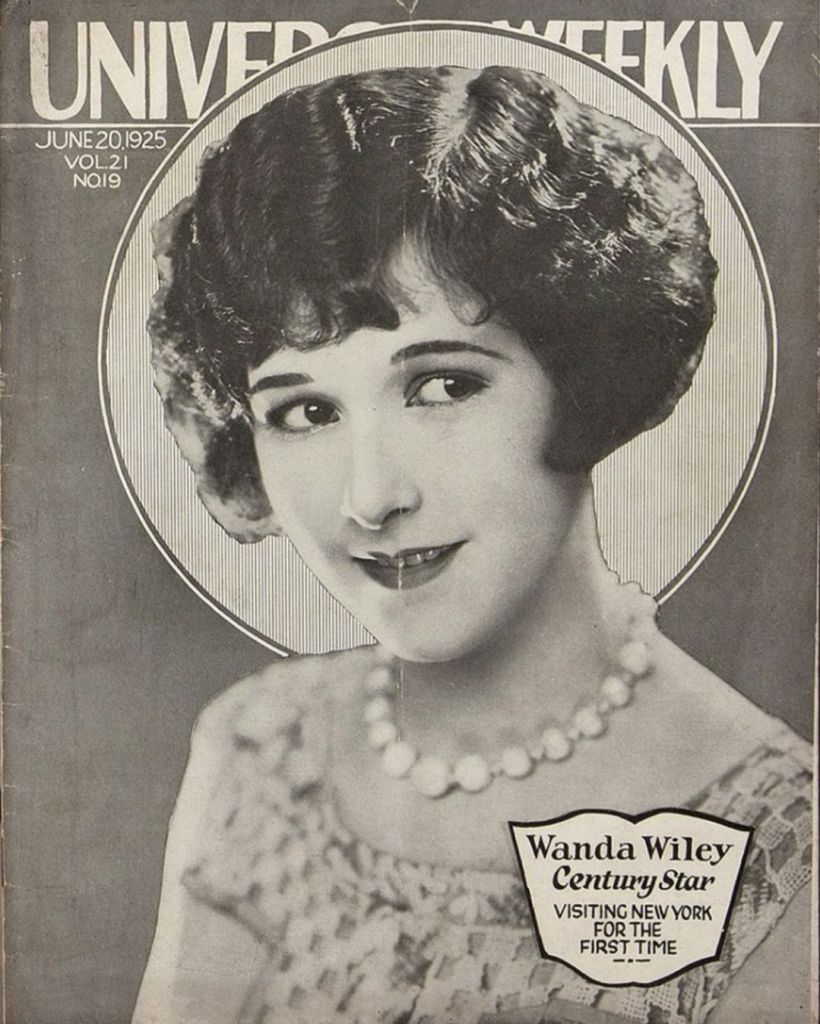
It’s the 2025 Silent Laughter event this Sunday at The Cinema Museum! A full day of silent comedies on the big screen, with live musical accompaniment and introductions from film historians. Among the line-up are W.C.Fields, Louise Brooks, Colleen Moore, Mabel Normand, Wanda Wiley, Fred Evans (‘Pimple’), Snub Pollard, a long-lost silent P.G. Wodehouse adaptation, and Laurel & Hardy as you’ve never seen them before…
The programme notes are now available for download – eleven pages of essays and commentary by Glenn Mitchell, Michelle Facey, Bob Geoghegan and yours truly. You can read them below, or download the pdf.
It’s back! This year’s Kennington Bioscope Silent Laughter day takes place on Sunday November 23rd at London’s Cinema Museum. We’ve got a full programme featuring some brilliant silent comedies that you won’t see on the big screen anywhere else, including some being shown for the first time in almost a century! As regular attendees will know, we’re all about telling the forgotten stories of silent comedy: the overlooked performers, the forgotten gems and the long-lost. So, among the highlights this year are a rediscovered adaptation of the P.G. Wodehouse novel The Small Bachelor (1927), an unlikely pairing of W.C. Fields and Louise Brooks, and a celebration of some of the brilliant funny women often neglected in the male-centred narratives of the silent comedy genre: Wanda Wiley, Mabel Normand, Colleen Moore and Marion Byron. We’ll also be featuring some familiar favourites, too: Chaplin, Laurel & Hardy and Charley Chase all feature in the programme. All screenings feature introductions from film historians, and live music from some of the best accomnpanists in the world! Tickets are just £21 for the day – a steal! – and you can get them from this link: https://www.tickettailor.com/events/kenningtonbioscope/1922369
Read on for the full programme:
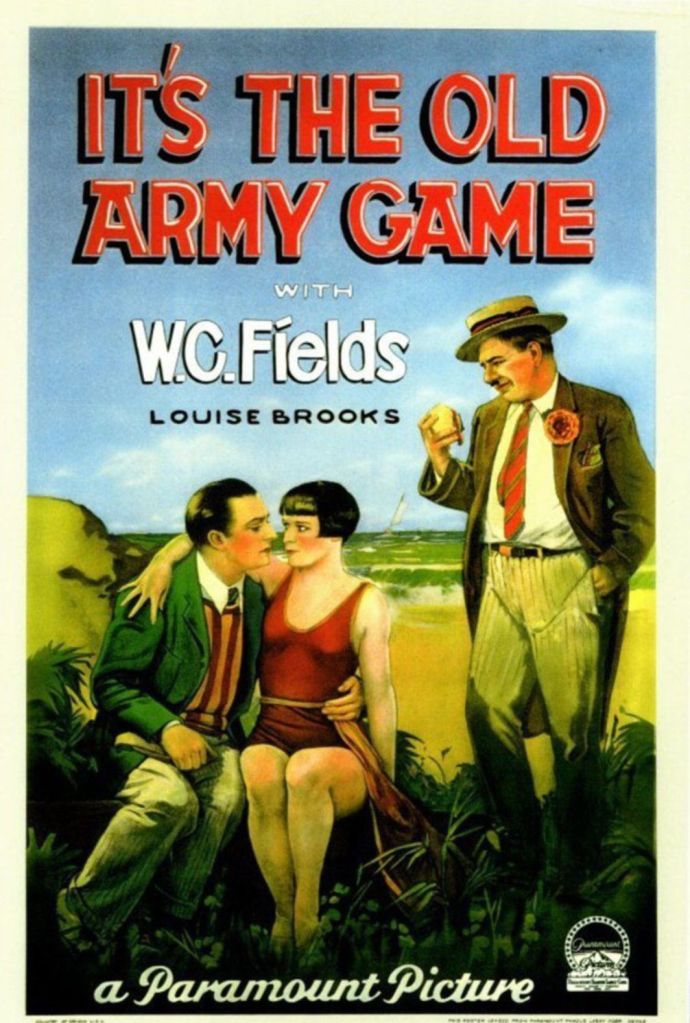
10.00 IT’S THE OLD ARMY GAME. Though posterity remembers him as a talking comedian, the great W.C. Fields – enemy of small dogs and children everywhere – made some wonderful silent comedies. This 1926 feature follows the trials and tribulations of small-town druggist Elmer Prettywillie (Fields) and boasts some terrific comic set pieces, from his encounters with difficult customers to a nightmare picnic. It later provided the blueprint for his 1934 classic It’s A Gift, and also features an unlikely co-star: silent icon Louise Brooks!
11.30 REDISCOVERIES & RESTORATIONS Almost a century after the silent era ended, some brilliant lost films keep resurfacing, while restoration efforts help others to live anew. Regular attendees will know that we always pull out some real goodies from the bag for this segment of Silent Laughter, and this year is no different. We’re still digging through the treasures on offer, and exact titles are TBC, but expect new restorations of long-lost (and hilarious) films starring Snub Pollard and Roscoe Arbuckle, as well as a long-lost British short Pimple’s Lady Godiva (1917). We’ll also be showing a sparkling new restoration of Laurel & Hardy’s classic Big Business.
14.00 FEMALE FUN Unfortunately, our view of silent comedy tends to be dominated by male performers. Although fewer studios provided opportunities for women to shine in comedy, there were still plenty of wonderful performers who managed to break through the slapstick patriarchy to achieve stardom in their own right. Here we shine a light on three of the best funny women: Wanda Wiley proves that women can do slapstick just as well as men in A Thrilling Romance, Marion Byron stars with Max Davidson in charming situation comedy The Boy Friend, and the wonderful Mabel Normand pokes fun at vanity in the rarely seen Anything Once. Introduced by Matthew Ross.
15.45 WHY BE GOOD? One of the defining ‘flappers’ of the 1920s, Colleen Moore sparkled in a series of deliciously frothy light comedies. Why Be Good? is a classic jazz-age tale set in a metropolitan world of department stores and night clubs: a real time capsule. Life-of-the-party Pert Kelly (Moore) falls for the boss of the department store where she works – but will her free-spirited ways be tolerated by high society?Lost for many years, Why Be Good? was restored in 2014, complete with its original ‘Vitaphone’ music and effects soundtrack. We’ll be showing the film with this vintage accompaniment today. Introduced by Michelle Facey.
17.30 FOCUS ON… KEYSTONE In the early teens, Keystone Studios was a crucible forfilm comedy. From Charlie Chaplin to Roscoe Arbuckle, Mabel Normand and The Keystone Cops, many of the icons of silent comedy were forged here. Dave Glass and Glenn Mitchell take a deep dive into the studio’s modius operandi and its seismic influence on comedy, with classic and rare film clips galore!
20.00 THE SMALL BACHELOR Lost for a century, we’re proud to present this re-premiere of a rediscovered adaptation of a P. G. Wodehouse novel. Set in Greenwich Village, the plot focuses on aspiring artist Finch (George Beranger) and his romantic entanglements. The New York setting gave Wodehouse plenty of chance to gently lampoon American culture, especially through the Western-obsessed character Sigsbee Waddington. A cast of great comic character actors bring Wodehouse’s characters to life, including Lucien Littlefield, Tom Dugan, Gertrude Astor and George Davis. Directed by light comedy specialist William A Seiter, The Small Bachelor fizzes with gentle wit and farcical humour: a rediscovered treasure for fans of Wodehouse and silent comedy alike. This screening will be introduced of Christopher Bird, who rediscovered the film. Continuing the spirit of the main feature, The Small Bachelor will also be supported by a short film starring Bioscope favourite – and farceur extraordinaire – Charley Chase. Limousine Love is one of Chase’s all-time funniest films, as he -innocently – acquires a naked woman in the back of his car en route to his wedding!
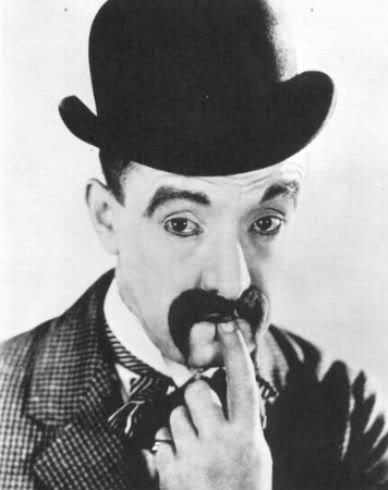
Snub Pollard’s bowler and moustache might not be as iconic as Chaplin’s or Oliver Hardy’s, but he’s still a sort of silent comedy totem. That worried little face with the upside-down Kaiser Wilhelm ‘tache is shorthand for a whole genre of delightfully deranged, gag-happy comedies from the early 20s. IT’S A GIFT is an acknowledged classic of surreal gadget comedies, but it’s far from the only great Snub film. He was a busy man, turning out dozens of terrific one and two-reelers for Hal Roach in the early 1920s. Gag-for-gag, these are among the funniest silent comedy shorts, but there’s never been a proper, high-quality collection of his films. Until Now.
Dave Glass’s latest Kickstarter will hopefully change that. It aims to shine a light on our boy Snub, in a packed BluRay collection of some of his best – and rarest – films. A mammoth TWENTY SIX of them, in fact! As well as private collections, many of these come from archivists such as Serge Bromberg, EYE, and The Library of Congress, and they’ll all be restored and scored by some of the finest silent film accompanists around. This is simply an unmissable Kickstarter, and will hopefully give Snub the due he deserves. To take a peek at the riches that will be featured, take a look at Dave’s great little promo video:
As always, when one tugs at a strand in the tangled silent comedy web, one finds it is attached to many others: Charley Chase directed several of these films, James Finlayson shows up in a few, and there’s even a couple of long-unseen Harold Lloyd films included, with Snub as his sidekick. So, this isn’t just for diehard Snub fans, by any means. If you enjoy gagged up silent comedy on any level, you’ll find something to enjoy here. Make sure you don’t miss out: the Kickstarter runs until September 15th. here’s the link. Go go go! https://www.kickstarter.com/projects/reelcomedy/snub-pollard-silent-comedian/creator
By the way, if you want more info about Snub, there’s a detailed article about him in issue 13 of THE LOST LAUGH magazine. You can download that for free here: The Lost Laugh magazine.
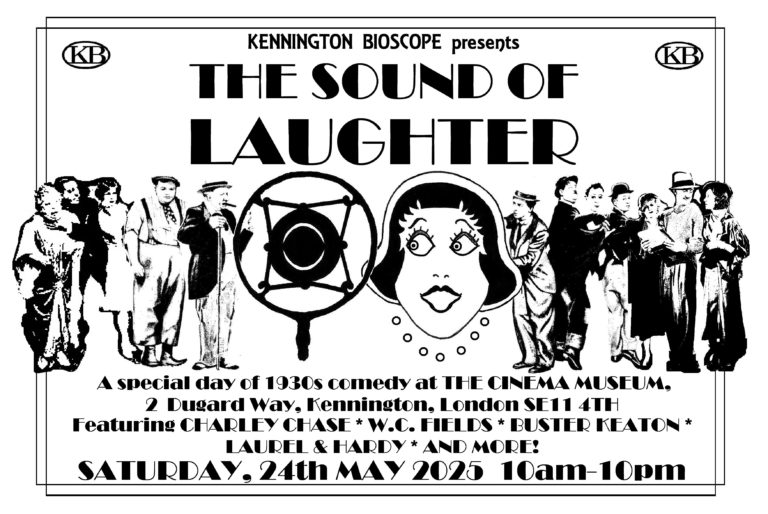
Next Saturday, the Kennington Bioscope’s event The Sound of Laughter takes place at London’s Cinema Museum.
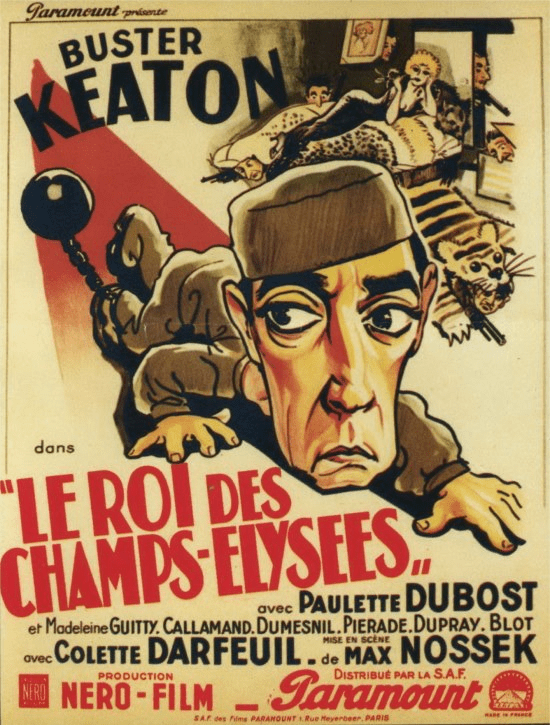
It’s an all day celebration of 1930s comedy, everything from Laurel & Hardy, the Marx Brothers and W.C. Fields to Clark & McCullough, Charley Chase, Thelma Todd, Harry Sweet, Robert Benchley, Harry Langdon and more! There’s also a spotlight on sound films of the silent comedians, with a complete screening of Buster Keaton’s wonderful French film LE ROI DES CHAMPS-ÉLYSÉES, and the classic British farce comedy ROOKERY NOOK – shown on 35mm.
The programme notes are now available for download at the bottom of this post – 12 pages of info written by Glenn Mitchell, Mark Newell and yours truly. Some bonus reading if you’ve finished reading issue 15 of The Lost Laugh by now!
For those tempted to join us, there are still some tickets available, a steal at £21 for an all day pass / Afternoon and evening pass £16 / Evening pass £8. You can also book dinner (£12) at the Cafe Jamyang, next door to the Museum. Tickets and dinner bookable here.
Well, it’s been a while, but the new issue is done.
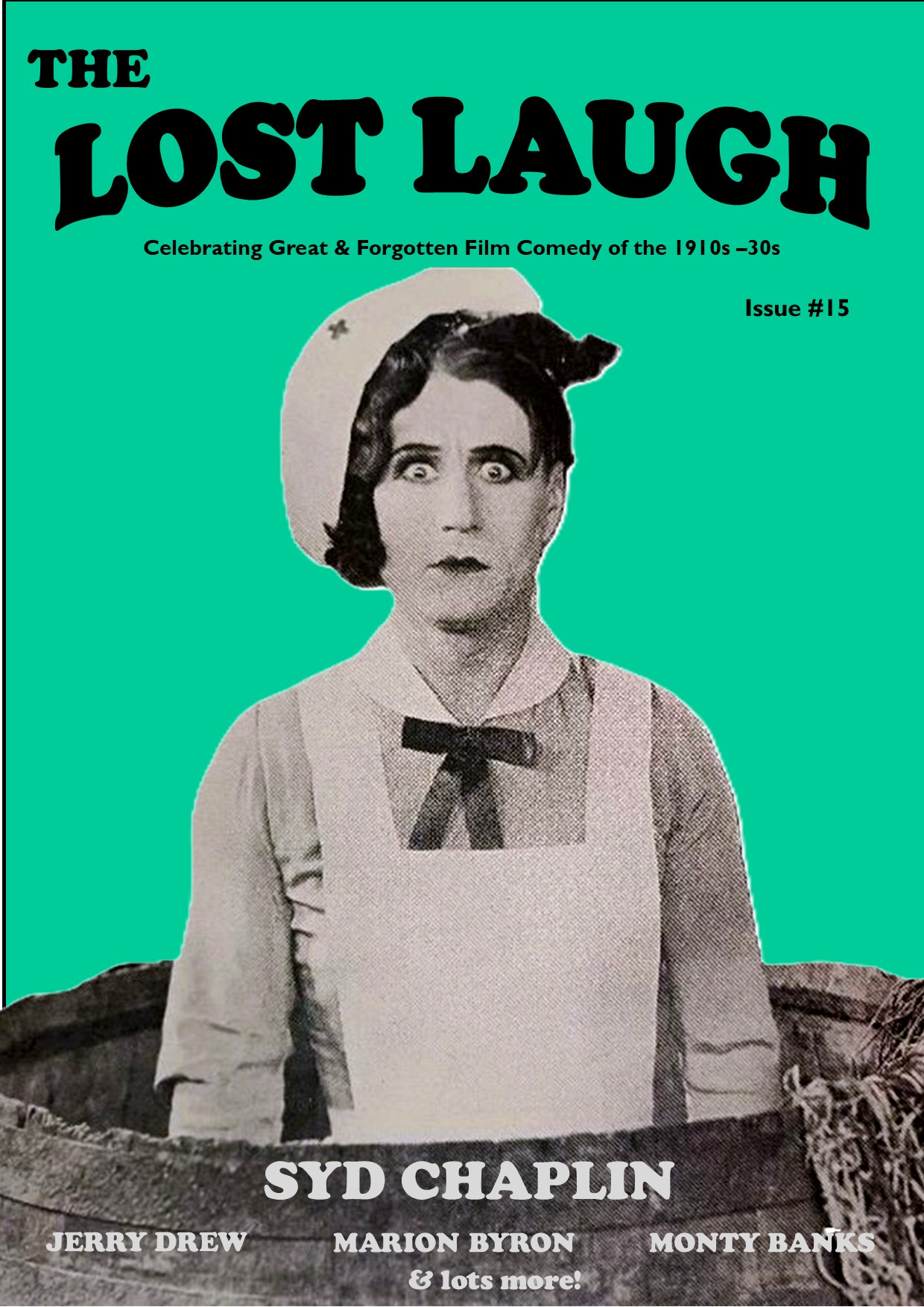
At 60 pages, this is the longest one yet, and I’m proud to feature some fantastic guest contributors this time. Syd Chaplin’s biographer Lisa Stein Haven has provided some great insights into our cover star, as well as his more famous little brother… There are also some details on the newly restored Syd feature, Oh! What a Nurse!.
I’m absolutely thrilled to be able to publish an exclusive excerpt from Steve Massa’s new book about Harold Lloyd’s Lonesome Luke films, and the early years of the Hal Roach studios – available soon from Split-Reel. There’s also a very informative Q & A with Steve about the new book.
There are also articles about Jerry Drew, Marion Byron, Monty Banks and a piece about gagman extraordinaire Charles Rogers, by Holly Foskett and Matthew Lydick from A Lot of Fun Writers. Plus, a transcript of an interview with Al St John, film and BluRay reviews and lots more.
I really hope you enjoy this issue. I hope it won’t take as long for #16 to come along! If you’d like to contribute an article, plug a project you’re working on, or take part in a Q & A for the next issue, please do get in touch – either in the comments section here, or by emailing movienightmag [AT] gmail.com
And finally… The magazine is totally free. However if, you do enjoy reading the issues and would like to make a donation to support site running costs, software etc then these would be gratefully received! If you would like to donate, you can buy me a coffee on Ko-Fi. Thanks!
Coming next month at The Cinema Museum! After years of celebrating silent comedy, we thought it was high time we did a spin-off event to celebrate the best sound comedy. From favourites like Laurel & Hardy, Charley Chase and W.C. Fields, to forgotten funnies like Harry Gribbon, Lloyd Hamilton and Tom Walls, we think we’ve got a great programme. But it’s your laughter that will bring the films to life… so we hope to see you there.
Here’s the link to the event page, and to buy tickets. You can also find the full programme below, but this great little video by Dave Glass gives a nice flavour of what it’s all about…
—
Kennington Bioscope present a fun-packed day of vintage film comedies from the 1930s, on the big screen. A spin-off from the ever-popular Silent Laughter events, this all-dayer will feature some of the very best talking comedians in a hilarious selection of shorts, features and rarities. We’ll also be spotlighting the work of silent comedians who transitioned to sound, with classic shorts from Laurel & Hardy, Charley Chase and W.C. Fields, plus the rare chance to see a fantastic Buster Keaton feature that captures the essence of his silent work. All this, plus some choice rarities from the British Film Institute, Library of Congress and private collections. Introductions and presentations by film comedy experts will spotlight the work of key performers and studios, and there will be plenty of screenings on celluloid! So come along and enjoy the sound of laughter as we celebrate one of film comedy’s greatest decades. The full programme is below. All films subject to confirmation.
10.00 SOUND BEGINNINGS
The coming of sound brought new opportunities in cinema for comedians specialising in verbal humour, nonsense patter and musical comedy. From the zany antics of the Marx Brothers and The Three Stooges to the sly humour of Mae West, or songs and patter of Eddie Cantor, there was a dazzling array of fresh talent. This programme will showcase the best of the new guard, through short films and excerpts. Among the gems we’ll be showing complete are Robert Benchley’s witty, Academy Award winning How To Sleep and The Druggist’s Dilemma, featuring the hilarious comedy team Clark & McCullough with James Finlayson. Presented by Matthew Ross.
11.30 ROOKERY NOOK (1930)
Ben Travers’ series of Aldwych Farces were some of the most popular British films of the 30s. Featuring the wonderful dynamic between disreputable Tom Walls, silly-ass Ralph Lynn and nervous Robertson Hare, the films set a benchmark for situation comedy. The first of the farces to be filmed, Rookery Nook was voted the best comedy of 1930, but has rarely been screened since. This is a rare chance to see the farceurs at the top of their game in one of their classic films. Rookery Nook will be screened on 35mm, in a copy from the BFI National Archive and introduced by film historian Geoff Brown.
14.00 THE TALKIE FUN FACTORIES
The comedy two-reeler was a mainstay of cinema programmes throughout the 1930, and here we spotlight the efforts from specialist comedy studios. From the Mack Sennett Studios comes a terrific spoof of early musicals, A Hollywood Theme Song, with Harry Gribbon; we’ll be screening this on 16mm. The same studio also made some of W.C. Fields’ funniest films, including The Dentist, which we’ll be showing in its rarely seen, complete and uncensored version! Other films include a very rare – and very funny – RKO short starring Harry Sweet, Firehouse Honeymoon. Presented by Glenn Mitchell and Dave Glass.
15.30 LE ROI DES CHAMPS-ÉLYSÉES (1934)
Legend has it that Buster Keaton’s sound films are all horrors that allowed him no creative control, but that’s not completely true. While MGM may have mis-used his talents, independent studios gave him much better opportunities – albeit on a low-budget. In 1934, Keaton travelled to France to make this indie feature for producer Max Nosseck. Within the story of an amateur actor who gets mixed up with gangsters, Keaton creates new silent comedy routines and shows off his acting chops in a dual role – all set against great location backdrops of Paris in the 1930s. A rare chance to see this charming and funny film on the big screen. In French, with English subtitles. Introduced by Keaton expert David MacLeod.
17.00 SILENT SURVIVORS
Another film comedy myth is that the lion’s share of silent comedians were out of work when sound came in. Actually, many of them remained busy and continued to produce some great comedy. Glenn Mitchell and Matthew Ross present a selection of the funniest and most fascinating sound appearances by silent comics, including excerpts featuring Harold Lloyd, Roscoe Arbuckle and Lupino Lane. The programme will also feature complete screenings of Lloyd Hamilton’s Good Morning Sheriff (courtesy of The Library of Congress), Harry Langdon’s charming A Dog-Gone Mix-Up and Laurel & Hardy’s Our Wife, in which the duo meet silent comics Babe London and Ben Turpin! The last two of these films will be screened on 16mm.
20.00 THE LOT OF FUN: LAUREL & HARDY & CO
The Hal Roach studios were the gold standard for comedy studios in the 1930s, turning out wonderful and charming short films. This programme will show some of the finest comedies made on ‘The Lot of Fun’! The female comedy team of Thelma Todd & Zasu Pitts crash society in The Pajama Party, while Charley Chase brings his talent for farce into the sound era in Looser Than Loose. The programme will conclude with Laurel & Hardy’s Academy Award winning classic The Music Box (the one with the piano!), which will be shown on 35mm. A fitting end to a day filled with the sound of laughter!
Where does the time go? Somehow, It’s just over three years since the last issue of The Lost Laugh appeared. Well, finally I’ve been cracking on with a new one, and though life has thrown a few delays in the way, I hope it will be out by the end of March.
This time round, I’m really thrilled to be featuring contributions from silent comedy experts Steve Massa, Lisa Stein Haven, Holly Foskett & Matthew Lydick, and have enjoyed researching some corners of silent film comedy that were new to me. Here’s a teaser of some of the contents:
Syd Chaplin. As Syd’s newly restored feature Oh!What a Nurse! is restored and re-premiered, it’s the perfect opportunity to revisit his neglected comedy career. Syd’s biographer and Charlie Chaplin expert/author Lisa Stein Haven has very kindly agreed to a Q & A about the brothers.
Monty Banks: his career in short films, from supporting actor to star comic.
Steve Massa provides an insight into the early years of Hal Roach‘s studio – Rolin, and fills us in on his exciting new book project
Jerry Drew: aka Clem Beauchamp, Educational’s corner on the sophisticated comedy market of the late 1920s. But there’s more to Drew than that; he was also a writer, director, stunt pilot, husband of Anita Garvin… and an Oscar winner!
Charley Rogers:Holly Foskett and Matthew Lydick shine a light on Stan Laurel’s right hand man, a talented gagman, director and performer whose career has been under-researched… until now.
A celebration of Marion Byron: one of Buster Keaton’s best leading ladies, and a very talented comedian.
A Charley Chase feature film is a sadly rare thing, but 1929’s Modern Love still exists and provides some vintage Chase comedy!
news of exciting new Kickstarter projects, film festivals, DVD/BluRay releases, plus reviews…
It’s not too late to add something, if you’d like to! Contributions are always welcomed, and if you have a project you’d like to plug, then please do get in touch. I’m always happy to help spread the word. Drop me a line in the comments section, or at movienightmag [AT] gmail .com if I can help!
Here’s the cover of the issue. I thought I’d try a simpler, cleaner look this time. What do you think?
After returning to Britain in 1930, Lupino Lane managed the starring career in feature films that eluded him in Hollywood. One of his final Hollywood films, FIRE PROOF, had shown that he could successfully make a slapstick film in his old style with sound. In Britain, he achieved this again with 1931’s NO LADY, a great little film that features some of his best pantomime routines, revisited. But by the mid-1930s, this sort of comedy was going out of fashion, and light musical comedies were in. As a comedy all-rounder, this was a medium that Lane also enjoyed, and he had alternated much of his film career with appearances in stage plays.
In the mid 30s, British film exhibitors were beholden to exhibiting a quota of home-grown films, in an attempt by the industry to limit the dominance of Hollywood. This set up a boom of production, with many small companies deciding to have a go: quantity did not mean quality of course, and many of these films gained the derogatory term “quota quickies”. Still, with a guaranteed market for their product, it was a good time for filmmakers to launch a new venture, and Lane decided to get in on the game. He set up his own production company, ‘St George’s Pictures’, in 1935, with the intention of making independent comedy features. Most of these are lost, but THE DEPUTY DRUMMER survives, and shows him moving more in the light comedy direction. In it, he plays struggling composer Adolphus Miggs, who joins a band as drummer to attend a party at a stately home, but is mistaken for Lord Miggs. Subsequently, he’s mixed up witha jewel theft, but manages to both catch the thieves, and find a patron for his rhapsody. It’s easy to imagine this concotion as a stage play, and it’s similar to the vehicles that Lane’s cousin Stanley Lupino was making: a light, farcical comedy with some dialogue routines, songs, romance, and the odd bit of visual comedy.
The low budget, “quota quickie” status of THE DEPUTY DRUMMER shows through; it has a slightly slapdash feel to it, with a few half-burning dialogue routines. There’s much less visual comedy than usual for Lane, and a sequence of him let loose on a rare collection of china vases (I bet you can’t guess what’s going to happen…) is pretty predictable. Nevertheless, a running gag of a missing necklace seeming to follow him around comes off much better, and as with every Lane film, there’s at least one spectacular pratfall. Here, he misses the top step of a flight, and somersaults right down to the bottom. It’s over in a few seconds, but is a reminder of the absolute physical mastery of this unique comedian.
Elsewhere, the musical comedy format permits some charming musical numbers, especially a wonderfully understated dance number with Brutus the dog, ‘Dear Old Pal’. Oh, and look out for the always reliable Wallace Lupino and Syd Crossley as two villains, plus George Formby’s regular foil Hal Gordon.
So, overall, a mixed bag, but an interesting one. If you see the film for what it is, a 30s British musical comedy with low ambitions but some great assets, then it’s a pleasant way to spend an hour or so. Lane would make one more film with St George’s Pictures, TRUST THE NAVY – now lost – before the venture fizzled, but still had one more great film in him: 1939’s THE LAMBETH WALK. But that’s another story. Here’s THE DEPUTY DRUMMER…
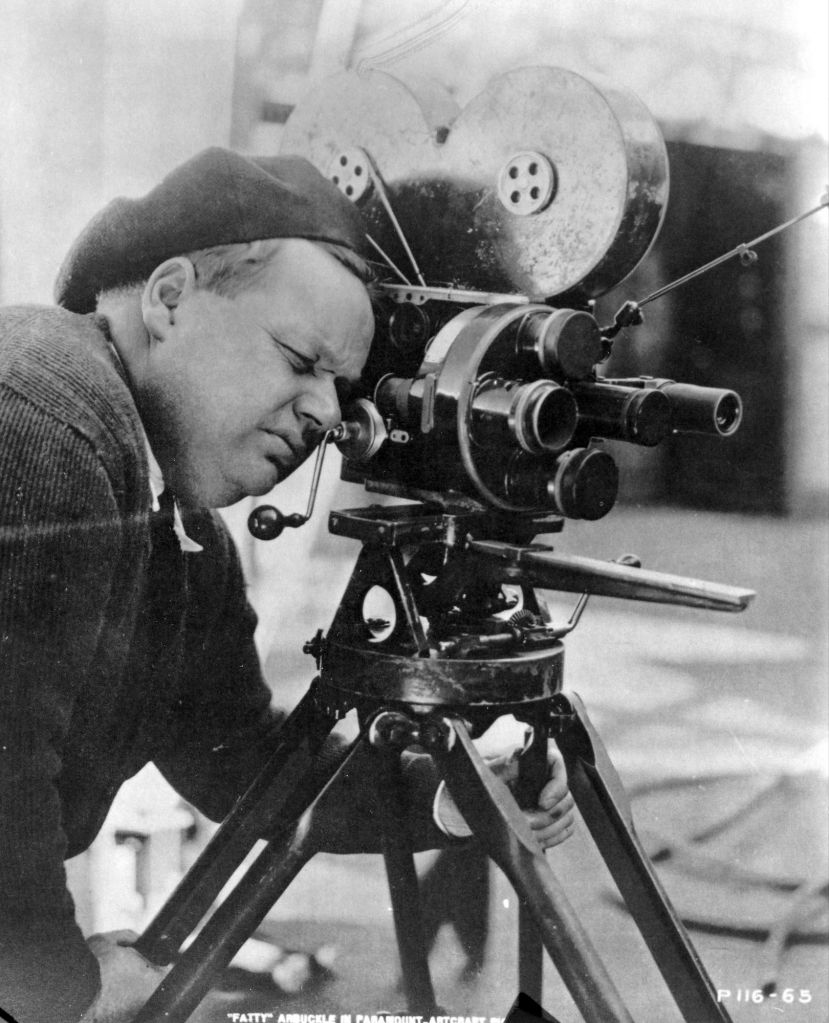
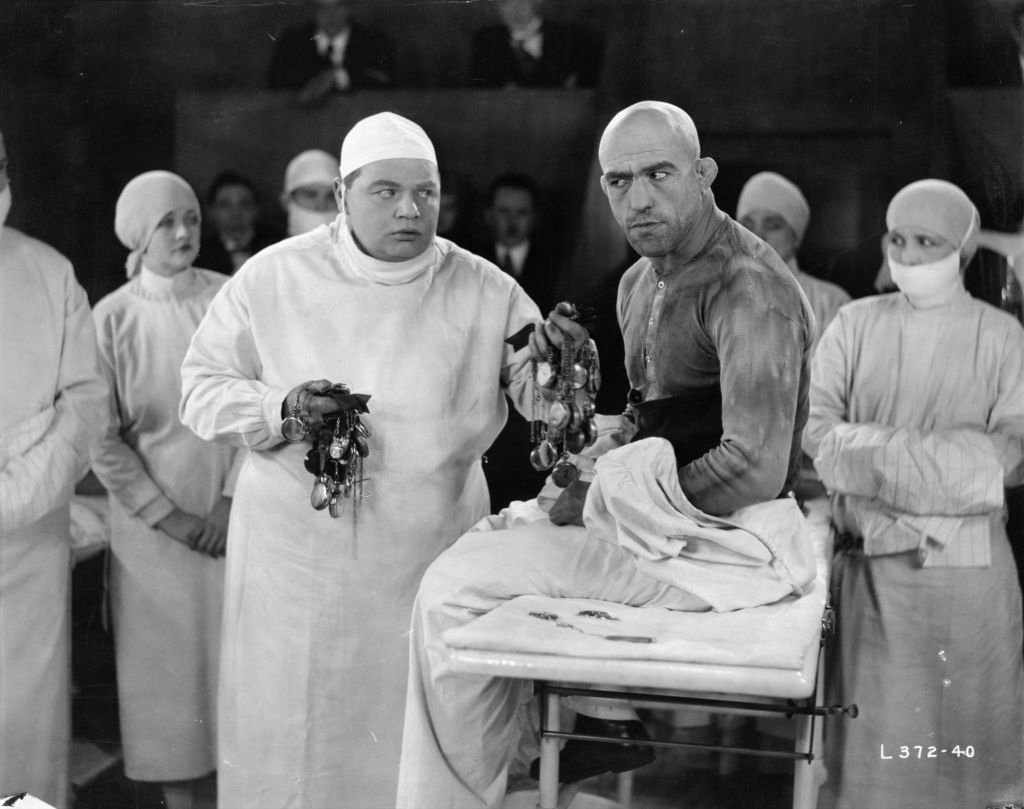
For over twenty years, Roscoe Arbuckle made enormous contributions to screen comedy, in front of and behind the camera. This is a man who not only mentored Buster Keaton, but also gave valuable help to both Charlie and Syd Chaplin in their early careers, as well as many other comedians like Charley Chase and Al St John. Later, he was instrumental in directing films for St John, Lloyd Hamilton, Lupino Lane and many others. As a performer, he inspired a wave of ‘jolly fat man’ performers: Babe Hardy, Hughie Mack, Walter Hiers, ‘The Ton of Fun’.
Yet for all that, Arbuckle often seems slightly taken for granted. His image is so sewn up with Keystone slapstick that his broader achievements in gentle situation comedy, farce and feature length comedies and as a director, are overlooked.
It’s hard to believe that it’s now twenty years since the definitive DVD set, ‘ The Forgotten Films of Roscoe ‘Fatty’ Arbuckle’. This was the first set to really illuminate Roscoe’s wider achievements, and set a high bar. In the years since then, crowdfunding projects, access to Archives and digital technology have advanced, and the time is ripe to showcase some of the previously unseen and newly restored Arbuckle gems out there.
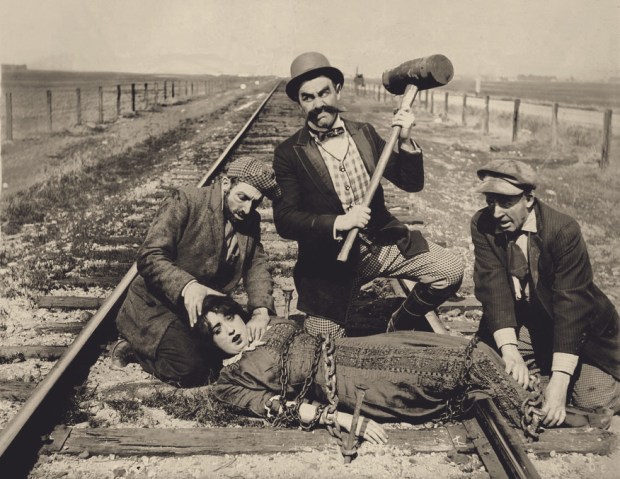
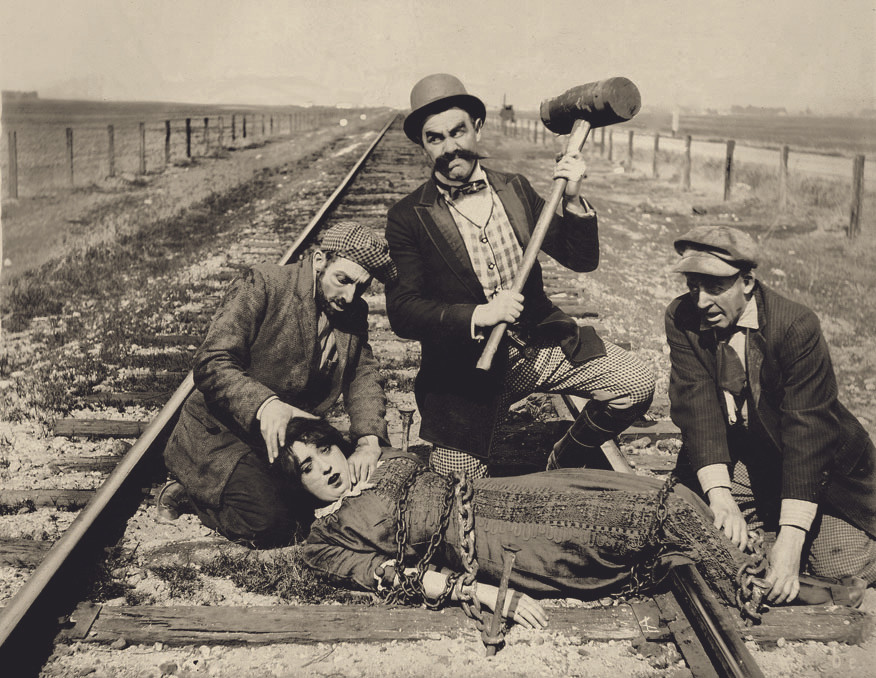
Among the highlights culled from Archives and private collections around the world are Arbuckle’s first Keystone THE GANGSTERS, THE SEA NYMPHS with Mabel Normand, rarely seen feature CRAZY TO MARRY, the Al St John shorts DYNAMITE DOGGIE and NEVER AGAIN and loads more! Overall, it’s a terrific sampler of silent comedy gold from one of tits finest talents. The Kickstarter campaign runs til Feb 14th and provides your opportunity to help bring these films to new audiences.
Crazy to Marry
Behind the Kickstarter campaign are silent comedy expert and author of ‘Rediscovering Roscoe’, Steve Massa, and producer Crystal Kui, with the new project being distributed through Ben Model’s Undercrank Productions.
Steve and Crystal very kindly offered to talk us through the new project, and some of the highlights it features. Read on for more…
This new Kickstarter release features a wealth of restored and reconstructed films, sourced from a range of archives and private collections. What are some of the logistical challenges in pulling all these disparate sources together?
Crystal Kui: In this Arbuckle release will be 11 shorts plus a feature sourced from seven different archives and two private collectors. Logistically, it will be quite a challenge to keep track of the shipping, scanning and restoration on all these films. We’re very fortunate that all of the participating archives were keen to provide access to their prints and are supportive of our efforts to share these treasures with the public. Thanks to Steve’s enthusiasm and deep knowledge of the films, we have been able to work with the archives on our side. After we draw up contracts with the participating archives, the next step is to coordinate the shipping or scanning of the film prints. A few archives have facilities on site to scan and restore the films, while for others we are able to ship the prints either to the Library of Congress for scanning on the east coast or to USC on the west coast. We have a team of digital restorers and color graders who are archive conscious and work diligently to bring the end result as close as possible to the original viewing experience. Not all films are complete, but we work with the best surviving or only surviving copies. My favorite aspect of working on this project is doing the research to reconstruct the missing parts or titles, finding out whether there was tinting and how it was used, and comparing foreign versions or reissues to the original domestic releases.
Were there any particular technical challenges involved in working with such rare and precious film elements?
CK: Several films in our release are sourced from foreign release prints including Crazy to Marry (1921) with Russian titles, The Sea Nymphs (1914) with Danish titles, and Fatty and the Broadway Stars with Norwegian titles. Instead of simply translating the titles into English, we tried to source scripts and censorship records in an attempt to reconstruct the titles as they were written originally in English. This requires a lot of close scrutiny and comparison. In studying the scripts, we also learned that Crazy to Marry had three tinting colors: yellow, blue and amber, which are detailed by reel, and will be recreated digitally by our graders Chris Crouse and Graham Brown, using original tinting samples from the early 1920s. Our regular collaborator, Jesse Pierce, an expert at recreating the intertitles, will design titles that faithfully match the original style of a Paramount feature, Keystone Comedy or Triangle release, for example.
Is therea particular restoration effort on this set that you’re most proud of?
CK: Perhaps ask me this in a year; the real in-depth restoration work is only beginning now that the Kickstarter has met its initial goals. We have a lot of work ahead of us!
Steve, this set comes on the heels of your book, ‘Rediscovering Roscoe’. Championing Arbuckle is clearly a passion project for you. What is it about him and his comedy style that speaks to you?
Steve Massa: I grew up hooked on silent comedy, and although I got a steady diet of Chaplin, Keaton, and Laurel & Hardy there was almost no Arbuckle to be seen. This was probably due to left over stigma from the scandal. My first real look at Roscoe was thanks to film historian William K. Everson. In a 1983 all-Arbuckle evening at New York’s Collective for Living Cinema, Professor Everson showed The Waiter’s Ball (1916), his feature Leap Year (made in 1921), and the comeback sound short Buzzin’ Around (1933). Seeing the comedian from his first full flowering to his last hurrah was an eye opening experience and inspired me to try and get as much of his work seen as possible. Since then I’ve taken every opportunity I could to present his films – at places like The Museum of Modern Art and Library of Congress, on DVD, and in print.
The fact that Arbuckle made feature films is often overlooked. ‘Crazy to Marry’ shows him mixing polite comedy plots with slapstick. Where do you think his comedy style might have headed in the 20s, if fate had not intervened?
SM: Mabel Normand and Roscoe were the first stars of slapstick shorts to move into feature films. Their type of comedy shorts, while loved by audiences, didn’t get much respect in the film industry itself, where they were often treated like poor step-children. To be taken seriously they had to appear in more serious fare and be “legitimized” as feature stars. Roscoe’s first feature was the dramatic western The Round Up (1920). The films that immediately followed, such as The Life of the Party (1920) and Brewster’s Millions (1921), were polite drawing room comedies based on popular stories, novels or plays, and were very plot heavy.
Unfortunately we don’t have access to all of his features, but by the time of Crazy to Marry and Leap Year he moved to farce comedy – which was better suited to his talents and gave him more situations to react to and opportunity to work in more helpings of slapstick. At the time of his banishment from the screen Paramount had very similar properties lined up for his next projects, so it seems likely that he would have stayed in that style.
It’s great to see Arbuckle’s directorial career represented as well. What led you to choose the particular films featured here? ( ‘Dynamite Doggie’, ‘Home cured’, ‘Never Again’, ‘Stupid But Brave’, ‘Honeymoon Trio’)
SM: The particular directorial films chosen for the set were picked for their excellence as well as their rarity and unavailability. In all of them Roscoe uses a very restrained and low-key approach that has the slapstick growing logically out of the situations. He gets very natural performances from the actors, with wonderful close-ups and reaction shots. His early sound short Honeymoon Trio (1931) will be a surprise to many people. It’s Roscoe’s “road film” – a black comic version of Detour (1946) and The Hitch-Hiker (1953), as Al St John and Dorothy Grainger head off on their honeymoon motor trip with Al’s former rival Walter Catlett in tow. Powerless to thwart or even shut up the obnoxious Catlett, Al is symbolically cuckolded as he’s caught in a never-ending honeymoon from hell.
Do you each have a favourite film or gag from the set?
SM: One of my favorite films on the set is The Gangsters (1913). This was Roscoe’s very first film for Mack Sennett, it’s amazing to see how he hit the ground running. Besides being very funny he pulls the focus whenever he’s on screen, and his “Fatty” character is already developed at this early date. When this was made Roscoe was already a well-seasoned performer, having spent a decade touring with various stock companies around the U.S. and Asia. His film experience before this had been very limited – brief sojourns for Selig and Nestor, but he instinctively seemed to understand the intimacy of the movie camera. Understanding it, he used that intimacy extremely well and quickly became an audience favorite around the world.
CK: These films are so rare, I won’t have a chance to see the films until the scans have come in from the archives. We received our first film last week, The Sea Nymphs (1914) from the Danish Film Institute, and it was so much fun to watch, with extended scenes shot on Catalina Island.
What do you hope viewers will take away from this set? Is there a particular facet of Arbuckle’s talents you’d like them to have a new appreciation for?
SM: I’d like viewers to get a full picture of what an excellent overall comedy creator Roscoe was. He’s best remembered for his on screen persona, but his work behind the camera gets taken for granted. He was a very sophisticated writer and director – even as early as 1915 his sure hand can be seen in films like That Little Band of Gold, Fatty and Mabel Adrift (1916), and He Did and He Didn’t (1916). That’s why after the scandal he was able to transition so easily to just writing and directing. He was already a pro, and turned out excellent shorts with comics such as Al St John, Lloyd Hamilton, Lupino Lane and Johnny Arthur.
So there you have it: a fantastic set rammed full of rarities featuring one of the true comic pioneers. I’m sure you won’t want to miss out on this chance to rediscover Roscoe! Here’s the link to the Kickstarter, and the full planned contents:
The Gangsters(1913) – 10 min, Museum of Modern Art Roscoe had been making sporadic appearances for Selig and Nestor since 1909. The Gangsters is his very first film for Keystone, where he shares the picture with Fred Mace and becomes an overnight Mack Sennett star.
A Noise From the Deep (1913) – 10 min, Museum of Modern Art The earliest surviving film of Roscoe with his frequent co-star Mabel Normand. It is also considered to have the first use of a thrown Keystone pie.
An Incompetent Hero (1914) – 12 min, Library of Congress Roscoe is a victim of circumstances in this rarely seen comedy, which also highlights Edgar Kennedy, Minta Durfee, Al St John, and Roscoe’s tight rope walking skills.
The Sea Nymphs (1914) – 25 min, Restored by the Danish Film Institute Mabel, Roscoe and a seal have fun in the surf at Catalina, in a new scan made from the only known surviving print.
Crazy to Marry (1921) – 40 min, Restored by Cinematek (Brussels) This was the sixth of Roscoe’s starring features, and was only in theatres for about a week before being yanked out of distribution and vanishing. This rare survivor illustrates how Roscoe was taking polite comedy plots and working in more and more of his signature physical gags and slapstick.
Bonus: New reconstruction of Fatty and the Broadway Stars (1916) – 7 mins, Nationalbiblioteket (Oslo) & Private collection / Restored by theUSC HMH Foundation Moving Image Archive Only a few 35mm and 9.5mm chunks are all that’s known to exist today of this short. The Triangle Film Corp. had hired famous stage stars like Weber & Fields and William Collier to give prestige to their films, and used Roscoe to introduce some of these stage personalities to movie audiences.
Disc Two
Never Again (1924) – 12 min, Lobster/Blackhawk Roscoe here reworks the plots of Fatty at San Diego (1913) and A Reckless Romeo (1917) for his nephew Al St John. Scanned from the only surviving print.
Stupid but Brave (1924) – 21 min, Private collection / Restored by the USC HMH Foundation Moving Image Archive Having been banned from the screen, Roscoe focused on writing and directing, creating excellent comedies with Ned Sparks, Poodles Hanneford and Al St John.
Dynamite Doggie (1925) – 24 min, Lobster/Blackhawk Al St John co-stars with Pete the Pup in this rarity that reworks material from Love (1919) and Sherlock Jr. (1924), as well as early films that featured Roscoe’s dog Luke.
Home Cured (1926) – 10 min, Library of Congress Roscoe launched the series of Tuxedo Comedies for Educational Pictures which starred the fairly new screen comic Johnny Arthur. Scanned from the only known 35mm material, Johnny is a hypochondriac whose wife has had enough.
Honeymoon Trio (1931) – 12 min, Library of Congress This early sound short is Roscoe’s “road film,” a black comic version of Detour (1946) or The Hitchhiker (1953) that details Al St John on a never-ending honeymoon from hell.
Bonus: Video essay on Roscoe Arbuckle’s life and career.
Huge thanks to Steve and Crystal for giving their time to answer my questions, and for their efforts in making this project happen. I’m really excited for this set!
 The Lost Laugh