SILENT LAUGHTER WEEKEND: programme revealed!

Well, the programme for Kennington Bioscope’s Silent Laughter Weekend is here at last! There are still a few additions and potential small changes to come, as well as exact show times, but the majority of the films being shown are now online.

The idea is to showcase silent comedy beyond Chaplin, Keaton and Lloyd. That’s not to put down the magnificence of the eternal trio, but to give a broader picture of the many other fine talents whose films don’t see the light of day enough. Of course, the old favourites make appearances in the programme too, so hopefully there’s something for all silent comedy fans, from those with a casual interest to the more seasoned enthusiasts! All but a handful of these films are unavailable on DVD, and we’re also proud to be presenting several UK premieres of newly rediscovered or restored films.

Below is the programme, mirrored from www.silentlaughter.org. All events take place at London’s Cinema Museum, Kennington.

Each day’s films will begin at 10am. Exact show times to be announced soon!

 SATURDAY 22ND OCTOBER
kid-bootsKID BOOTS  (1926)

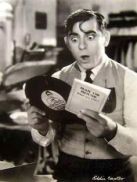
Great American entertainer Eddie Cantor made his screen debut in this adaptation of his 1923 Broadway musical. ‘IT’ girl Clara Bow is wonderfully perky as his love interest. the result is a sparky romantic comedy featuring two American jazz age icons for the price of one! We’re proud to present the premiere of a newly restored version of this wonderful film.

EARLY DAYSfilm_linder

Before Chaplin and Keystone, when Hollywood was still just a sunkissed patch of orange groves, the world centre of film-making was in Europe. Legendary film historian David Robinson introduces the first film comedy stars – Max Linder (deemed ‘the professor’ by Chaplin), Charles Prince and more. The prints being shown today are on the archaic 28mm gauge, and are very nearly as  old as the films themselves. Chris Bird and Brian Giles, who will be running them on equally vintage projectors, are a little younger!


LAUREL & HARDY – AND STILL THEY COME!

second-100

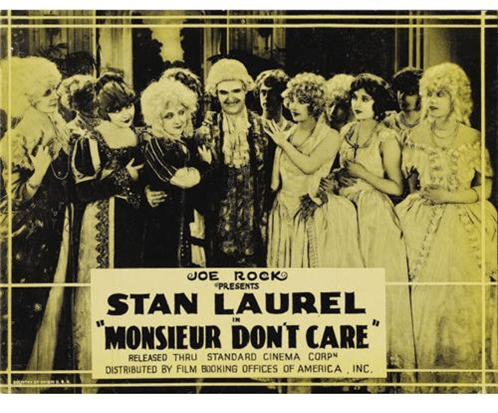
It’s hard to believe, but unseen Laurel and Hardy footage is still turning up almost 70 years after their last on-camera appearance. We present a treat for L & H fans, with a host of UK premieres of long lost footage. Among them are ‘new versions’ of classic silent shorts from Robert Youngson’s personal collection, featuring scenes not seen since their original release. Also showing will be two of L & H’s solo films, recently restored by the Cinemateca Nazionale: Stan Laurel’s Pythonesque Rudolph Valentino parody ‘MONSIEUR DON’T CARE’, and the Hardy solo film ‘MAIDS AND MUSLIN’.


HOME JAMES! (1928)

Laura La Plante, best known for Universal’s ‘THE CAT & THE CANARY’, had several hits in comedy roles. This rarely seen film shows her to winning effect, as a small town girl trying to make it big in a New York department store. Introduced by legendary film historian Kevin Brownlow, from whose collection this print comes.


counting relativesLUPINO LANE – A LOCAL HERO

British comedian Lupino Lane  was something of a local hero to this part of town, being the originator of the ‘Lambeth Walk’ dance craze in his hit musical ‘ME AND MY GIRL’. Long before that, he made a string of wonderful silent comedy shorts, featuring finely honed slapstick and acrobatic skills to surpass even Buster Keaton! We revisit his career with the aid of film clips and extracts from Lane’s book ‘HOW TO BECOME A COMEDIAN’. Includes a full showing of the rare two reel comedy ‘A HALF PINT HERO’ (1927).

THE LAMBETH WALK (1939)

Did someone mention Lambeth? We sneak into the sound era to show this exuberant, long-lost film version of ‘ME AND MY GIRL’. Starring Lupino Lane, it enables him to show off several of his favourite silent comedy routines.


SUNDAY 23RD OCTOBER:

SILENT SURPRISES

Our first programme of the day will contain a few surprises! Among them, we are hoping to show a very rare Harold Lloyd short, and a few more familiar faces…

SLAPSTICK IN SKIRTS

While silent comedy was dominated by males, it was by no means an exclusive field; there were some terrifically talented female comedy stars out there, too. Michelle Facey showcases two overlooked ladies; Dorothy Devore rivals Harold Lloyd’s high-rise antics in ‘HOLD YOUR BREATH’, while Martha Sleeper shines in the Max Davidson classic ‘PASS THE GRAVY’.

MACK SENNETT’S FUN FACTORY

Mack Sennett was the silent era’s first ‘King of Comedy’, responsible for starting the film careers of Chaplin, Harry Langdon, Roscoe Arbuckle and many others. David Glass explains what made his studio so great, assisted by Brent Walker (author of the definitive Sennett book). Includes clips and films restored by David himself.
342_HL-LongPants-portraitTRAMP, TRAMP, TRAMP(1926)

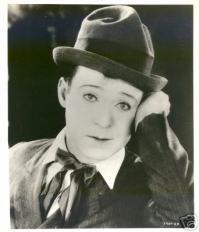
Eternal baby Harry Langdon was at one point considered to be Chaplin’s successor. Today, his idiosyncratic talent is sadly neglected, but he made some wonderfully individual films. Featuring Harry as hapless participant in a cross-country race, this is one of his greatest and funniest films.  Matthew Ross introduces the film, and the context in which Langdon’s unique talent developed.


Walter Forde 2WAIT AND SEE (1927)

Walter Forde, Britain’s best silent comedian, and later an eminent director, in his first (and perhaps funniest) feature film. A great chance to see classic silent comedy played out against vintage English backdrops. Introduced by Geoff Brown, author of the only book on Walter Forde.


THE BETTER ‘OLE (1926)

Warner Brothers’ first comedy feature to have a Vitaphone soundtrack, this features Charlie Chaplin’s brother Syd in an adaptation of the wartime comic strip by Captain Bruce Bairnsfather. The sterling cast also includes Edgar Kennedy and Harold Goodwin. Introduced by Barbara Witemeyer, daughter of chief Vitaphone sound engineer Jack Watkins.

Tickets are available through www.kenningtonbioscope.com
Rare Ham

ham

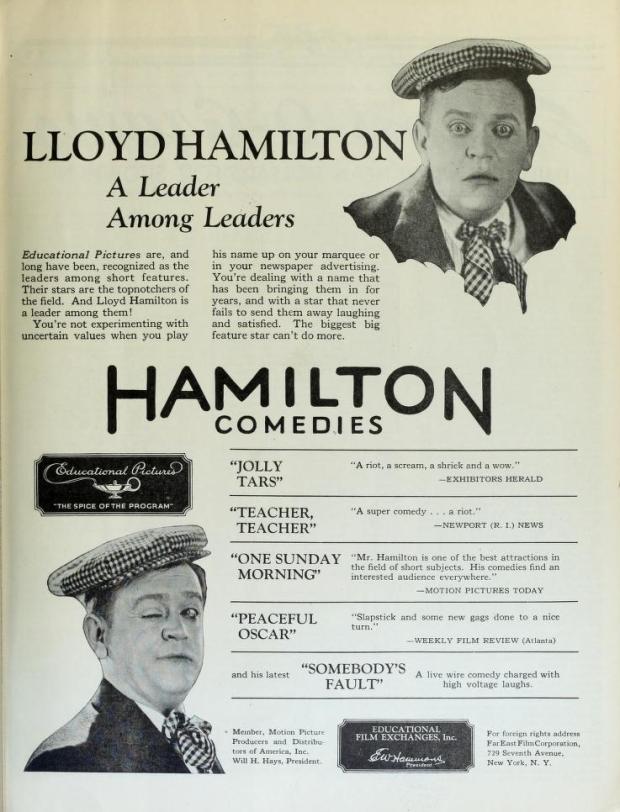
Lloyd Hamilton exists now like one of those dusty, anonymous portraits hanging in a long corridor. To most people, if his image is seen at all, it is a faded likeness of the flesh and blood he once was, the achievements of his life almost totally forgotten. While this analogy could go for a good majority of the performers I write about here, none have faded or fallen so far from their previous colourful heights as Hamilton.

With his offbeat humour and fantastic reaction-based comedy, ‘Ham’ was once considered among the funniest men in the world (he was reportedly a favourite of both Chaplin and Keaton). But his career was dogged by spectacularly persistent bad luck. This continued beyond his early death, as his best films went up in smoke, leaving only a fraction of his works scattered in archives. Most of these are from the bookends of his career, either embryonic versions of the style he later perfected, or tired re-workings that his heart clearly wasn’t in. Only in snatches of classics like ‘THE VAGRANT’, ‘CRUSHED’ or ‘MOVE ALONG’ can we see what really made him special.

So, when a scarce or previously unseen Hamilton film turns up, it’s a pretty big deal for Ham’s fans (all 17 of us). Could each new discovery be the one, the film that restores his tattered reputation beyond doubt? A couple of years ago, a very rare example of his films, ‘A HOME MADE MAN’, turned up on eBay in a 16mm print. I placed several bids but lost out. The film never resurfaced; I figured it had gone to someone who didn’t want to share it with the world. That is, until I mentioned it to a friend, and it turned out that they had known the person who bought it. (Not only this, but there were some potential plans to have it telecine-ed (sic) with some other rare Ham films in the hope of possibly putting together a DVD of a few of his films. Excitingly, I finally got the chance to see the film a little while ago.

The stakes were high,  but the chances of it being a classic were pretty low. It was among Hamilton’s last silents, as problems with alcohol were taking their toll. Of another 1928 release, ‘ALMOST A GENTLEMAN’ critic Raymond Ganly’s review was short but brutal: “Remember how good Lloyd Hamilton used to be? Weep when you see him in this.” These late silent shorts tended to eschew his character based comedies for random gags and gratuitous slapstick. Would ‘A HOME MADE MAN’ be any different?

Well, as expected, it’s not the holy grail of Hamilton films. But, I doubt it would have made Mr Ganly weep, either. It was a pretty good comedy, below the Hal Roach comedies of the same time and Hamilton’s better previous work, but enjoyable. Like another late period Ham short, ‘BLAZING AWAY’, it has two distinct halves, and is based around Ham finding a job.

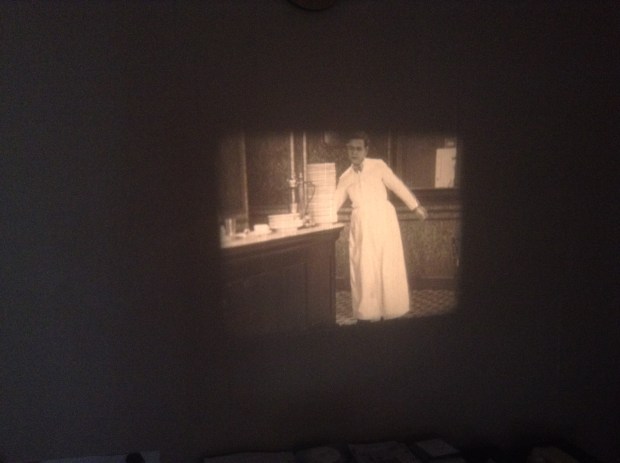
In the first reel, Ham has been sent by the employment agency to a soda fountain-cum-gym run by Kewpie Morgan. Morgan takes one look at him and winces, but he’s desperate, so Ham gets the job. Next we get the incompetent soda jerk routines you’d expect, with ice cream splattered, eggs broken and plates smashed. In fact, it’s all quite similar to the early scenes of Buster Keaton’s ‘COLLEGE’, from the year before. However, Hamilton is able to show what made him special. The way he delivers hackneyed gags in this line is uniquely his own, and it is not the slapstick itself that causes the laughs, but rather his hurt dignity. As a result, you feel less like you’re watching a Keaton rip-off, and more a reaction comedy that anticipates Oliver Hardy’s attempts to master simple tasks. As a result, the soda bar gags are the best moments of the film.

img_5413

Another typical Hamilton twist on standard material: he is carrying a huge pile of plates, that wobble to and fro. He loses his footing, and theplates are sliding all over the place…. but the crash never happens as he safely reaches the counter. Morgan and Hamilton sigh with relief; “I never broke a plate in my life,” says Lloyd. However, he has placed them on top of his apron on the counter top, and as he walks off, the plates finally crash to the ground.

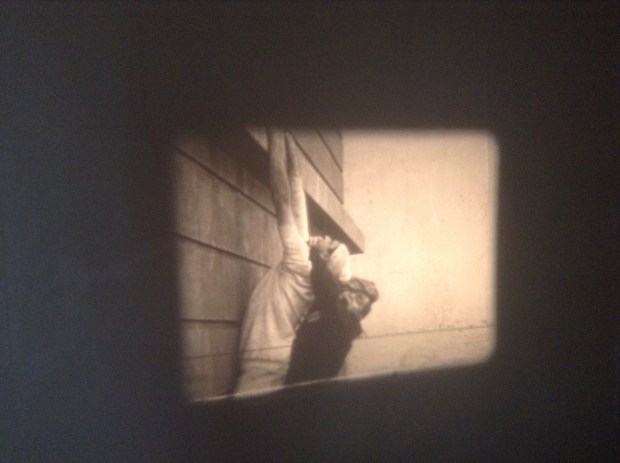
Fearing for his remaining crockery, Morgan sends Hamilton in to the gym as a personal trainer. After all, if you can’t trust someone with breakables, then why not trust them with peoples’ health? Here, he predictably makes an equal mess of things, first trying to instruct a line of athletes in a nicely choreographed sequence, then taking to the gym equipment himself. Things go downhill from here, as his efforts on the rings lead to him swinging out of the window and clinging on to the ledge in a pretty feeble Harold Lloyd ripoff.

img_5425

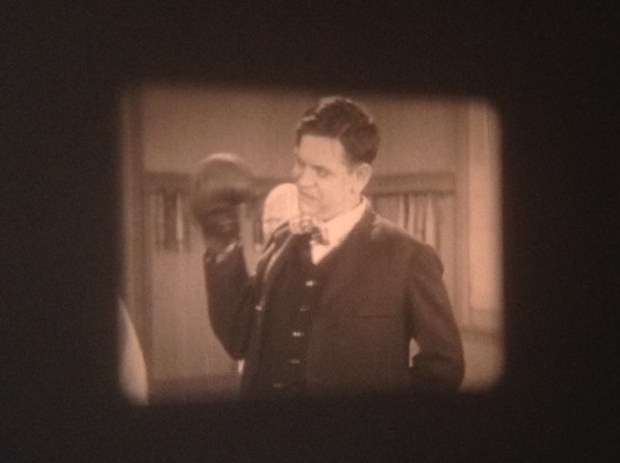
Once he is safely back inside, the film ends with him pitted against Morgan in a boxing match, which he surprisingly wins. Ham victoriously leaves the gym behind.

img_5429

OK, so it’s not the classic  we could hope for. But, it does show what Hamilton could do, even with mediocre material, and as such I’m very glad to have seen it. Certainly it’s a decent comedy short for the time, and he makes the most of his opportunities, even when the material is subpar. Hamilton was without doubt a great, individual comic performer with his own distinct style. Yet again, after viewing one of his films, I’m left with the question: What could he have done with better material?


New issue of the Lost Laugh magazine

THE LOST LAUGH #10

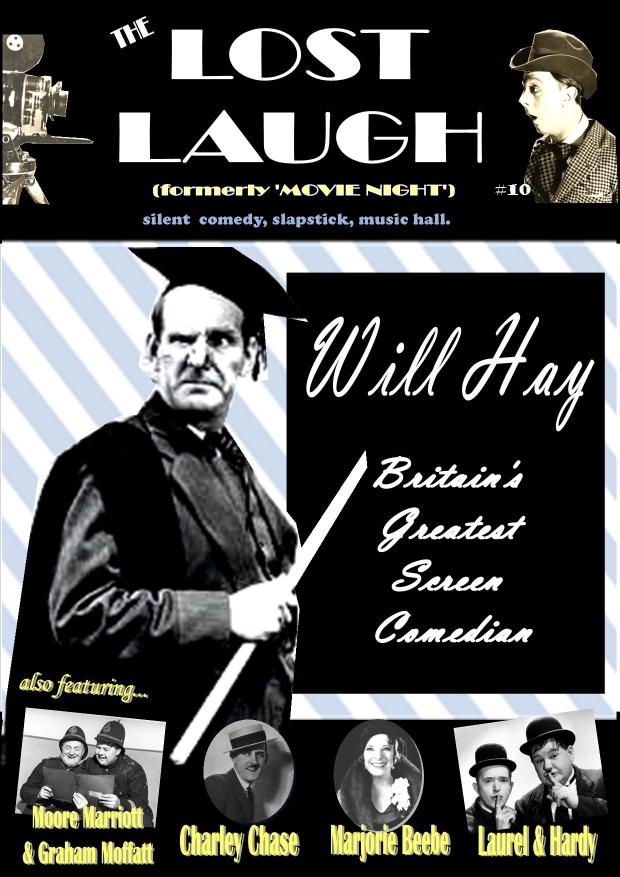
It’s here, finally! 1001 things seem to have got in the way of completing it, but here we are. Inside you’ll find the final part of our look at the great Charley Chase’s films, an in-depth appreciation of master British comedian Will Hay, details of other British comics coming to DVD, a guest article about forgotten comedienne Marjorie Beebe, reports from last year’s Silent Laughter Saturday, plus all the usual news and views.

Right -click the link, and choose ‘Save target as…’ to download:

THE LOST LAUGH #10

Why not make sure you never miss an issue? Send an email to movienightmag <AT> gmail.com for details of how to subscribe to the mailing list. It’s free!

Oh, and don’t forget that back issues of ‘Movie Night’ (before we rebranded) are available to download from the magazine page.

Happy Reading!


Silent Laughter returns to London!

silent laughter logo

Last October, Kennington Bioscope presented an all-day feast of silent comedy, which I wrote about here, here, here and here. Now, Silent Laughter returns to London’s Cinema Museum for a full weekend!

The programme is just days away from being revealed, but in the meantime, save the date of October 22 – 23, 2016.

More info will be available at http://www.kenningtonbioscope.com  and also at http://www.silentlaughter.org. I’ve also made a dedicated page on this site.

Tickets are a steal at just £28 for  weekend pass, or £16 for a day.

Watch this space for more details as they come!

Rhubarb Vaselino rides again!

A little while back, I posted about the discovery, in November last year, of the lost Stan Laurel solo film ‘MONSIEUR DON’T CARE’, or 7 minutes of it, at least.

monsieur

The film revisits Stan’s parody of Rudolph Valentino in his earlier classic ‘MUD AND SAND. Stan’s version of the great lover -‘Rhubarb Vaselino’ – gives him lots of opportunity for the silly parody that the British sense of humour does so well. Here, he parodies another Valentino film, ‘MONSIEUR BEAUCAIRE’, in which the Latin lover portrayed a favourite courtier of Louis XIV, forced to flee to England and pose as a barber.

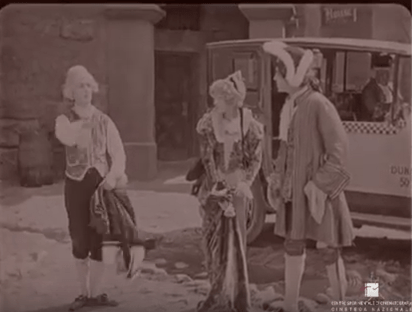
So, why am I returning to this? Well, 2 minutes of the rediscovered footage has been posted on YouTube, and it provides some interesting talking points. It’s a brief scene of Stan parodying Valentino’s reputation as a vainglorious ladies’ man, flirting with another man’s wife, and attempting to escort her into a taxi.

monsieur 2

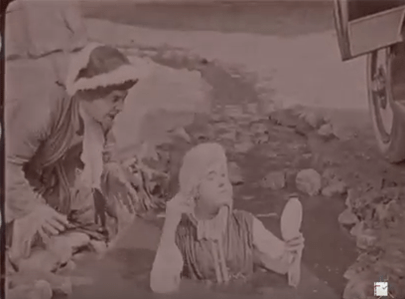
The footage, jumpy though it is, has some great moments. There’s a healthy dose of the comic anachronism that makes Laurel’s other parodies, like ‘WHEN KNIGHTS WERE COLD’, such a delight, as New York yellow cabs roam the streets of 17th Century France. Most interestingly, at the end of the scene, there’s a forerunner of the legendary Hal Roach bottomless mudhole™ that enlivened so many Laurel & Hardy films. Stan is attempting to escort the lady across a puddle in the street, and lays down his coat, Walter Raleigh style, on top of the puddle. Stepping on it, Stan and escort disappear beneath the water. Sound familiar? With the coat replaced by a kilt, the scene is reworked as a running gag in the seminal L & H film, ‘PUTTING PANTS ON PHILIP’. Considering this, and the atypical role of Stan as woman chaser in that film, and it turns out a big chunk of ‘PHILIP’ was quite possibly inspired by ‘MONSIEUR DON’T CARE’. Who knew?

The scene in ‘MONSIEUR’ also has  a great punchline: as Stan resurfaces from the water he is most concerned with redoing his hair, in a parody of Valentino’s famous vanity. But, while Stan’s lost dignity (and his refusal to acknowledge it) here is good for a laugh, it took Oliver Hardy’s sense of real hurt pride to make it into a great comic scene.

monsieur

It’s always fascinating to see more footage of L & H turning up, especially when it helps to fill in pieces of the puzzle we didn’t even know were missing. Here’s hoping we can see the whole 7 minute extract soon.

Here’s the 2 minute extract…

…. and the similar scene from ‘PUTTING PANTS ON PHILIP’


Lessons in punctuation with Stainless Stephen (open brackets, exclamation mark,close brackets)

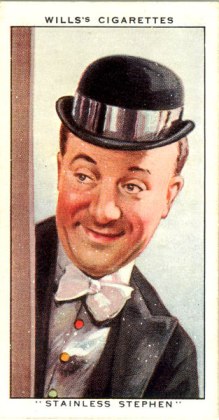
StainlessstephenIn the hectic world of variety, performers needed a niche to stand out from the crowd. ‘Stainless Stephen’ found an especially idiosyncratic one. Taking his moniker from his Sheffield origins (then centre of the U.K.’s stainless steel industry), he continued the gimmick by  wearing a stainless steel waistcoat and steel-rimmed bowler hat.

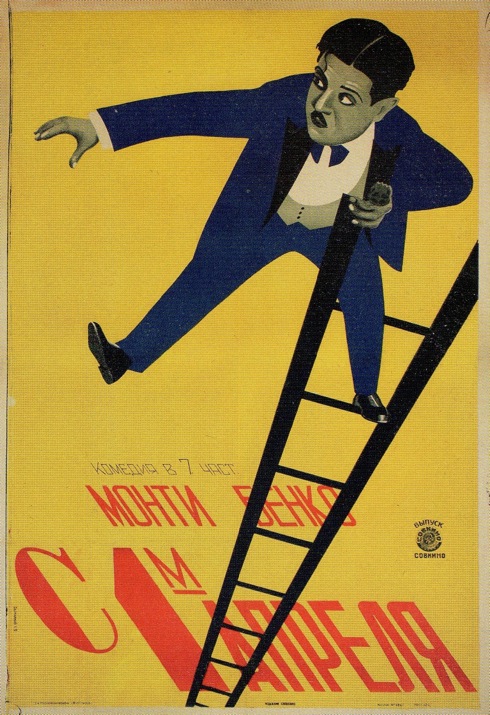
Such gimmickry was ‘Stephen’s forte; in addition to his costume, the core of his act was to soliloquize in a whistling Robb Wilton deadpan, speaking all the punctuation, and adding in other asides:

“What a wonderful year 1930 was, semi-colon, said Stainless Stephen, semi-conscious. Thousands of new motorists took to the road, comma, and as a result thousands of pedestrians took to the pavements”

A little of this obviously goes quite a long way, and its no surprise that he never carried full films or shows on his own, but as a short turn on the radio, or on a 78, he was good fun. He made but one film appearance, in the all-star extravaganza RADIO PARADE (1933). While it sadly presents him out of his bizarre regalia, his 3 minute routine playing a railway guard is really quite funny and one of the highlights of the film.

Stephen’s real name was Arthur Baynes and his day job was as a school teacher, a job he continued for some time after finding success, meaning he could only make appearances at weekends and during school holidays!

crookes

Stainless Stephen’s day job was at the former Crookes Endowed School in Sheffield. Coincidentally, it’s about a mile from my home.


Legend has it that Stainless’ lessons on Friday were always a bit light on the ground, as he spent most of the time leaving his classes to it whilst he wrote his radio material for the weekend! Baynes retired in 1952 to become a gentleman farmer in Kent, describing himself as “stainless, painless, brainless, shameless, aimless, semi-conscious and approaching semi dotage.” He died in 1957.

(On a teacher’s note, there is currently much panic over the introduction of a new punctuation and grammar test for primary school children. This would surely have been a breeze for Stainless Stephen’s classes!)


The Full Monty!

IMG_5447

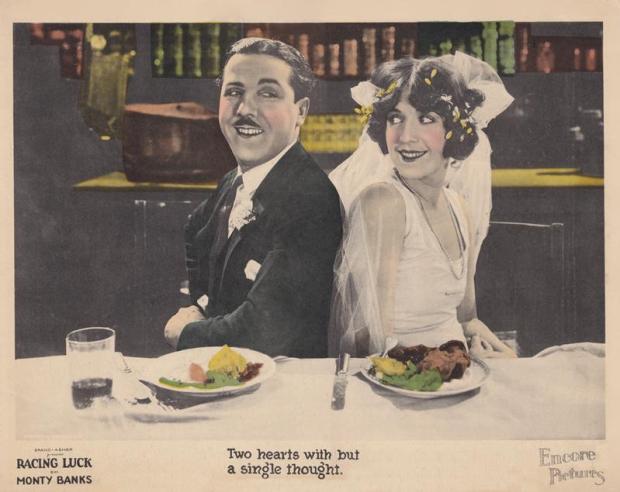
This terrific poster features Monty Banks, in a scene from ATTA BOY. Monty was, even in his day, a bit undervalued, so it’s no wonder he’s not mentioned much these days. A tubby yet dapper little Italian, he presented an appealing cross between Charley Chase’s farces and the Keaton-Lloyd model of thrill-climaxed gangbusters silent comedy. His most famous film nowadays is ‘PLAY SAFE’, or at least an extract titled ‘CHASING CHOO-CHOOS’. It features a stunt-filled train climax that ranks with anything by Keaton or Lloyd. His other starring features, among them HORSESHOES and A PERFECT GENTLEMAN, were of a similarly high calibre (these two films actually shared Keaton & Lloyd’s collaborator Clyde Bruckman as director). Here’s a clip from HORSESHOES. If you’ve seen the 1940 Buster Keaton Columbia short ‘PARDON MY BERTH MARKS’, you’ll notice that writer Bruckman lifted much of that film wholesale from here…

Despite the fact that he got to make features, and despite the evident quality of his work, Monty Banks never seems to have quite ‘broken through’ to full success. Perhaps audiences were just spoiled in the 20s by having such an outpouring of comedy films (generally two a year from Keaton & Lloyd, plus Chaplin’s sporadic efforts, not to mention Banks and all the other contenders). As a result, it was harder to stand out during a time of such riches. Despite Monty’s films being released by Pathe to replace the Harold Lloyd films they had lost to Paramount, he seems to have not been as financially successful as hoped, leaving him to head to England to escape bankruptcy proceedings in 1928.

IMG_5435

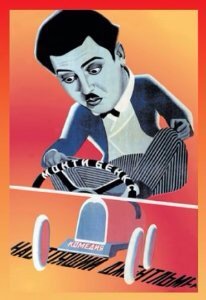
The Russians though, seem to have been fond of Monty, at least if their wonderful posters of him are anything to go by. Here’s another great Soviet poster, for A PERFECT GENTLEMAN. I recently watched the BFI’s copy of this film, and it’s an absolute gem of a farce comedy.

The English, too, were Monty Banks fans. Making his home there, he was welcomed by the film industry (as with Lupino Lane) as both star comic (‘ADAM’S APPLE’, ‘WEEKEND WIVES’, ‘SO YOU WON’T TALK’) and director (many films, most notably George Formby’s ‘NO LIMIT’ and ‘KEEP YOUR SEATS PLEASE!’ and several with Gracie Fields). In fact, these days he is best remembered as Mr Gracie Fields; they were married in 1940.

Certainly, his films need re-evaluating and to reach a wider audience. Based on what I’ve seen so far, they’re great fun.


Easter Treats

Just for fun, as it’s the Easter weekend, here are some egg-themed comic moments!

STAN LAUREL – THE EGG

One of Stan’s solo films for G.M. Anderson, this is one of his better comedies from this period. There’s plenty of lively lumberyard slapstick that Laurel later reworked in his own solo ‘THE NOON WHISTLE’ as well as the great L & H comedies ‘THE FINISHING TOUCH’ and ‘BUSY BODIES’. This is more thoughtfully put together than many of his early comedies, with the opening scenes reliant on cross-cutting to compare Stan’s lowly life with that of the villain, Colin Kenny. (Incidentally, Kenny’s butler is believed to be Stan’s younger brother, Ted).

Stan’s performance is more subtle here, too, than in many of his solo films. He does, however, still have the occasional tendency to break the fourth wall and mug unnecessarily to the audience, a visual equivalent of the music hall comic’s asides to the audiences that just doesn’t translate. On the whole, though, this is a pretty good effort.


CHARLEY BOWERS – EGGED ON

The lysergic dream visions of Charley Bowers are some of the most creative films in all of silent comedy. Mixing live action and animation, he seemed to be especially fixated on eggs and the magical transformations that occur in them. You might even call him an egg-centric… (Thank you, thank you. I’ll be here all week…)

Hmm, anyway, ‘EGGED ON’, his first ‘Whirlwind Comedy’, takes this further by featuring him as an inventor working on unbreakable eggshells. The whole film doesn’t appear to be on YouTube, but here’s a clip of its most brilliant segment, in which Charley discovers transporting eggs by flivver can result in unusual side effects…

Two sound-era clips to finish with. Groucho orders dinner, with a little help from Chico and Harpo, in ‘A NIGHT AT THE OPERA’…

And lastly, who could forget COUNTY HOSPITAL..? “Hard boiled eggs and nuts…. MMMMHH!!!” Happy Easter!


The Little Chap with a Big Nerve: Rediscovering Stanley Lupino

$_57

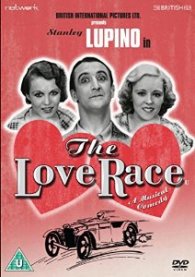
Network DVD’s groundbreaking ‘The British Film’ series continues to illuminate the murky waters of 30s British film comedy. The dominant Film History 101 myth of 30s cinema tells us that the only worthwhile British comedies were Will Hay, Gracie Fields and George Formby. Occasionally, Jack Hulbert or The Crazy Gang get a mention, but mostly everything else is brushed over. Actually, there are hundreds of other 30s British comedies out there, and some hidden gems among them, too.

A gamut of Stanley Lupino films have made their appearance out of the archives for the first time. To me, these are really the highlights of this DVD series. Lupino is a terrific performer, who also took a big hand in the writing of his scripts and musical numbers; indeed, the majority of his films are based on his own musical plays. Lupino’s persona is that of a little cockney playboy, often an aspiring songwriter; usually, he’s down on his uppers. He’s a small fellow, and a little peculiar looking, but he has a whole lot of nerve, and relies on this, as well as his energy, quick wit and acidic sense of humour to pull him through. A typical Lupino put-down, delivered with a sickly mock-earnest grin:

DOORMAN: Your face makes me tired.

LUPINO: And yours gives me insomnia!

And another:

MAN IN BRIGHT SUIT: Be careful! You nearly spoiled my suit!

LUPINO: Impossible!

Lupino was another member of the illustrious Lupino family. Here, he hams it up with a rather awkward interviewer, discussing his heritage and career:

Stanley was cousin to Lupino Lane, and sure enough, the two performers share a certain comic technique derived from their family training. If you’ve seen Lupino Lane’s films, then Stanley’s wide-eyed, darting glances and jerky, bird-like movements in the face of danger will be familiar. While Stanley was certainly limber enough, he didn’t take the acrobatic slant of Lane, directing ,most of his energies into musical numbers and farce comedy instead.

Typically his plays and films followed one, some or all out of the following formulae: quirky variations on farces (‘THE LOVE RACE’ ‘HONEYMOON FOR THREE’, YOU MADE ME LOVE YOU), moonstruck quests for a girl in a crowd (‘YOU MADE ME LOVE YOU’, ‘CHEER UP’, ‘FACING THE MUSIC’) or a similarly dogged mission to sell an invention, song or play (‘HAPPY’, ‘CHEER UP’ ). All feature some great musical numbers, including comic songs like ‘STEAK & KIDNEY PUDDING, I ADORE YOU’, and creative dance routines. These reach their zenith in ‘OVER SHE GOES’: a perfectly synchronised 3-man song-and-dance routine, ‘SIDE BY SIDE’, filmed with a continuous 360 degree camera pan.


the love race It was Lupino Lane who scaffolded Stanley’s entry into films, directing his first two efforts. ‘LOVE LIES’, his debut, remains elusive, but ‘THE LOVE RACE’ has been released in a sparkling print. It’s is a good early effort, obviously stage-based in it’s country house settings, but with a zip to it that transcends a typical 1931 stage adaptation. Based on his play, it features Stanley as Reggie Powley, best buddy to Jack Hobbs, even though their families are fierce rivals. He’s also engaged to Hobbs’ sister Ida. Unfortunately he’s had a baggage mix up and up turns Rita Payne with his case.(Keeping things further in the family, the girls Ida and Rita are named after Stanley’s daughters, by the way)
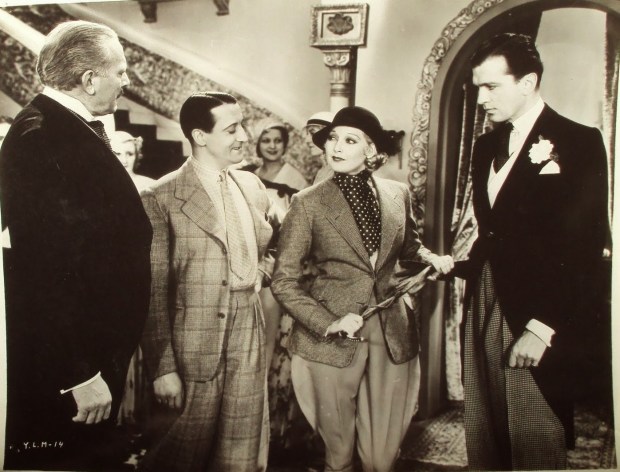
The contents of the bags get mixed, and Reggie’s fiancé arrives just in time to sees his pyjamas fall out of her bag. Hobbs gets flustered and passes her off as his sister. Confused yet? Well, ‘THE LOVE RACE’ takes delight in piling on complications. Adding to the confusion, Hobbs’ mother has remarried silly ass Ferdinand Fish (Wallace Lupino, here billed as Wallace Arthur—was he just one Lupino too many?). He arrives unbeknown to the mother, and makes himself at home in his new house. Lupino and Hobbs think he’s nuts, and humour him. There’s a terrific scene of Stanley repeatedly conning Wallace out of hisdrink by manipulating a swivelling table. Each time his lips find the glass empty, he mutters “Well, well, well, dear, dear dear…”, rising in incredulity each time. It’s a great example of music hall pantomime, executed by some of its finest exponents.

When the Furious father turns up, now Rita is passed off as Stanley’s wife! Throw in a drunken cabbie looking for his hat, and a gawky spinster determined to wed Lupino, and you have a very entertaining, if highly improbably, high speed farce. The speed becomes literal in a racing car climax which features an amusing cameo from Lane as a race spectator.

His later films streamline the farcical ingredients, to their advantage, but still provide original twists. ‘HONEYMOON FOR THREE’ sees him drunkenly entering the wrong flat and waking up, innocently, in a girls’ bed. The girl’s father happens to be meeting Lupino’s father on business; when the two men find Stanley and the girl together, they insist on their getting married and going on a honeymoon. Stanley agrees to go along with it, promising he will give her a divorce as soon as the honeymoon cruise is over. Her fiancé, furious at being spurned, tags along, threatening Lupino at every turn. Eventually, of course, the newlyweds really do fall in love, and the divorce never happens.

YOU MADE ME LOVE YOU

Stanley Lupino and Thelma Todd in ‘YOU MADE ME LOVE YOU’

One of Lupino’s most unusual films was made in 1933, and it is also one of his best. ‘YOU MADE ME LOVE YOU’ is one of a series of early 30s English films by British International Pictures featuring Hollywood stars in an attempt to bring prestige to the domestic industry. As such it features lots of resources thrown at it. There’s wonderful comedienne Thelma Todd moonlighting from appearances in Hal Roach comedies, during a promotional trip taken with Roach and Charley Chase. Rather than a jarring contrast, Todd’s Hollywood glamour is a great foil to Lupino’s English musical comedy and pantomime heritage. The film is ably directed by slapstick comedian Monty Banks, who himself makes a cameo. To top it all off, the last ingredient in this cinematic hodgepodge is a screenplay by Frank Launder, based on Shakespeare’s ‘THE TAMING OF THE SHREW’! Unlike many of the films made by comedians in unfamiliar foreign studios (Atoll K, The Invader, El Moderno Barba Azul, anyone) works out just dandy, thank you very much.Such a contrived confection really should be dreadful, but there’s so much talent in here that everything comes off beautifully. The performances are pitch-perfect by all concerned, and the script zings with one-liners and comebacks. Stanley Lupino’s usual moonstruck lover, small but determined to get his way and laugh in the face of bad luck, is made for this film; having seen Thelma, he is determined to win her over, even when he finds out she’s a holy terror. He hatches a plan to “treat her mean”, with lots of comic contrivances along the way, including cheerily putting her through an awful honeymoon, before everything turns out happily. The whole film is a barely believable piece of fluff, but it is packed with such energy, humour and movement that it carries off its unlikely ingredients with aplomb.

Similar in tone, and very nearly is good is ‘FACING THE MUSIC’, which sees Lupino again in dogged pursuit, this time to the beautiful secretary to a temperamental opera singer. Once more, it’s Lupino’s energy that really carries the film through some great visual comedy and dance routines.  Films like these prove Stanley Lupino to be one of the most under-rated English film comedians, his films glossy, well produced and action packed.  He undoubtedly offers the most rewards of any comic performer yet rehabilitated by Network’s ‘The British Film’ series. See for yourself here!

Stanley_Lupino

Not-so-Blue Monday: 3 clips to start your week with a smile!


Ah, it’s Monday. But fear not, here are three clips to make everything better! First up, Groucho v Chico in HORSE FEATHERS. Swordfish!

Buster Keaton, live on ‘The Ed Wynn Show’, 1949. A cracking spot, which proved to a new audience that BK was back!

Lastly, here’s a great little Lupino Lane short that’s been pieced back together from a couple of sources by David Glass. It has most of Lane’s pet routines, as well as an interesting look at the Educational studios as Lane tries to crash the movies. Look out for a brief Lloyd Hamilton cameo, too! ‘MOVIELAND’ was released in 1926.


All for now! More posts coming later this week, on Harry Langdon and Stanley Lupino. Stay tuned!