Well, it’s been a while, but the new issue is done.
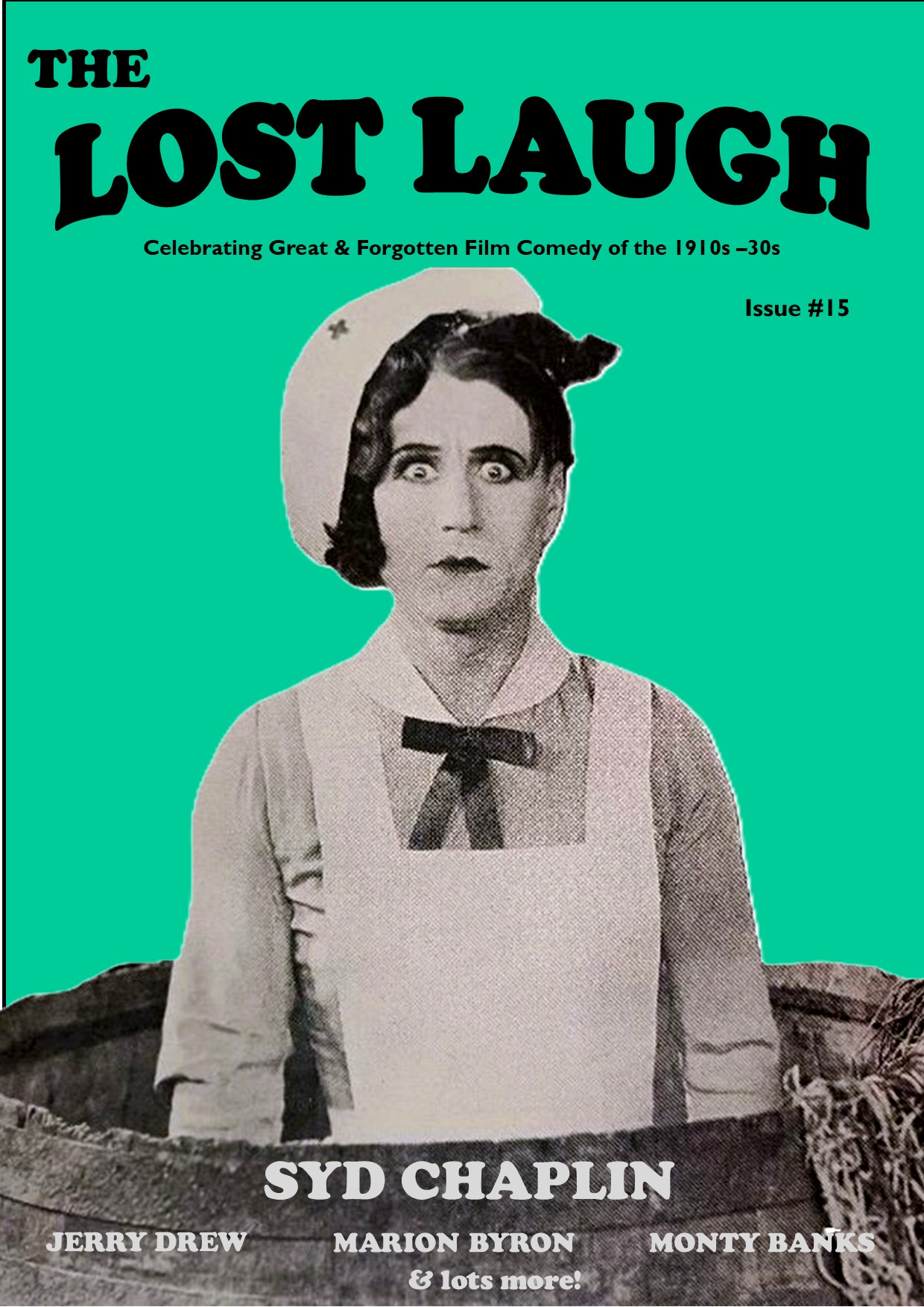
At 60 pages, this is the longest one yet, and I’m proud to feature some fantastic guest contributors this time. Syd Chaplin’s biographer Lisa Stein Haven has provided some great insights into our cover star, as well as his more famous little brother… There are also some details on the newly restored Syd feature, Oh! What a Nurse!.
I’m absolutely thrilled to be able to publish an exclusive excerpt from Steve Massa’s new book about Harold Lloyd’s Lonesome Luke films, and the early years of the Hal Roach studios – available soon from Split-Reel. There’s also a very informative Q & A with Steve about the new book.
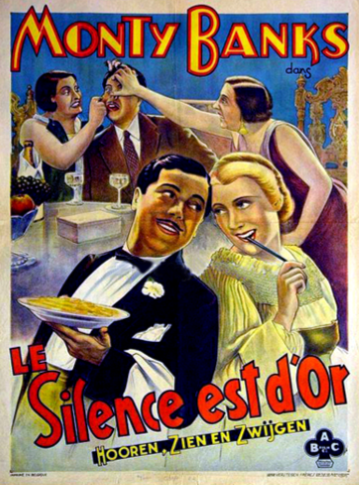
There are also articles about Jerry Drew, Marion Byron, Monty Banks and a piece about gagman extraordinaire Charles Rogers, by Holly Foskett and Matthew Lydick from A Lot of Fun Writers. Plus, a transcript of an interview with Al St John, film and BluRay reviews and lots more.
I really hope you enjoy this issue. I hope it won’t take as long for #16 to come along! If you’d like to contribute an article, plug a project you’re working on, or take part in a Q & A for the next issue, please do get in touch – either in the comments section here, or by emailing movienightmag [AT] gmail.com
And finally… The magazine is totally free. However if, you do enjoy reading the issues and would like to make a donation to support site running costs, software etc then these would be gratefully received! If you would like to donate, you can buy me a coffee on Ko-Fi. Thanks!
Where does the time go? Somehow, It’s just over three years since the last issue of The Lost Laugh appeared. Well, finally I’ve been cracking on with a new one, and though life has thrown a few delays in the way, I hope it will be out by the end of March.
This time round, I’m really thrilled to be featuring contributions from silent comedy experts Steve Massa, Lisa Stein Haven, Holly Foskett & Matthew Lydick, and have enjoyed researching some corners of silent film comedy that were new to me. Here’s a teaser of some of the contents:
Syd Chaplin. As Syd’s newly restored feature Oh!What a Nurse! is restored and re-premiered, it’s the perfect opportunity to revisit his neglected comedy career. Syd’s biographer and Charlie Chaplin expert/author Lisa Stein Haven has very kindly agreed to a Q & A about the brothers.
Monty Banks: his career in short films, from supporting actor to star comic.
Steve Massa provides an insight into the early years of Hal Roach‘s studio – Rolin, and fills us in on his exciting new book project
Jerry Drew: aka Clem Beauchamp, Educational’s corner on the sophisticated comedy market of the late 1920s. But there’s more to Drew than that; he was also a writer, director, stunt pilot, husband of Anita Garvin… and an Oscar winner!
Charley Rogers:Holly Foskett and Matthew Lydick shine a light on Stan Laurel’s right hand man, a talented gagman, director and performer whose career has been under-researched… until now.
A celebration of Marion Byron: one of Buster Keaton’s best leading ladies, and a very talented comedian.
A Charley Chase feature film is a sadly rare thing, but 1929’s Modern Love still exists and provides some vintage Chase comedy!
news of exciting new Kickstarter projects, film festivals, DVD/BluRay releases, plus reviews…
It’s not too late to add something, if you’d like to! Contributions are always welcomed, and if you have a project you’d like to plug, then please do get in touch. I’m always happy to help spread the word. Drop me a line in the comments section, or at movienightmag [AT] gmail .com if I can help!
Here’s the cover of the issue. I thought I’d try a simpler, cleaner look this time. What do you think?
Charley Chase at Hal Roach. The Late Silents: 1927 features fifteen great Chase shorts, most of them unseen for years.Here’s the trailer, and read on for a review. Spoiler alert: it’s insanely good, and you should buy it.
There’s a – quite possibly apochryphal – legend that Charley Chase buried a boxcar full of his old film prints and personal memorabilia somewhere in the San Jacinto desert. That rumour may never be verified, but this latest DVD/BluRay collection from The Sprocket Vault gets us close in spirit to unveiling such a Chase treasure trove. The films here have been largely unseen for decades; some were considered lost, others locked away in archives, or withheld due to copyright restrictions. When The Sprocket Vault began their series of Chase DVDs a few years ago with his talkie shorts, this already seemed like an unlikely and amazing bonus; when they moved on to his uber-rare (and hilarious) 1929 films, I thought I’d seen everything. But this set is the culmination of everything that Richard M Roberts and Kit Parker have been working towards in the series so far. It’s yet another release I never thought I’d see, and it presents some of the greatest silent short comedies ever made, rescued from the void. Quite simply, this is one of the most important silent comedy DVD/Blu Ray releases ever.
Why? Well, it represents the biggest release of “new” (ie. largely unseen) Chase films in years, and they capture him at the peak of his powers. 1927 was maybe Charley’s annus mirabilis. He made many of his best films, and was Roach’s biggest star. A reminder of his status is that both Stan Laurel and Oliver Hardy appear as supporting actors to him in that year’s Now I’ll Tell One, the remaining footage of which is included here. Within a year, the Laurel & Hardy team would supplant him as the big news from Culver City, and Chase would forever play second, or third, fiddle to them.
However, the work presented here is compelling evidence – perhaps the most compelling yet? – for Chase’s status in the top echelon of silent film comedians. There’s a dazzling array of comedy techniques on display – from farce (Assistant Wives, A One Mama Man) to topical humour (Us), and adroitly handled slapstick and sight gags (The Way of All Pants, Are Brunettes Safe?).
A couple of the films have been seen before, but scattered across a variety of releases, often in poor quality. They look much improved here, courtesy of the restorations by Paul Gierucki at CineMuseum, and its great to have films like Forgotten Sweeties and There Ain’t No Santa Claus available as part of a cohesive Chase collection. The most familiar film here is Fluttering Hearts, which is so good that I’m sure no-one would begrudge owning another copy. After that, almost everything is new to Chase fans. And what joys there are to experience. I don’t want to give everything away in this review, but here are a few samplers:
Are Brunettes Safe is a wonderful comedy featuring Chase standing in for his doppleganger, who turns out to be a dangerous bandit. There’s some terrific physical comedy here as he has to incorporate the villain’s distinctive limp into his impersonation. This climaxes in another one of his fantastic eccentric dances, with Polly Moran.
A One Mama Man has great performances from both Gale Henry and Vernon Dent (rarely spotted at Roach) to add to the fun. This film was remade by Chase as the talkie Skip The Maloo! In 1931, but this version is much superior.
Assistant Wives is one of his best farces – another ridiculous premise, made believable by Chase’s perfect characterization and storytelling. A terrific cast here, too: Anita Garvin, Noah Young, Eugene Pallette and Edna Marian all add to the fun as Charley has to hire a stand-in wife when the boss invites himself to dinner. Some beautiful, original gags as well; Charley trying to carry three bowls of soup backwards up a fire escape is a particular highlight.
The jewels in the crown are the long-unseen, complete versions of two films sampled in Robert Youngson’s comedy compilations. A brief section of the Lindbergh-baiting Us was seen in Four Clowns. Alongside the other Chase excerpts showcased there, I’d always been a little underwhelmed by this one, but the whole film is an absolute delight. While there are quite a few silent comedies featuring aerobatic finales, Us is a winner by virtue of relying on Chase’s character to provide the comedy. A nervous would-be flyer afraid to leave the ground, he presents himself as an aviator to impress Margaret Quimby, then has to constantly find new excuses to weasel out of actually going up in an aeroplane. This makes for some really funny sequences, and the film looks beautiful too.
The Way of All Pants was, for many years, thought to only exist in the cut-down excerpt featured in The Further Perils of Laurel & Hardy. Even in that truncated format, it was an absolute barnstormer of a comedy, but happily the full version was rediscovered a few years ago. The extra space of the full version really sets up the characters, and provides plenty of wonderful new gags (not forgetting the witty original intertitles). While losing trousers for comedy purposes can seem like a hackneyed idea, Chase’s absolutely mastery of how to provide variations on a running gag, expertly paced, make this one of the best of all his films, and among the top tier of Hal Roach comedies. We were privileged to showcase this new restoration at the 2023 Silent Laughter Weekend, and many people said it was their favourite film of the entire weekend!
The Way of All Pants is also a great example of how Chase’s silent films have such perfect rhythm, not just the way they are directed and edited, but in Chase’s own pitch-perfect timing and body control. I was really struck by this when watching all the shorts on this set.
This set ranks along with All Day Entertainment’s Harry Langdon: Lost & Found set, Lobster’s Charley Bowers collection, Dave Glass’ Monty Banks restorations and Undercrank’s Edward Everett Horton set as a major, game-changing showcase for a silent comedy talent. And, if the films themselves weren’t enough, you get great musical scores from Dr Andrew Simpson, and information-packed commentaries from Richard M Roberts, which really put the films into their historical context. Massive thanks and congratulations to everyone involved in making this release happen. It puts Chase at the forefront of the silent comedians, where he belongs. Now, what are you waiting for? Go buy it!
From the archives, here’s an article that first appeared in issue #13 of The Lost Laugh, in 2021…
DOUBLE TROUBLE: THE SNUB POLLARD & MARVIN LOBACK FILMS
One of my earliest memories of silent comedy is of watching a ‘COMEDY CAPERS’ VHS when I was very young. One of the episodes on the tape, ‘BABY BACHELOR’ confused me: it was a virtual copy of Laurel and Hardy, but the Laurel character was wearing an enormous moustache. Who were these L & H wannabes? Years later, I learned that they were Snub Pollard and Marvin Loback, jumping on the bandwagon of fat-and-skinny comedy teams as Stan and Babe were at their zenith. I’ve always been intrigued by these copycat shorts, and endeavoured to find out more about them. Here’s the story…
It’s late 1927. Laurel & Hardy’s pairing has blossomed, and they’ve just produced their biggest hit to date, THE BATTLE OF THE CENTURY, for Hal Roach. For another ex-Roach employee, Snub Pollard, things are not going so well. Once one of the studio’s big stars in classics like IT’S A GIFT and SOLD AT AUCTION, he had been let go as the studio moved to more sophisticated comedy. A series of shorts at the low-budget Weiss Brothers studios was a step down the ladder; even further down was a return to vaudeville when that series ended.
While Snub was treading the boards, Laurel and Hardy’s meteoric rise gave someone at Weiss Brothers a brainwave: why not produce their own version of the team, with Snub as the thin half? Pollard was called back to Weiss Brothers in early 1928, and teamed with large comic Marvin Loback. Loback was a veteran of Sennett and Roach, and had even appeared with Snub a few times in small parts.
The films that resulted might charitably be called homages to Laurel & Hardy; less kindly, they could be called blatant rip-offs. To be fair, some of the films were more original than others, and there was always a certain amount of shared ground and gag-borrowing in silent comedy. However, the way that some of the Pollard-Lobacks like SOCK & RUN re-enact whole chunks of L & H films is particularly shameless. What particularly attracted attention is the one-time belief that these shorts were made before the Laurel & Hardy films they resemble. We now know this to be untrue. However, there do seem to be some examples where the Pollard films did a gag or routine simultaneously or before the Roach crews.
The films are an interesting sidelight in Snub’s career, and a fun curio for L & H fans. The Laurel & Hardy influence is obvious from the outset, but is painted broadly: the amount of nuance may be gauged from the fact that Loback’s character is called ‘Fat’. There’s none of Oliver Hardy’s quiet dignity in that! To be fair, Loback does a decent job throughout the series of replicating Hardy’s impatience, if not his charm. It’s his presence that really brings the L & H comparison. As for Snub, he hasn’t changed his appearance from his standard costume of bowler, moustache, striped shirts and spats. As far as his performance goes, he’s definitely gone a bit more passive, but his trademark moustache is a handicap in reproducing Stan’s blank innocence. He rarely does a complete rip-off of Laurel mannerisms (although he does a crude version of the cry in one film), but the intention is clear.
Though the first few films of the series mainly aped L & H in the comic’s appearance, soon more similarities began to creep in. Perhaps it was lack of inspiration for new material, but the intentional effort to piggyback on the team’s success soon becomes a bit more blatant by –ahem- borrowing their material. Sometimes the likenesses are vague – Snub and Marvin as two sailors in HERE COMES A SAILOR, or a hint of DOUBLE WHOOPEE in MITT THE PRNCE, for instance. At other times, the similarities constitute plagiarism pure and simple, as entire gags and plots are ripped from L & H films like FROM SOUP TO NUTS, PUTTING PANTS ON PHILLIP and SHOULD MARRIED MEN GO HOME!
The L & H connection has brought the Pollard-Loback films into focus now and again, particularly when one theory suggested the films actually pre-dated the Laurel & Hardy films! In the pre-Internet days, and before the onset of trade paper archives like the Media History Digital Library, States-Rights films made by companies like The Weiss Brothers were obscure and hard to trace. As a result, the films seem to have been confused with Pollard’s first (solo) Artclass series, which were made in 1926-27. We now know that the Pollard – Lobacks were released in two batches, six films in 1928-29, and a further four in 1929-30, disproving the claim that Laurel & Hardy were the ones doing the borrowing.
The trade magazines only gave light coverage to low-budget, indie two-reelers like these, but after sifting through, I’ve gathered a handful of more precise dates. British trades like The Bioscope and Kinematograph Weekly also came in handy – though the films generally hit the UK a little later, the release dates gives a rough indication of when they were made and registered for release. Below is the information I’ve been able to gather to pin down the dates and titles a bit more.
1928 -29
Variety reported that Snub was working for Artclass on May 2, 1928. By June 19, they note that both Pollard and Ben Turpin have finished filming their first shorts for the company (THICK & THIN and SHE SAID NO, respectively). By September 1st, 1928, Film Daily reports that an additional two films are ready: ONCE OVER & THE BIG SHOT. American mentions of the series are scant hereafter. However, the British Press picks up the slack. Louis Weiss visited London to trade-show the series in the Autumn and they were distributed by Gaumont from November 1928. The Films Act, article 6 required that all films must be registered for exhibition – these listings tells us that the other three films from the first series were SOCK & RUN, MEN ABOUT TOWN and HERE COMES A SAILOR.
1929-30
In May 1929 Film Daily reported that Snub listed four titles in production for 1929-30; however, the titles listed were actually ones from the previous season, presumably an error. Actually, the four films were DOUBLE TROUBLE, NO KIDDING, SPRINGTIME SAPS and MITT THE PRINCE. These were released with synchronised music tracks (but no dialogue) as a concession to the advancing sound revolution. Adverts exist for the reissue of these films, with soundtracks, in 1943.
All the films were filmed in the Spring of 1929, with Variety reporting that the series wrapped in the second week of May, 1929. DOUBLE TROUBLE was used to launch the second series, and was reviewed in Film Daily on August 18th, 1929. SPRINGTIME SAPS was reviewed on October 24th. In Britain at lease, MITT THE PRINCE was the last of the series to be released, in February 1930.
With the above in mind, here’s a run-down of these seldom-discussed films, in what I believe is the order of release.
THICK & THIN
THICK & THIN was definitely the first of the shorts to be released and sets the tone for the series, with Snub and Marvin as two penniless gents in a shabby boarding house, trying to cook a meal, and then sneaking their belongings out without paying the rent.
Of all the series, this is the one that most harks back to Snub’s Hal Roach films, the hidden devices that the pair use to cook their meal a bit like a less elaborate reminder of IT’S A GIFT, STRICTLY MODERN and other films featuring Snub gadgetry.
There’s also a bit of a Harry Langdon influence, both in Pollard’s subdued persona, and in a gag lifted from Langdon’s FIDDLESTICKS. THICK & THIN is undoubtedly derivative, but the gags flow nicely and it’s an entertaining little two-reeler.
2. ONCE OVER
Snub and Marvin roll into town on a freight train, riding in a boxcar of cows. There’s a funny scene featuring the atrociously fake cow heads they use as a disguise, confounding brakeman Tiny Lipson (even more so when one of the cows appears to smoke his cigar!). For a topper, they exit the boxcar under blankets that make them appear to be a strange, two-headed beast!
The bulk of the film centres around their attempts to filch some food, pursued by cop Harry Martell. Along the way, two Hal Roach gags are – *cough* – borrowed. The scene from THE FINISHING TOUCH with Stan Laurel on both ends of the same plank is used, and there’s also a gag with a mailbag and a fence lifted shot-for-shot from Max Davidson’s DUMB DADDIES
Then it’s on to the park, where they fail to steal a family’s picnic before Snub has a brainwave. Covering his hand with a long white sock, he hides in a bush and pretends to be a swan, stealing the sandwiches a lady is feeding to the birds. Unfortunately, he knocks her in the water, and the cop is on their trail again. To elude him they enter a restaurant and are put to work as waiters. A predictable level of competence ensues, and things wrap up with some pie-throwing. Though the finish is weak, ONCE OVER is maybe the best of the Pollard-Lobacks. The borrowing is less overt than in many of the other shorts, and the film rambles along happily from one gag situation to the next, with some nice original ones thrown into the mix.
3. THE BIG SHOT (Released October 1928, belatedly reviewed in Film daily, Feb 1929)
THE BIG SHOT is another one of the better Pollard-Lobacks, having some semblance of following the same story from start to finish. Snub and Marvin are reporters tasked with getting a photo of a camera-shy Scottish inventor. This involves Snub being coerced into wearing a kilt, and we’re into a semi re-run of PUTTING PANTS ON PHILIP. It doesn’t work on the same level of the L & H film – the sexual ambiguity surrounding the innocent Laurel character in PHILIP just cannot translate to a character wearing a huge moustache! To be fair, the gags don’t try to be a carbon copy and mainly just deal in the incongruity of Snub’s appearance. There are a few nice original variations, including Snub trying to change a tyre, with the draught from every passing car sending his kilt flying up. Snub and Marvin wind up following the inventor onto a boat and eventually corner him for a photo, but Snub is too generous with the flash powder and after a huge explosion, he is left clinging to the mast.
4. MEN ABOUT TOWN
After three films that borrowed from Laurel & Hardy but at least tried to have original plots, the Pollard unit pretty much gave up the pretence of trying to be original for the next few films.
MEN ABOUT TOWN is largely a re-run of SHOULD MARRIED MEN GO HOME set on the golf course, with added gags from YOU’RE DARN TOOTIN’. However, there are some occasional moments in the Weiss Bros films where they seem to foreshadow a later Laurel & Hardy moment. Here, Marvin’s attempts to contact Snub and sneak him out of the house include trying to contact him by phone, anticipate L & H’s BLOTTO of 1930. However, L &H knew how to milk the scene for all it was worth, whereas here it is just a quick throwaway gag. MEN ABOUT TOWN is definitely one of the weaker films in the series.
5. SOCK & RUN
Ok, now they’re really taking the Mickey. Not content with pinching the kilt material from PUTTING PANTS ON PHILIP, they basically re-film the entire first reel of that film, throwing in some soup gags from YOU’RE DARN TOOTIN’ and ending with a boxing match á la BATTLE OF THE CENTURY!
The PHILIP material is recreated gag for gag, from the laughter of the crowd as Snub arrives, to his medical examination, to Marvin’s attempts to keep him walking a few paces behind. Oh, but wait, it’s actually been changed – Snub is French, not Scottish, and people are laughing at his silly top hat instead of his kilt. That ought to avoid the copyright infringement lawsuit…
Of all the Pollard-Lobacks, SOCK & RUN is maybe the one that has most secured the reputation of the series as being mindless L & H rip-offs. In this sense, it’s the worst of the bunch. On its own terms, it’s not terrible, and if you’d never seen a Laurel & Hardy picture, you’d probably find it entertaining. But if you lived in a world without Laurel & Hardy, SOCK & RUN would be the least of your problems.
6. HERE COMES A SAILOR
HERE COMES A SAILOR starts out with the boys as sailors who hire a car, in the spirit of TWO TARS, but doesn’t get down to mass car destruction (something Weiss Bros surely didn’t have the budget for). Instead, it takes a left turn to become a clone of FROM SOUP TO NUTS as the pair get jobs at a dinner party, down to Snub serving the salad “undressed”.
There is one nice original gag, as Snub accidentally causes a cameraman’s tripod camera to collapse on top of him; bumbling around on all fours with the cloth over his back and the lens dangling out in front, the man resembles some strange elephantine creature!
7. DOUBLE TROUBLE
Snub and Marvin unsuccessfully rehearse and audition their terrible vaudeville act, then are hired as process servers to repossess their landlord’s piano. This second series of Pollard-Lobacks are where some of the confusion over their originality seems to have come from. While the first-series L & H rip-offs like SOCK & RUN are blatant steals, the second batch do actually contain some gags or situations used by Pollard & Loback before Laurel & Hardy. DOUBLE TROUBLE is a case in point; Snub and Marvin’s attempts at repossession anticipate BACON GRABBERS, not just in story, but also down to individual gags.
Held back until after L & H’s first few talkies, BACON GRABBERS wasn’t released until October 1929, but DOUBLE TROUBLE was filmed before May, and had already been released and previewed by August of 1929. Therefore, it couldn’t have been a simple case of Les Goodwins or other Weiss gagmen having been to see the latest L & H film at their local theatre and filling their notebooks with ideas.
However, while DOUBLE TROUBLE may have reached cinemas before BACON GRABBERS, the Laurel & Hardy film was almost certainly finished first. My theory is that a Roach gagman moved over to Weiss Brothers, probably during the time when the Roach studios were being fitted out for sound. Another possible ‘mole’ was Bert Ennis, Snub’s gag and title writer. Ennis doubled as a publicist, and had his own regular column in Motion Picture Classic, so was probably quite well connected with other studios.
8. NO KIDDING (September 1929)
NO KIDDING is a fun little short, featuring Snub and Marvin accidentally in charge of a toddler, and then having to hide him from the landlord of their bachelor apartment. The toddler is actually played by midget Billy Barty (incidentally, he played a similar role in the Laurel-Hardy SAILORS BEWARE). There are some amusing scenes as they disguise the toddler as an adult in a suit, complete with cigar, but the deception is undermined as he proceeds to make various noises and arouse the landlord’s suspicion.
Again, there’s a parallel situation of the Snub film seeming to pre-empt the Laurel & Hardy film. The central situation of the team hiding an unwanted guest in their apartment was also the basis of ANGORA LOVE, and one particular gag appears in both films. As the landlord lectures Snub & Marvin/Stan & Ollie that “this is a respectable boarding house”, a woman walks behind him towards her room, pursued by a sailor! NO KIDDING was filmed in early Summer 1929, and released in the Autumn, but ANGORA LOVE wasn’t released until December 1929. The Roach Mole seems to have been at work again…
(By the way, this is the short I saw on COMEDY CAPERS VHS, cut down and retitled…)
9. SPRINGTIME SAPS (October 1929)
SPRINGTIME SAPS is a ragbag effort that changes situations as the team run out of gags for each one. The best scenes are set in the park, with Snub and Marvin attempting to get 40 winks on a bench before being woken by a cop, and then trying to steal a man’s cigar.
When that’s milked for all the comedy they can manage, the pair get jobs as taxi drivers, mainly so that they can nab a gag from the Sennett film TAXI DOLLS. Then things peter out in some feeble haunted house comedy.
The most notable aspect of this film is a moment where a man angrily gives Snub the middle finger! It’s not a slip or even made to seem like one – it’s just blatantly there, in full shot! It shows how low under the radar these states-rights films must have flown, particularly at the tail end of the silent era.
10. MITT THE PRINCE (Release dates variously quoted as Dec 1929 and Feb 1930).
Snub and Fat are two incompetent handy men. Sent to deliver some parcels to the social-climbing Mrs Woodby-Noble (Ho Ho!), they write off the car on the way there with bit of L & H patent tit-for-tat. When the Prince who is supposed to attend fails to show, the hostess persuades Snub to take his place. There’s a vague hint of DOUBLE WHOOPEE in this premise, but no direct stealing of material.
The best thing about MITT THE PRINCE is a nice running gag of Snub accidentally getting his hand continually in others’ pockets; other than that, it’s a middling effort.
The series wrapped in May of 1929, and with it Snub’s career in silents. However. there was still one last gasp for his starring career, and his association with Weiss Brothers. In July 1929, Film Daily reported that the company was planning some talkie shorts, with Snub heading east to film some. Two shorts resulted, and the Pollard-Loback faux L & H vibe was dropped:
HERE WE ARE (filmed July 1929, released August 1929 )
Snub played a plumber’s assistant, who ends up pretending to be the plumber’s wife. Obviously, he didn’t wear his moustache in this one, or the deception wouldn’t have been very convincing!
PIPE DOWN (Trade shown September 1929)
Snub was teamed with Jack Kearney as a pair of sailors on shore leave who keep running afoul of tough guy Gunboat Smith, ending in a slapstick fight. After Kearney knocks smith unconscious, the pair light cigarettes, but an open gas lamp next to them causes a huge explosion. At least Snub’s starring career ended with a literal bang! Variety wasn’t impressed, calling PIPE DOWN “third-rate Vaude stuff passed off as film comedy”.
These two talkies were released in the UK in February, 1930.
And with that, the Snub Pollard Weiss Brothers series was over. The films were hardly his most glorious moment, but they helped keep his starring career afloat a little longer. Viewed today, the films range from good fun, to middling, to outrageous rip-offs (sometimes within the space of the same film!), but they show an interesting sidelight to how silent comedians could try to meet changing tastes and demand for particular styles of comedy. They are also a reminder of how special, and how hard to replicate, the chemistry between Stan Laurel and Oliver Hardy was.
You can enjoy some of Snub’s Weiss Brothers films (and a host of others from the studio, including Ben Turpin and Jimmy Aubrey) in the great DVD WEISS-O-RAMA
Old films give us a window into the cultures, values and everyday norms of the past, and comedies sometimes hold up the mirror to society best of all. Although silent comedies rarely tackled politics head-on, they often took inspiration from current events and trends, and people’s attitude to them. Often this was in passing, but sometimes comics went the whole hog to make satires. The Suffrage moment became a favourite topic for comedy; many men in the male-dominated society felt threatened by the increasing voice of women, and this was reflected in comedic portrayals of fearsome battleaxes. As the 1920s rolled on, the increasingly confident and empowered flapper generation began to be represented in films, with wonderful performers like Clara Bow, Dorothy Devore and Marie Prevost flying the flag for contemporary women.
However, not all welcomed such developments. The narrow-minded mutterings in some quarters that skirts were getting too short and things really were going too far were ripe for spoofing. Emasculated men having to deal with the housework became a comedy staple, but the gagwriters at the Hal Roach studios went one step further and made some wonderfully silly and surreal films where genders were bent as men and women swapped roles fully. They weren’t trying to make a serious point, just having some fun and trying to make good comedy that would resonate with their audiences. Nevertheless, the films give a fascinating insight into what was considered conventional for each gender in the 1920s.
In 1922, the gagmen and performers had great fun playing with exaggerated gender stereotypes in Snub Pollard’s YEARS TO COME. Set in a future where men’s and women’s roles are reversed, it offers the amusingly goofy sight of the heavily moustached Pollard and the usually tough and burly Noah Young delighting in incongruous feminine mannerisms.
The Roach gagmen always liked to revist a good idea, and in 1926 they remodelled the basic idea of YEARS TO COME with another moustachioed comic, Clyde Cook. WHAT’S THE WORLD COMING TO? was even dafter than the original, and mocks the more ridiculous gender conventions of Hollywood film for all they are worth. To this end, we get James Finlayson as a shrewish father-in-law (“about to bear up bravely as his little one is wrenched from his apron strings”), and Laura de Cardi as a caddish lounge-lizard, as well as a series of ridicuously surreal visions of an outlandish future.
This gag-happy little film was co-written by Stan Laurel and Frank Terry (It is Terry who makes a cameo as a man in a window, not Laurel as often stated. Sorry, Stan Fans!) For many years known primarily in a one-reel cutdown, WHAT’S THE WORLD COMING TO? has been restored to its full glory, and kindly shared online by The San Francisco Silent Film Festival:
Roach comedian Charley Chase had a theory that comedy ideas could be recycled around every seven years. Sure enough, in the mid-30s he began reaching back to some older plots from the silent era. 1935’s OKAY TOOTS! was maybe inspired by the two previous films. Though not a remake of them, it takes a similar approach in playing with gender roles. In fact, it anticipates FREAKY FRIDAY as Charley and his wife Toots (Jeanie Roberts) swap bodies, each speaking with the other’s voice as Charley gets a lesson not to take all his wife does for granted. It’s a bizarre little film – unlike the previous two shorts, Charley and Jeanie do not outwardly look or dress like the opposite sex, but everyone accepts them as such without question. Chase’s impotent indignation as a group of housewives give him an enforced makeover is a highlight, as is his variation on a parallel parking routine used by Lloyd Hamilton and W.C.Fields. Look out for a funny bit from Charlie Hall at his most menacing too!
Though these films and the conventions they spoof are obviously very dated now, they remain interesting artefacts of their times – and more importantly, they’re still funny!
It came! After weeks of waiting for Trans-Atlantic deliveries to return to normality, yesterday HARRY LANGDON AT HAL ROACH: THE TALKIES 1929-30 finally dropped into my mailbox.
A DVD release of these much maligned, obscure little films is a wonderful thing indeed. These shorts have had a decidedly mixed reputation, but were well received at the time and deserve a fresh viewing.
Even in his best work, Harry Langdon always arouses quite visceral reactions, and these films are maybe the most contentious of his entire career. Partly this is because they were hugely obscure for a long time, and partly because when they were written about it, it was often by someone who didn’t enjoy them (most notably by Leonard Maltin in THE GREAT MOVIE SHORTS) . Well, recent showings of some of the films on TCM have enabled people to at last judge for themselves. Now, they’re out in the real world again on this wonderful DVD from The Sprocket Vault, which collects all eight of the shorts, including the incredibly rare HOTTER THAN HOT and SKY BOY.
The shorts brought Langdon to the Hal Roach studios for the first time. His career in features had crashed, coinciding with the arrival of sound. Harry’s return to the short comedy was celebrated as a comeback, and though I have some favourites among his features, I do feel that this was the idiom that suited him best. Langdon’s comedy was all about creating his own little world, and in twenty minutes the real world doesn’t need to impinge on his fantasies too much.
Langdon fully capitalises on that here. His childlike ‘little elf’ character always tended toward the surreal (in one of his silent films he has a bearded woman as his leading lady!). These shorts continued that trend, with the new era of sound seeming to encourage him to be more experimental. Harry always babbled away in his silent films – now you can hear him as well as see him! Much has been made of his use of his voice, and it did take him a little while to get it right, but I think his voice actually suits his character really well. It’s not all talk, anyway. In the best of these films, there are terrific pantomime routines and some, like THE BIG KICK are practically silent comedies. There are some wonderful sight gags and images in these shorts that, if they weren’t quite so bizarre, might be considered iconic: Harry sat with his fingers in his ears and a firecracker fizzing away in his mouth, for instance, or in a cartoonish boxing match, his gloves floating around on the end of long poles coming out of his jumper!
It doesn’t always work, and the early sound technology does create some pacing problems, but there’s a lot to enjoy here. While films like SKIRT SHY and THE HEAD GUY are a little unsure of themselves, there is some vintage Harry on show, with THE BIG KICK and THE SHRIMP near-classics.
If you’re on the fence about Langdon (or his sound work), give this set a go; I think you’ll be pleasantly surprised. There are some terrific moments, and you also get to enjoy some choice moments of Hal Roach players like Thelma Todd, Edgar Kennedy and Max Davidson into the bargain.
Of course, if you’re already a Langdon fan, then buying this set is a no-brainer. For one thing, this is your first chance to see HOTTER THAN HOT & SKY BOY in 90 years!
These two films, contrasting tales of fire and ice, are among the most offbeat of all Langdon’s work (against some stiff competition!). HOTTER THAN HOT might just be one of my new favourite Langdon shorts. Harry plays a pyromaniac of all things, who is chasing a fire engine when Edgar Kennedy bribes him to take a ‘Dear John’ letter to Thelma Todd’s apartment. There are some lovely sight gags in this one, including Harry trying to cross a slippery floor, his attempts to retrieve a key that an unconscious Thelma has hidden in her dress, and his manipulation of a doll so that it seems to have Thelma’s legs. The film was based on Langdon’s own vaudeville skit THE MESSENGER, so he was intimately familiar with the material and pulls it off wonderfully.
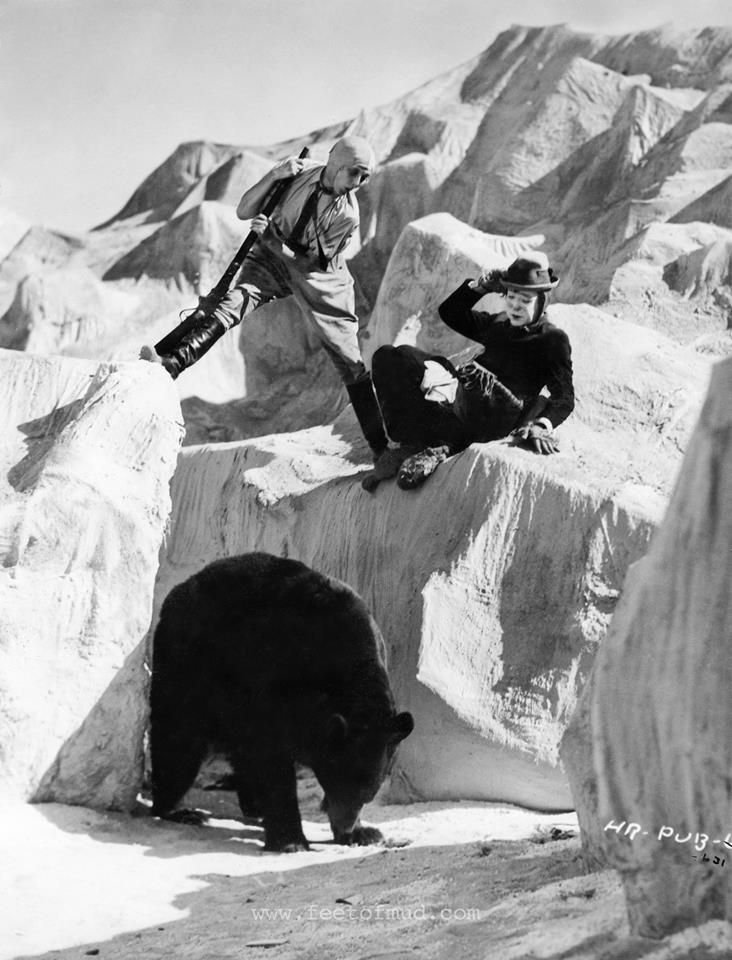
SKY BOY has him marooned on an iceberg with Thelma, Eddie Dunn and a bear! The striking iceberg setting is an unusual but fitting backdrop for Langdon’s minimalism, and the centrepiece of the film is a long routine of Harry trying to shave the bullying Eddie Dunn. The angelic Langdon character often had darkness lurking not far away, and there’s a wonderful example here, as Thelma tries to persuade him to cut Eddie’s throat; add to this a fishing line attached to Harry’s wrist that causes his hand to jerk dangerously all over the place and you have a great little routine that’s suspenseful as well as funny.
Both these films are missing their original soundtracks, but subtitles and music from Andrew Earle Simpson carry them along nicely. After all, the visual is the essence of Langdon’s beautiful pantomime performances. Even if he never made me laugh, I could happily sit and watch him act for hours. Do you know what, though? He made me laugh a lot in these shorts. I laughed out loud, in fact.
Leonard Maltin got it so wrong when he called these shorts “horrible”. That’s like criticising Picasso for getting his faces all mixed up. Sure, they’re quirky, sometimes surreal and abstract, but that was Langdon’s vision. What you have here is a master comedian still pushing the envelope and creating something that no other comedian could have. Often, he manages to be very funny in the process. Maltin said that the “blame” for the films “surely lies with Langdon himself”. Change “blame” to “credit”, and now you’re talking!
As far as the DVD goes, the presentation of these films is exemplary. I once owned a print of LONG PANTS that was so bleached out that you could barely see Harry’s facial expressions. Without this ability, it became virtually unwatchable. You need to see every nuance of Langdon’s being, and the terrific digital restorations here make that possible. The films benefit hugely from this.
Like the previous Charley Chase and Thelma Todd DVD sets, all the shorts come with tremendously detailed commentaries from Richard Roberts. So, even if the films aren’t your cup of tea, you can still listen and learn a great deal not just about Langdon and these films, but about the Hal Roach studios in general.
Bravo to Richard Roberts and Kit Parker for making this, the most improbable of all DVDs, available for us to enjoy. The Sprocket Vault continue to give us chance to appreciate films that no-one else would even consider releasing, with the best possible presentation. If you’re still not convinced to buy, just remember that incredibly niche projects like this can only continue if we support them. Here’s the Amazon link… https://www.amazon.com/Harry-Langdon-Roach-Talkies-1929-1930/dp/B07ZW9Y36M
With his upside-down Kaiser Wilhelm ‘tache and permanently startled expression, Snub Pollard is another one of those moustachioed icons on the silent comedy Totem pole. Like Billy Bevan and Ben Turpin, he was a gift to caricaturists, a flesh cartoon. Realism was never the idiom of these comics; instead, they traded in fast-paced sight gags. They might not have had deeply developed characterisations, but what gags they had!
There’s sometimes a snobbery towards the one-and-two reelers full of slapstick and sight gags, which is totally unmerited. Yes, there was a lot of filler turned out by the industry, but many of these comedies have wonderfully inventive gags and routines, and amazing stunts. Pollard’s films are some of the best examples of these.
Snub was an Australian, real name Harry Fraser, who adopted his stage name after working as part of the ‘Pollards Liliputians’ juvenile theatrical troupe. He made early films at Essanay in the teens, appearing opposite Chaplin and Ben Turpin. It was also at Essanay that he met Hal Roach.
When Roach set up in independent production, he hired Pollard to be second comic and villain to Harold Lloyd, before promoting him to his own series in 1919. The Kaiser moustache was a remnant of his more villainous roles, but came to suit his starring character well. As he came to play roles of the little man, always being trodden on, the ‘tache became a perfect match for his drooping, put-upon countenance.
Snub starred in films for Roach until 1924 (though a couple were held back and released into 1926), and is best remembered today for this wonderful little short. IT’S A GIFT is a beautifully zany little two reeler featuring his many Rube Goldberg-esque inventions. Wallace and Gromit, eat your heart out!
Thanks to being featured in Robert Youngson’s WHEN COMEDY WAS KING, IT’S A GIFT has long been hailed as one of the classic silent shorts. However, the side effect is that it’s often the only Pollard film ever mentioned. It’s the easy (read: lazy) Silent Comedy 101 option to write that IT’S A GIFT is Pollard’s magnum opus, but there are many other great ones out there! While you wouldn’t rank Pollard with comic auteurs like Keaton or Laurel, he was surrounded by hordes of brilliant gagmen and directors at the Hal Roach studios who kept cranking out wonderfully funny gags and situations for him. One of these was Charles Parrott/Charley Chase, who helmed many of the best Pollard films.
Here are two examples, the terrific FIFTEEN MINUTES (recently pieced together by David Glass) and WHAT A WHOPPER. Both feature a classic Chase premise of a mundane beginning that swiftly escalates to become absurd, yet somehow believable.
Another of my favourite Chase-Pollard collaborations is SOLD AT AUCTION. Again, it starts simply: Pollard is an auctioneer, and does a house clearance. Trouble is, he’s gone to the wrong house! Cop James Finlayson is none-too-pleased to find his house empty and demands that Snub recovers every single item, including a runaway grand piano and a pair of false teeth being worn by an airplane pilot! Like the best of Snub’s films, it’s wonderfully absurd, but remains human. The whole film is on YouTube, but only in awful, retina-detaching quality; here’s a much better looking excerpt, courtesy of Ben Model:
Many of the Pollards only exist thanks to home movie excerpts, especially 9.5mm Pathex cutdowns. Here’s one such example. ‘CALIFORNIA OR BUST’ is a tale of Snub and his wife (regular leading lady, the charming Marie Mosquini) driving west with a wagonful of all their possessions. You can guess that they don’t make it, but the inevitable destruction of their belongings takes place in some wonderfully original ways. A favourite grace note is Snub struggling to play a game of Pool in the back of the wagon; only when it has been smashed to smithereens is he able to steady the balls to pot them! There’s only about half the original film here, but the essence is preserved nicely.
Snub Pollard’s films are full of ingenious gags, snappily performed, and deserve a wider audience. Kickstarter, anyone…?
The Sprocket Vault continue their terrific mission to release rarely seen classics from the Hal Roach archives. The latest volume, out next week, covers the series of sound shorts made by the great Harry Langdon.
These are an offbeat and sometimes bizarre group of films, but I find them absolutely fascinating and often quite wonderful. Click here to read a detailed piece I wrote about them a few years ago, and below is my favourite of the shorts, THE BIG KICK. It’s an almost silent short with some wonderful bits of pantomime from Harry, and some truly strange gag ideas!
As usual, the disc is packed with real treats. For Langdon’s devotees, the real holy grail is the inclusion of his first two talkies, HOTTER THAN HOT and SKY BOY. These now only exist in silent versions without their soundtracks, and haven’t been seen in many, many years. There’s also a Spanish phonetic version of THE BIG KICK! Many find Langdon’s speaking voice strange in English.. imagine what it must be like in Spanish. There are also commentaries on the films by Richard Roberts. All in all, a wonderful gift for these troubled times.
After falling from Hollywood stardom at the end of the Silent Era, quirky silent film comedian Harry Langdon made not only his first talking films, but also his first screen comeback with a series of eight two-reelers for comedy producer Hal Roach. This pre-code series offers an interesting and entertaining look at what critic James Agee referred to as Langdon’s ”baby dope fiend” characterization, presented for the only time in sound as the undiluted comic creation he made famous in silent films. Langdon had developed a strange, stream-of-consciousness vocal patter in vaudeville, as showcased here. With another fifteen years to go in talkies after he made these shorts, Harry Langdon would never again deliver to films full-force his truly bizarre humor. Along for the ride is the beautiful comedienne Thelma Todd in some of her earliest film appearances at the Lot of Fun, as well as others from the Hal Roach Stock Company like Edgar Kennedy and Max Davidson.
This is Harry Langdon at his most surreal:
1929: Hotter Than Hot
1929: Sky Boy
1929: Skirt Shy
1930: The Head Guy
1930: The Fighting Parson
1930: The Big Kick
1930: The Shrimp
1930: The King
Bonus Material:
”La estación de gasolina” (Spanish language version of ”The Big Kick”)
”Hal Roach Presents Harry Langdon” (1929)
”Hal Roach Studio Auction”(1963)
Commentary by Richard M. Roberts
Photo Gallery
Supplemental music composed and performed by Andrew Earle Simpson
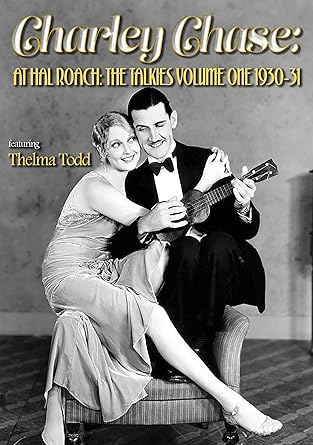
Charley Chase has gone from being an under-represented figure on home video releases to having much of his classic work out there in superior quality. Thanks to DVD releases from Kino, AllDay Entertainment and Milestone films, a majority of his existing silent work can now be widely seen. In recent years, even his late sound shorts for Columbia have even been pulled from the vaults and released by Sony.
All this is extremely heartening, but the holy grail has always been his Hal Roach sound shorts. Picking up from where he left off in silent days, Chase kept on churning out little gems at Roach until 1936. The distinctive charm of the Roach films, with their stock company and background music, along with Chase’s excellent performances and some great gags, made these a wonderful bunch of films. More’s the pity that they’ve been so hard to see! There was a period when the films were aired semi-regularly on TCM in the USA, and it has been possible to cobble them together through a ragbag assortment of bootlegs from off-air recordings, VHS transfers and often ropey 16mm prints, but a legitimate and comprehensive release, in nice quality, has remained elusive.
No longer. Step forward expert comedy historian Richard M Roberts and The Sprocket Vault, who have achieved what no-one else has been able to in bringing some of Chase’s sound shorts to DVD (it’s the first in a planned series of volumes, which will hopefully work through all the other Chases). Simply by existing, this set would be automatically brilliant; that it presents the films in the best quality possible, with great extras and authoritative commentaries, makes it an absolute triumph.
Chase’s earliest talkies are currently unavailable, so this set picks up with THE REAL McCOY, his first release of 1930, and goes through to his last release of 1931. Within these parameters, you get some of his all time best, including WHISPERING WHOOPEE, LOOSER THAN LOOSE, THE HASTY MARRIAGE and, of course, THE PIP FROM PITTSBURG. Disc 1 covers 1930, and disc 2 1931. The chronological nature means that you get to see how Charley developed his approach to comedy during the early sound era. This was a transitional period for Chase, and while sound gave him no cause for alarm, it did give him pause for thought, and to try some new approaches and variations in character. As well as films in the vein of his silent farces like LOOSER THAN LOOSE and DOLLAR DIZZY , several of the 1930 films are particularly offbeat and experimental in nature. FIFTY MILLION HUSBANDS is a really fun little short full of quirky bits of business and GIRL SHOCK is a particularly unusual comedy, with Charley bordering on Harpo Marx-style mania every time a girl touches him. This one was new to me, and while it’s not one of Chase’s all-time best, I find it a fascinating film. Present also are his experiments at making mini musicals, HIGH Cs and its wonderful companion piece, ROUGH SEAS. Not all the experiments are entirely successful, but that said, practically everything Chase did is diverting and most watchable, especially for L & H buffs, who can enjoy seeing familiar Roach faces like James Finlayson and Charlie Hall in other roles.
Of course, the most famous supporting player to feature opposite Charley is the pip herself, Thelma Todd. Their partnership resulted in some absolutely charming comedies, of which THE PIP FROM PITTSBURG endures the most. This simple tale of Charley’s attempts to turn off a blind date, then trying to undo his work when it turns out to be Thelma, is elegantly told and full of great sight gags. As a fascinating extra, the Spanish phonetic version, LA SENORITA DE CHICAGO, is included. While it loses Thelma Todd, it gains an extra reel, including a song from Charley and some bridging scenes that actually make it flow much better than the English original (for more details on THE PIP FROM PITTSBURG and Chase & Todd’s other films together, take a look here)
While PIP is most definitely a highlight, some of the less vaunted shorts are just as delightful. Personal favourites:
LOOSER THAN LOOSE, a charming romantic situation comedy, where much of the humour is down entirely to the wonderful performances of the cast;
HASTY MARRIAGE, full of great sight gags and slapstick in a tale of streetcar romance;
ONE OF THE SMITHS, a hillbilly comedy with some terrific mechanical gags, and a much funnier update of L& H’s upper berth sequence, as Charley tries to share his tiny berth with a large tuba!
THE PANIC IS ON, riffing on black humour gags spoofing the depression. There’s an added bonus of a nice little cameo from Laughing Gravy.
Richard Roberts provides detailed and entertaining commentaries for all the film. It’s clear that this is a labour of love, and we owe a huge vote of thanks for the effort in creating the set. As he has said, it is hoped that other volumes in this series will follow; that just depends on how well this first volume sells. So what are you waiting for? Buy, buy, buy! I’m certain you won’t regret it. It’s hard not to like Charley Chase, and this set is a must-have if you have even the slightest interest in his work, or that of Laurel & Hardy and the Hal Roach studios. While the Chase talkies are generally looser than his impeccably constructed silents, there’s a heckuva lot of talent in these films, and a heckuva lot of fun, too. And there’s plenty more where that came from: Many of the films that the prolific Chase made in 1932 and beyond, such as YOUNG IRONSIDES, HIS SILENT RACKET, NURSE TO YOU, MANHATTAN MONKEY BUSINESS and POKER AT EIGHT, are as good as anything he ever did, so here’s (greedily) hoping for more volumes soon!
What’s better than a whole day of rare silent comedies on the big screen? A whole weekend of it! After an action-packed Saturday, the second and final day of SILENT LAUGHTER WEEKEND saw even more rare screenings, along with some very special guests. So, it was back into the Cinema Museum early on a grey and sleepy Sunday morning…
And how better to wake up on a sleepy sabbath day than with some fast-paced slapstick comedies? The LAME BRAINS & LUNATICS programme showcased the more manic, knockabout end of the silent comedy spectrum in a programme curated by American expert Steve Massa (whose authoritative book the programme was named after). Thanks to the technical wizardry of David Glass, we were able to see filmed introductions by Mr Massa to each of the five shorts, full of details, and entertainingly presented. These were rare films; as far as we know, at least two or three of them are the only known copies. We’d taken a look at these in the BFI archive and thought they were worth showing; now, inn beautiful prints on the big screen and with expert musical accompaniment by John Sweeney, the films sprang to life.
First up was a rare Arbuckle short, ‘LOVERS’ LUCK’ (1913). A standard piece of rural knockabout from ‘The Prince of Whales’, this features Arbuckle at typically violent odds with Al St John for the hand of Minta Durfee (Arbuckle’s real life wife). With extra support from Frank Hayes as a parson and Phyllis Allen as a harridan, this was an unsophisticated but very fun short. There was an especially neat conclusion, as Parson Hayes finds himself on the wrong side of a jealous husband, and hides in a wardrobe.; hiding from Minta’s parents, so does Arbuckle. Minta is also locked in there by her parents until she agrees to marry Al, but she and Roscoe are able to be married by the parson inside the wardrobe.
Also from the teens was ‘HIS BUSY DAY’ (1918). This starred Toto the clown, an eccentric character whose success in circuses did not translate to films. Hal Roach found this out to his cost; Toto hated film making, objecting to the whir of the camera and refusing to be dunked in water. Eventually, he broke his contract to return to the circus.
On-screen, he is an odd creature to be sure; his slithery, amphibious movements inside oversized clothes and a bucket-shaped hat give him the appearance of a strange, giant newt. His saucer-shaped eyes and slow blink anticipate a little of Langdon, but nothing else indicates any real kind of character. HIS BUSY DAY, as its title suggests, was a fairly generic little trifle, with parks, pretty girls, pies and a lack of continuity: Toto steals a pie, dresses as a woman to escape a policeman, gets a job as a newsreel cameraman for a bit, then gives it up after he angers the newsreel proprietor (Bud Jamison). Even allowing for some missing footage, this was clearly a fairly run of the mill effort. Toto did have good timing however, as the highlight of the film showed: a scene where he hides from Bud Jamison behind a pivoting wooden sign, at one point attaching himself to it in the splits position! Ultimately, Toto’s biggest contribution to film comedy was in leaving films, thus opening the door for Roach to hire a young Stan Laurel as his replacement.
This was a beautiful, albeit incomplete, print from the BFI, found under the title TOTO CAMERAMAN, we were able to identify the real title after viewing it last year. I believe this is the only print around?
Next up was another European, Marcel Perez, the man of a thousand names. Robinet, Marcel Fabre, Tweedledum, Tweede-Dan and Tweedy were some of his screen names over the years. Billed under the latter moniker in ‘SWEET DADDY’ (1921), Perez was already a veteran of the screen; his European films dated back to 1906! Like Max Linder, he had come to the U.S. during WW1, making several series of independent comedies and also working as a director. ‘SWEET DADDY’ was a simple tale of a henpecked husband who seizes his hour of freedom when sent out for the groceries, but it was full of some great gags, and snappily directed by Perez. Particularly there was a charming sequence in which he gazes at a girl on a poster, who seems to come to life and flirt with him. Perez’ career was sadly coming to an end; cancer cost him a leg in 1923, and while he continued as a director, the illness returned and took his life in 1928. Nevertheless, he was obviously a real talent, and it’s been mainly due to the efforts of Steve Massa and Ben Model that we’re able to see his films again: they’ve put together two volumes of his surviving shorts on DVD.
The final two films were both Mermaid comedies, produced by Jack White, described by Steve as “silent comedy’s boy wonder!”. A fully-fledged producer by the age of 21, White specialised in fast and furious comedies full of stunts and sight gags. A typical example was DANGER! (1922), a magnificently elaborate gag fest starring Lige Conley. It’s hard to believe quite how much technical effort went into staging a little two-reeler like this, which contained chases, undercranked gags, wild stunts and animated trick gags, such as Conley’s eyebrows seeming to twirl around his forehead in surprise. No time to worry about characters in a film like this, but when it’s done so well, who cares? Even the borrowings were done well, as Conley appropriates Chaplin’s gag from THE ADVENTURER, where he utilises a lampshade as a disguise. Here, an extra twist was added, as Conley’s ‘lamp’ is next to the bed of the villain. The villain decides he wants to read, pulling Conley’s pyjama cord as the lightswitch, forcing him to continuously light matches to keep up the charade until he burns his fingers and the jig is up.
Similarly action packed was Al St John’s SKYBOUND (1926). Very much in the mould of the Roscoe Arbuckle shorts, this was full of slapstick grocery store gags, but Al’s performance was much more toned-down and almost Keatonesque. The second half had a rather arbitrary plane chase that was well filmed with trick shots, and had a great final gag as Al’s parachute blows him away down a very long, dusty road. This film came with an additional introduction from St John expert Annichen Skjaren in Norway, who shared entertaining tales about the film, and added that St John was in real life a wing walker capable of doing aerial stunts.
The more manic films like those that made up this programme are often shunned as being unsophisticated. Of course, they aren’t enduring classics, but you have to marvel at the sheer gusto and ingenuity that went into making them, and they can often be very funny indeed, especially when contextualised by experts such as Steve Massa and Annichen Skjaren. Many thanks to them for sharing their time with us, and to David Glass for coordinating the programme.
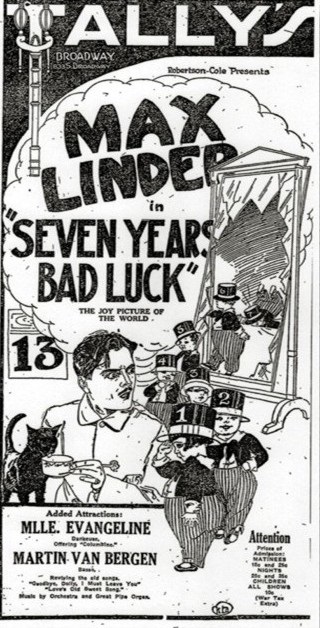
Next up was ‘SEVEN YEARS BAD LUCK’ (1921), perhaps Max Linder’s best feature. It’s now famous for having one of the best versions of that broken mirror routine, some 12 years before the Marx Brothers’ DUCK SOUP, but the whole film is most entertaining. David Robinson’s introduction paid a heartful tribute to Max’s daughter Maud Linder, who passed away last year. It was her zealous promotion of her father’s talents that has ensured he is still remebered today, almost 100 years after his death.
There was an extra Linder-shaped bonus in the form of ‘LES EFFETS DE PILULES’, or ‘LOVE AND GOOD FELLOWSHIP PILLS’. One of his French shorts, this was in a new restoration by Bob Geoghegan of the Archive Film Agency. Max is down in the dumps, and is prescribed the eponymous pills; they raise his spirits enormously. His wife also takes some, with even more vivid results: she’s soon launching herself at every man she meets in the street! Max is in hot pursuit, challenging each man to a duel! In the missing final sequence, all the men show up for a duel, but Max shares the pills around and all is forgotten. A great fun little short that shows how much more sophisticated Max was than his contemporaries.
Sophisticated was certainly not a word that applied to WE’RE IN THE NAVY NOW (1926). A vehicle for the team of gruff Wallace Beery and shrimp Raymond Hatton, this was a standard service comedy, basically a series of all-too-familiar blackout gags involving hammocks, scrubbing floors, peeling potatoes, etc etc. Still, perhaps audiences hadn’t seen it all 3000 times before in 1926; certainly the Beery-Hatton team were very popular, making 4 such service pictures that also took them through the army, air force and fire service. In fact, the commercial success of their teaming possibly inspired the Laurel & Hardy pairing. Certainly, the opening scenes in which boxer Beery is knocked cold and wakes up in the ring hours later was influential on the opening scenes of L & H’s ‘BATTLE OF THE CENTURY’. L & H, of course, made the situation much funnier by making the smaller member of the team the boxer, and added in Hardy’s exasperated camera looks to make something timeless. There was one superb gag in the original sequence though: Beery has landed on a chair when he is knocked out; when he finally comes round hours later, we see that he has been sat on a very crumpled Billy Bletcher the entire time!
Kevin Brownlow’s introduction admitted the failings of the film, and he recalled that he had offered director Eddie Sutherland the chance to view the film in later years. Sutherland repeatedly declined… ‘nuff said!
Next up was the return of Monty Banks, in a talkie! ‘SO YOU WON’T TALK’ (1935) is a rare sound starring vehicle for Banks, and is a wonderfully creative idea for a silent comedian: he spends most of the film unable to speak. This give him lots of opportunity for communicating in pantomime and sight gags. The reason is another one of those improbable inheritance plots –if he can go thirty days without talking, he will inherit a fortune – but it’s set up very well in the exposition; we get to meet the soon-to-be-deceased, a real grouch who is driven mad by his chatty, fortune-hunting family and understand his motivation for making the will. Banks is the family outcast, an incessantly talkative Italian waiter (a nice cover to make Banks’ strong Italian accent more acceptable to contemporary audiences), who staying silent will be a real challenge for. The build up to the will is quite slow, but it really sets the situation up well. Highlights of Banks’ silence include his attempts to mime what drink he wants, a wrestling match as the family attempt to find his birthmark, and Banks’ seduction by Enid Stamp-Taylor. A strong cast, including wonderfully dopey Claude Dampier, and snappy direction from William Beaudine, helped get lots of laughs from this film. If only more silent clowns had got to make a talkie like this. One can only wonder what Keaton might have done with the idea…
From talkies full of silence to silent filled with noise… it was time for some NOISY SILENTS! Hosted by masterful silent accompanist Neil Brand, this programme presented some of the silent shorts whose gags relied on noise. As well as Neil’s accompaniment, there was an orchestra of cacophony providing live sound effects ranging from kazoos and trumpets to ukuleles, squeakers, drums, car horns, pots and pans! A special shout out must also go to cellist Emily, who stepped in at the last moment and did a fantastic job. Her cello was an integral sound for Harry Langdon’s wonderful FIDDLESTICKS, a tale of Harry’s attempts to make a living busking. Lupino Lane’s SUMMER SAPS, a tale of a holiday from hell in a noisy boarding house, and Our Gang’s NOISY NOISES, both offered comedy of frustration and chance for some creative sound effects!
A selection of the sound effects for NOISY SILENTS…
We finished off in fine style with some audience participation for Laurel & Hardy’s YOU’RE DARN TOOTIN’, in which the pants-ripping finale was replicated through the ripping of newspapers placed under each chair in the auditorium. This programme was great fun, and a real variation on the usual silent film accompaniment. No kazoos were hurt during the screening of these films.
And just like that, it was time for the final show of the weekend. It was a fine finish, with a very special guest. Roy Hudd, one of the last links to the music hall and variety tradition, presented his favourite visual comedy clips, in conversation with Glenn Mitchell. This was a real treat; Roy was a fantastic, funny storyteller, and had real enthusiasm and knowledge for the old comedians. Among the highlights were clips from Tati’s MON ONCLE, Lupino Lane’s JOYLAND, and Roy’s own semi-silent film ‘THE MALADJUSTED BUSKER’. Finally, we concluded with a full showing of the complete ‘BATTLE OF THE CENTURY’. I’ve written about this film before, but it was as marvellous tonight as the first time I saw the ‘new’ footage; simply one of the iconic silent comedy scenes, now once again “as nature intended”.
As the lights came up for the final time, I felt incredibly lucky and grateful. Lucky that films like ‘BATTLE’ still exist, against the odds; luckier still that we are able to see them, especially with terrifically talented musicians and with informative introduction. Most of all, I felt lucky to be able to be able to share all this with other likeminded people in a warm and happy atmosphere. There’s a danger that watching old films in darkened rooms, sometimes alone, can become a very solitary hobby, but the chance to enjoy it as a shared experience, especially with the lovely folks at the Kennington Bioscope, is something else entirely.
Huge thanks to all the KB folk, especially to David Wyatt, who curated the event magnificently, and of course to Kevin Brownlow. Thanks too, to all the musicians and speakers. The Silent laughter events are something very special; here’s to the next one!

 It came! After weeks of waiting for Trans-Atlantic deliveries to return to normality, yesterday HARRY LANGDON AT HAL ROACH: THE TALKIES 1929-30 finally dropped into my mailbox.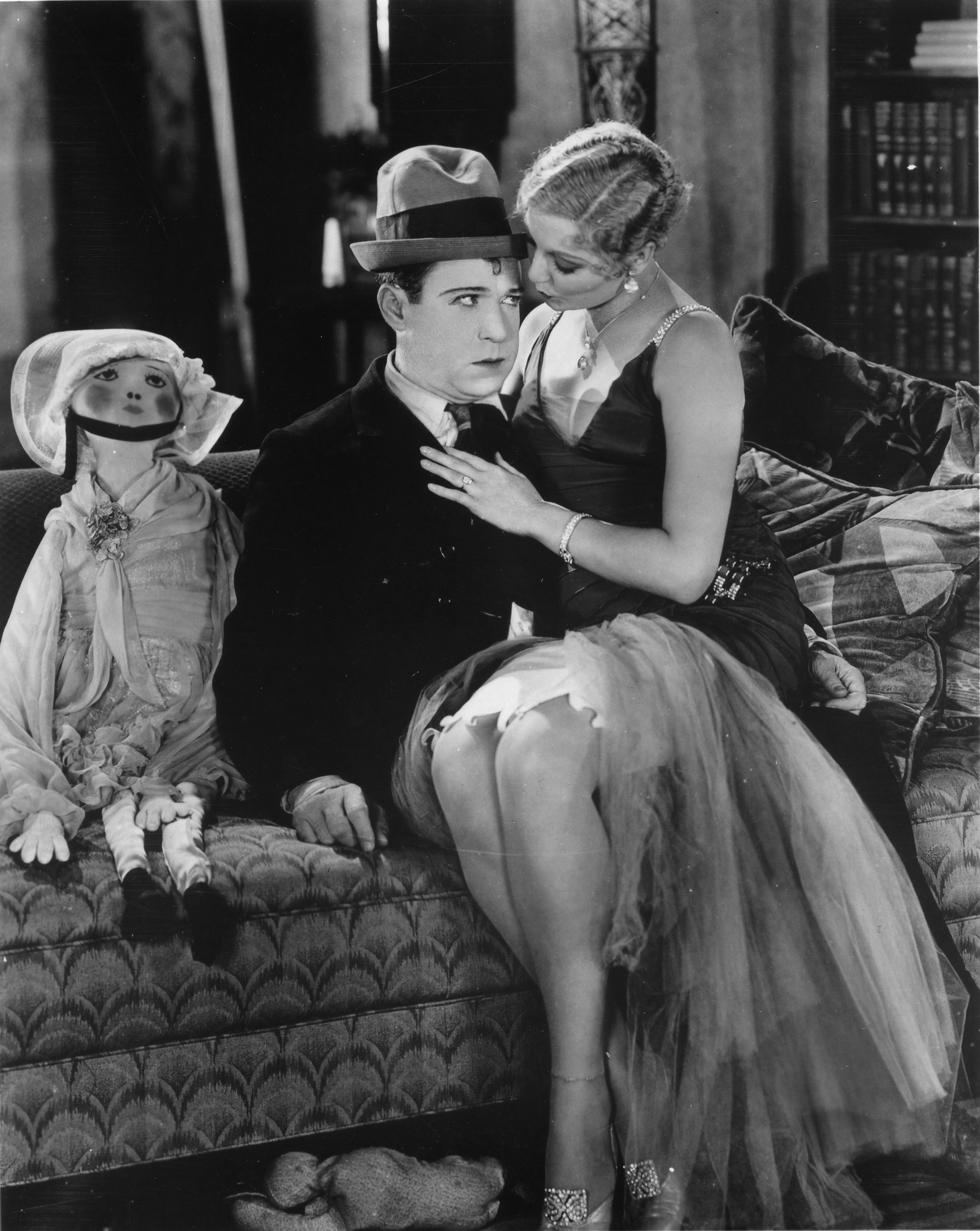
 Charley Chase has gone from being an under-represented figure on home video releases to having much of his classic work out there in superior quality. Thanks to DVD releases from Kino, AllDay Entertainment and Milestone films, a majority of his existing silent work can now be widely seen. In recent years, even his late sound shorts for Columbia have even been pulled from the vaults and released by Sony.
 Of course, the most famous supporting player to feature opposite Charley is the pip herself, Thelma Todd. Their partnership resulted in some absolutely charming comedies, of which THE PIP FROM PITTSBURG endures the most. This simple tale of Charley’s attempts to turn off a blind date, then trying to undo his work when it turns out to be Thelma, is elegantly told and full of great sight gags. As a fascinating extra, the Spanish phonetic version, LA SENORITA DE CHICAGO, is included. While it loses Thelma Todd, it gains an extra reel, including a song from Charley and some bridging scenes that actually make it flow much better than the English original (for more details on THE PIP FROM PITTSBURG and Chase & Todd’s other films together,
  LOOSER THAN LOOSE, a charming romantic situation comedy, where much of the humour is down entirely to the wonderful performances of the cast;
 On-screen, he is an odd creature to be sure; his slithery, amphibious movements inside oversized clothes and a bucket-shaped hat give him the appearance of a strange, giant newt. His saucer-shaped eyes and slow blink anticipate a little of Langdon, but nothing else indicates any real kind of character. HIS BUSY DAY, as its title suggests, was a fairly generic little trifle, with parks, pretty girls, pies and a lack of continuity: Toto steals a pie, dresses as a woman to escape a policeman, gets a job as a newsreel cameraman for a bit, then gives it up after he angers the newsreel proprietor (Bud Jamison). Even allowing for some missing footage, this was clearly a fairly run of the mill effort. Toto did have good timing however, as the highlight of the film showed: a scene where he hides from Bud Jamison behind a pivoting wooden sign, at one point attaching himself to it in the splits position! Ultimately, Toto’s biggest contribution to film comedy was in leaving films, thus opening the door for Roach to hire a young Stan Laurel as his replacement.
 of independent comedies and also working as a director. ‘SWEET DADDY’ was a simple tale of a henpecked husband who seizes his hour of freedom when sent out for the groceries, but it was full of some great gags, and snappily directed by Perez. Particularly there was a charming sequence in which he gazes at a girl on a poster, who seems to come to life and flirt with him. Perez’ career was sadly coming to an end; cancer cost him a leg in 1923, and while he continued as a director, the illness returned and took his life in 1928. Nevertheless, he was obviously a real talent, and it’s been mainly due to the efforts of Steve Massa and Ben Model that we’re able to see his films again: they’ve put together
 Next up was ‘SEVEN YEARS BAD LUCK’ (1921), perhaps Max Linder’s best feature. It’s now famous for having one of the best versions of that broken mirror routine, some 12 years before the Marx Brothers’ DUCK SOUP, but the whole film is most entertaining. David Robinson’s introduction paid a heartful tribute to Max’s daughter Maud Linder, who passed away last year. It was her zealous promotion of her father’s talents that has ensured he is still remebered today, almost 100 years after his death.

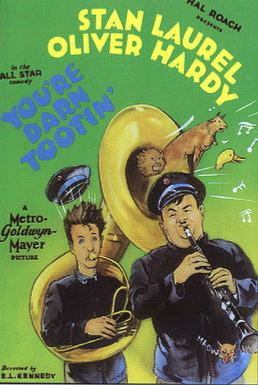 We finished off in fine style with some audience participation for Laurel & Hardy’s YOU’RE DARN TOOTIN’, in which the pants-ripping finale was replicated through the ripping of newspapers placed under each chair in the auditorium. This programme was great fun, and a real variation on the usual silent film accompaniment. No kazoos were hurt during the screening of these films.
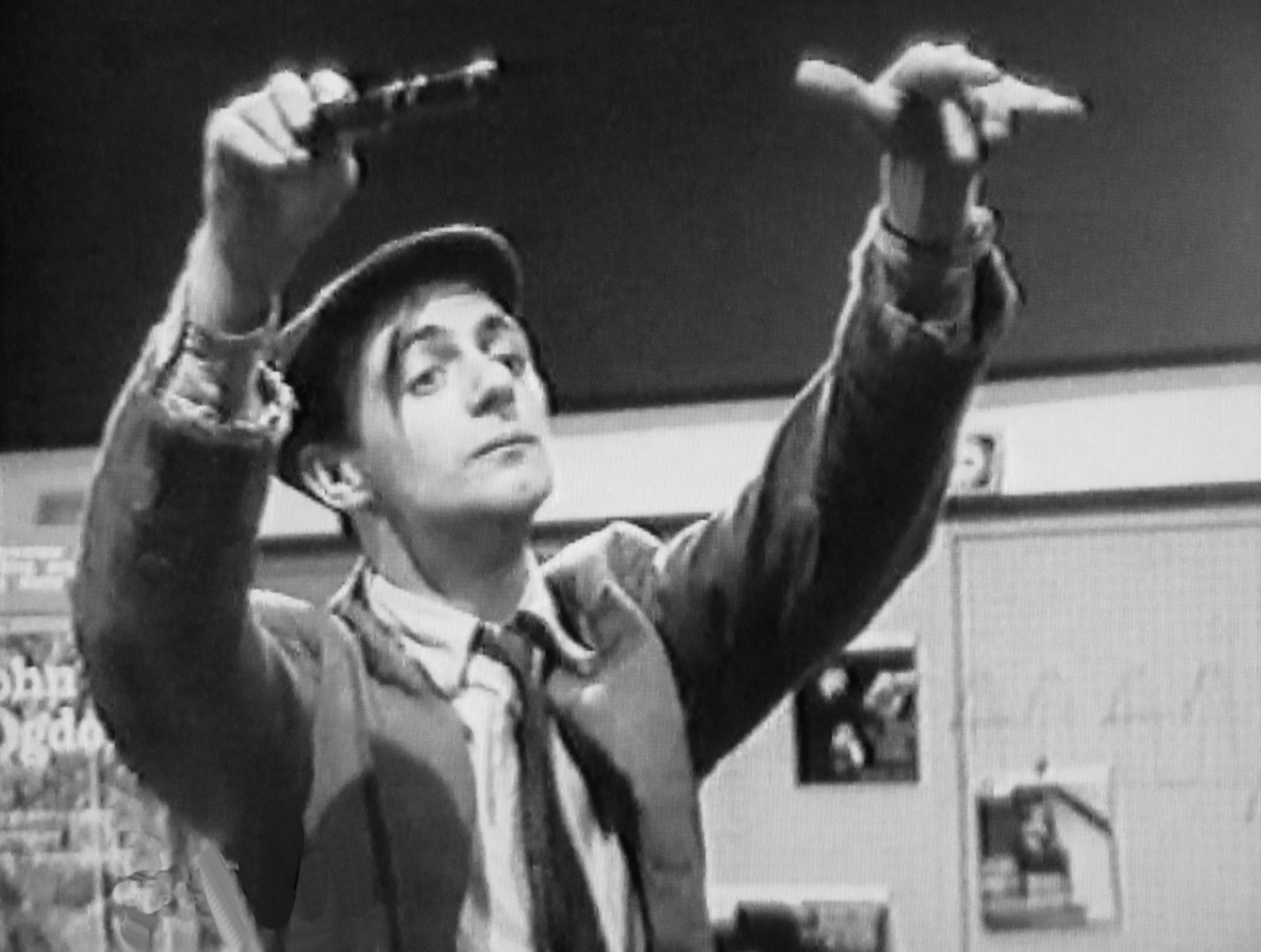 knowledge for the old comedians. Among the highlights were clips from Tati’s MON ONCLE, Lupino Lane’s JOYLAND, and Roy’s own semi-silent film ‘THE MALADJUSTED BUSKER’. Finally, we concluded with a full showing of the complete ‘BATTLE OF THE CENTURY’. I’ve written about this film before, but it was as marvellous tonight as the first time I saw the ‘new’ footage; simply one of the iconic silent comedy scenes, now once again “as nature intended”.
 The Lost Laugh