Standing on the shoulders of Munchkins, and walking in the steps of Comedy Giants in Culver City…
Culver City is a pleasant district to the South West of Los Angeles, not far from LAX airport. Not one of the tourist hotspots of L.A, it barely registers in guidebooks, but to classic comedy fans it is a special place of pilgrimage. Once home to both MGM and the Hal Roach Studios, it was the birthing pool of countless treasured films.
Nucleated around Culver and Venice Boulevards, Culver City was founded by Newspaperman Harry Culver in 1917. Thomas H Ince established the first studio there in 1918, followed by Hal Roach a year later. Most prestigiously, The Goldwyn studios were built in the early 20s, and later inherited by MGM. This behemoth of a studio survives, given a new lease of life as Sony Pictures Studios. It is even open to the public for daily tours.
‘THE LOT OF FUN’
Unlike MGM, Hal Roach’s elegant white wooden-fronted studio has not survived. It was torn down in the early 60s and now nothing remains. Yet, paradoxically, more of the spirit of the ‘Lot of Fun’ remains, in the streets and buildings of Culver City. While MGM’s stars generally remained cloistered on studio sets, Roach’s film-makers took every opportunity to film out on the streets. Time and time again, recognisable landmarks pop up as backdrops to the comedic action: the pie-slice-shaped Culver Hotel, the squat store-fronts of the buildings, the wide intersections where mayhem takes place. All of these, clean and sunlit in the then brand new suburb, become almost as recognisable as the bit part players, offering a comfortable familiarity to the viewer and a continuity to the films.
Until last Summer, I had never been there before, but yet I felt I knew the place already. While passing through LA I had to make a visit to this magical place home to so much laughter in the films I’ve grown up with and still love. Of course, I was prepared for disappointment. Surely time would have warped the streets beyond all recognition, the love and laughter put into the films long since departed…
Well, happily I was wrong. Naturally many things have changed, but these are still recognisably the same locations immortalised on film. What helps is that, despite having the whole of Los Angeles as a playground, the Roach film makers were particularly fond of a small handful of streets. This means that we have seen these locations countless times, from all angles. Best of all, it is this handful of locations that have remained the most unchanged. Unlike the scuzzy downtown locations favoured by Chaplin, Keaton and Lloyd, Culver City is also a very pleasant part of L.A. Recently it has been promoted as an art and food quarter, and makes very pleasant strolling. The traffic lights even emit a ‘kuku’ noise when it is safe to cross! Coincidence…?
Washington and Venice boulevards divide at the heart of Culver City, moving apart in a ‘V’ shape. Between them lies Main Street, a short road lined with storefronts, trees and alleyways. Main’s intersection with Washington is spacious; on the southeast side sits the elegant Culver Hotel. This small collection of roads and buildings formed the bulk of backgrounds in Roach films. The use of these locations reaches its apex in the MGM silents from 1927-29. Though many earlier and later films also used them, this particular run of films all seemed to feature crowds gathering on streets, to watch a Max Davidson dilemma, Charley Chase embarrassment or Laurel and Hardy fracas. Pick any Roach silent from this time and you can pretty much play Culver City Bingo!
Main Street, with its single storey shops, very much gives the appearance of a small town high street. Anytime street scenes were required that weren’t filmed on the backlot, they were usually filmed here. Laurel and Hardy’s bootlegging plans are made here in ‘PARDON US’, as are their attempts to busk on street corners. The Max Davidson films ‘DUMB DADDIES’ and ‘THE BOY FRIEND’ also make prominent use of the street, as does Thelma Todd’s ‘ON THE LOOSE’. In between the shops are alleyways, a staple of slapstick chase scenes. One of the alleyways on here was the scene of L & H’s infamous pants-changing in ‘LIBERTY’, and also appeared in their pre-teaming short ’45 MINUTES FROM HOLLYWOOD’.
Many times, this one little street was shot from different angles and made to represent a whole host of different locations in one go. ‘PUTTING PANTS ON PHILIP’ is one of the most notable examples of this; L & H’s adventures all over town are actually a merry dance up and down the same short length of street! The presence of the Culver Hotel is a giveaway to this. Looking out for the looming building is a key to spotting scenes filmed on Main Street. In ’45 MINUTES FROM HOLLYWOOD’, a tourbus heads down this way, as do the open topped buses in Chase’s ‘THE WAY OF ALL PANTS’ and, again, ‘PUTTING PANTS ON PHILIP’!
The Culver Hotel, built in 1923 by Harry Culver, was the focal point of Culver City, and remains so today. It’s elegantly austere exterior meant it could stand in for civil buildings, an office block or fancy restaurant, as well as a hotel. It’s even a dentist’s office in ‘LEAVE ‘EM LAUGHING!’. The unusual shape means that it also had entrances on the corners. This made quite a visually arresting, ‘clean’ space to film a scene, with little in the background to distract. Charley Chase’s wedding, in ‘LIMOUSINE LOVE’ , for instance, takes place here. The hotel’s ‘island’ status, surrounded by roads, adds to the plot as Charley drives around and around it, unable to stop because of the naked woman in his car!

OLYMPUS DIGITAL CAMERA

OLYMPUS DIGITAL CAMERA
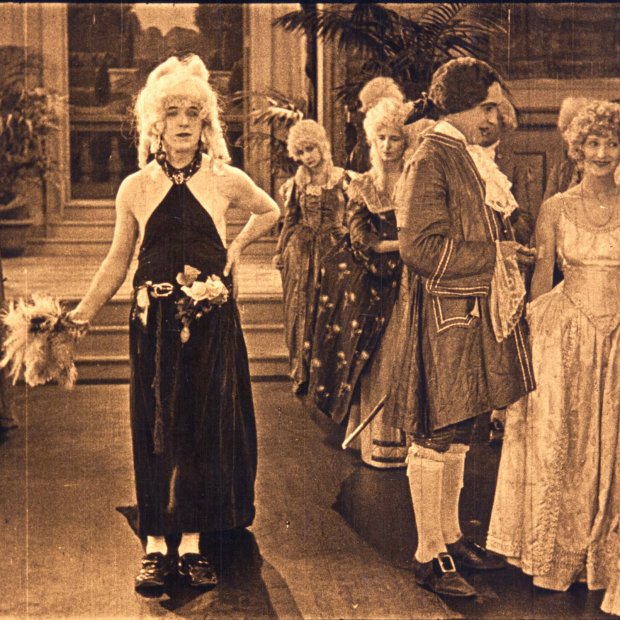
The back entrance, on is also the entrance where Laurel begins chasing Dorothy Coburn in ‘PUTTING PANTS ON PHILIP’, as seen in the still below. Into the Talkie era, the hotel seemed a natural taxi pickup point for ‘THE TAXI BOYS’ in films like ‘HOT SPOT’ and ‘BRING ‘EM BACK A WIFE’. The hotel also played a key role, albeit offscreen, in later film history. When ‘THE WIZARD OF OZ’ was filmed at MGM in 1939, it became living quarters for the Munchkins, who famously held debauched parties here!
With the hotel in the background, the Washington-Main intersection is where crowds all gather in the famous scenes from ‘PUTTING PANTS ON PHILIP’.
http://www.dailymotion.com/video/x24v7vf_putting-pants-on-philip-b-w-1927-laurel-hardy_shortfilms
Washington itself, busier and more recognisably metropolitan than Main Street, is featured in a number of car chases – ‘THE TAXI BOYS’ films, notably, and Chase’s ‘THE COUNT TAKES THE COUNT’. Walk a little further southwest, and you come to the site of the Culver City Hall. This was disguised as a courtroom in L & H’s ‘GOING BYE-BYE’, and was the eponymous ‘COUNTY HOSPITAL’. Sadly, the original was demolished, but an impressive replica façade has been erected in the exact same spot.
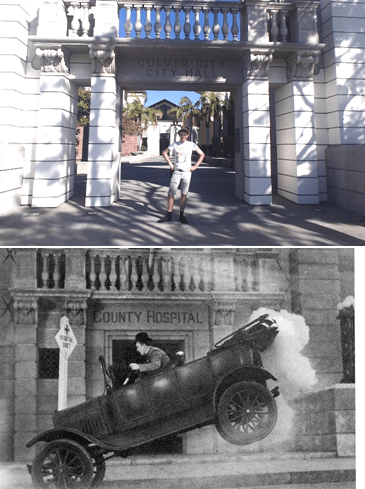
A replica facade stands on the spot of the former Culver City Hall, once ‘COUNTY HOSPITAL’.
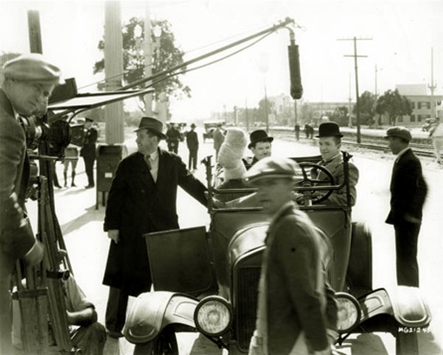
Filming ‘COUNTY HOSPITAL’ at the same spot.
So many films took place in this little area that it is impossible to list them all. Indeed, I struggled to even process them all while there. While the Music Box Steps in Silverlake are justifiably iconic, allowing you to follow in L & H’s footsteps, Culver City is actually a much more immersive experience. My favourite thing about standing in the spots where my heroes stood was not the chance to do a copycat photo, but to look out at the view they would have seen as they filmed. Suddenly, they weren’t confined to frames of film. The disappeared scene around those frames filled out; I could see the colours, hear the noise of traffic, feel the heat of the California sun. I imagined Stan Laurel or Charley Chase briefing the cameraman on the angle they wanted, then walking back to take their position, ready to be immortalised. I imagined the halted traffic on Washington Boulevard, or the crew walking back down Main Street, satisfied with a funny scene. Perhaps they conferred on this street corner, or under the shade of that awning, shaping the scenes that we now know and love. In such a well-filmed part of town, surely each corner had some part to play. If you use your imagination, you can step back in time in Culver City, and imagine you are part of it too.
Alas, time has marched on, and the Lot of Fun is long gone. So too are the laughter-makers, and in their places only the naked streets remain. The secret of Hal Roach studios was never in these streets themselves. There’s no magic in the humdrum concrete, no secrets in the fabric of the walls. But, on these pleasant yet unremarkable streets, a crowd of immensely talented people passed by briefly to weave their dreams. They congregated daily, on a mission to create laughter. On the plain concrete and through dark alleyways, in the shadow of that big hotel, they did so, giving of themselves to make audiences forget their troubles. Almost 100 years later, new audiences are still doing so in their company. The people responsible have long since gone, but they transcended these everyday streets into a place that feels special, an inventory of happy memories and smiles. Now, that is magic after all…