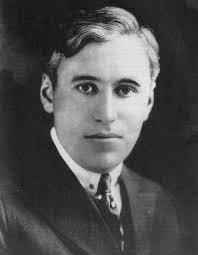
Mack Sennett: still the King of Comedy?

images5O4IAPI9

January 17 marked the 136th anniversary of comedy producer Mack Sennett’s birth. Sennett’s name is instantly evocative of the golden age of comedy, and of slapstick film making in particular. He was a true trailblazer in the field, opening the first dedicated comedy studio, and for 20 years creating an anarchic vision of chaos to become the self-styled “King of Comedy” (the name of his memoirs). This went unchallenged for many years, but is Sennett still the rightful owner of his royal title? The recent silent comedy revival has, in fact, tended to overlook his studio‘s efforts. Books and documentaries have focused on the iconic faces of big name comedians rather than producers, and if the subject does come up, Hal Roach is usually the first name mentioned.


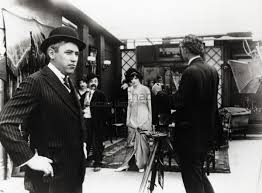
The Roach and Sennett styles present an obvious contrast. Roach films focused on characterisation, pausing to reflect on humanity’s foibles. Sennett’s style was anarchic, freewheeling, joyously madcap; a whirlwind of cross-eyed and moustachioed men racing like flesh cartoons through explosions, log cabins and frenzied car chases in a dazzling display of inventive visual gags. Roach allowed the individual to flourish; Sennett star comics were subsumed into the fast-paced madness. True, more individual personalities like Chaplin and Harry Langdon worked for Sennett. Significantly though, they got the best opportunities to develop their characters elsewhere. Roach films organically developed a story that could happen; at Sennett, continuity and common sense were trifling matters to be swept aside as long as something funny was happening.

Of course, this is a sweeping generalisation that can’t be totally accurate for hundreds of films; there was some overlap between the two styles but, on the whole, it is a fair comparison.  I must admit that my personal preference has always been for the Roach style, but why should there be only one way to make a comedy? Modern preference for the subtler side certainly doesn’t mean that Sennett should go unmentioned. People spend so much time comparing and choosing between Chaplin and Keaton, Beatles or Rolling Stones, sweet or savoury, and so forth. It isn’t really productive and misses a key point; one of the joys of silent comedy is the infinite number of variations on a theme. Watch Laurel and Hardy wreck their car as a result of carefully built squabbling arising from their characters; then watch Billy Bevan do the same in a series of dazzling stunts in a Sennett film. Both scenes are fun and the fact that two different approaches could exist is what makes silent comedy such a bubbling pool of inspiration.

In recent years we have, I think, come to place more value on character and story when we evaluate silent comedy. Partly, this is a defensive reflex. No longer widely seen on television, silent films easily slip into annoying, lazy stereotypes in the human consciousness. As anyone who has seen ‘THE GENERAL’, ‘LIBERTY’ or ‘THE KID’ knows  those under-cranked pastiches accompanied by tinny piano are way off the mark. But how many people have seen the inspiration of these films? To try and stand up for slapstick, we focus on its most sophisticated elements – the satire, the production values, the carefully developed characters – when presenting it to an often indifferent and hostile world. Ergo, we play up Chaplin, Keaton, Laurel and Hardy and Charley Chase, and play down Ben Turpin, Keystone madness and Del Lord’s car chases.
imagesCWONNIOV

I don’t think this emphasis is always so conscious though. Laurel and Hardy, Chaplin and Keaton have all been on TV in recent years. From a personal point of view, I was introduced to them all in this way, and then went on to buy videos and DVD as a result.

Until the recent centenary celebrations on TCM, when was the last time a Mack Sennett comedy was scheduled on TV? Or available in any extensive form on home video? Until recently, Sennett films had dropped out of sight, denied the restoration that they deserved.

Significantly, Sennett’s profile was much higher when Silent comedy last had a boom, in the 1960s. The difference is that, then, Sennett films were seen in the Robert Youngson compilations, in series like ‘COMEDY CAPERS’ and ‘THE FUNNY MANNS’, and on their own account on TV. It must be said, that perhaps a change in our sampling methods has had something to do with it. We’re fortunate now to be able to seek out complete versions of these films in nice DVD prints and at cinema showings. Compilation films sampling short clips and highlights from many films have dropped out of favour, yet they are probably the best way to see Sennett films. As Glenn Mitchell remarked in his ‘The A-Z of Silent Film Comedy’, they are often schizophrenic and look better as clips than in their entirety. Retrospective samplings enable all the strong points to be seen, rather than in more diluted form, exposing the weaknesses in plot. When you look at the whole film, one often comes away having laughed heartily for 20 minutes but with a feeling that the film was somehow unfinished, or disappointing as a narrative.


However, the more you think about this modern, revisionist way of thinking, the more illogical it becomes. Think about more recent comedy; Sketch shows move from one unrelated scene to another.

Spike Milligan, who grew up on visual comedy, essentially created a verbal version of the Sennett world in ‘THE GOON SHOW’, later recreating it on TV in his ‘Q’ series. The MONTY PYTHON films move abruptly from one unlikely dream to another. More recent comedies like ‘THE MIGHTY BOOSH’, ‘FATHER TED’ and ‘FAMILY GUY’ are all about surreal, randomly motivated plot points and are loved for it. Comedy has become edgy. Well, Sennett’s films were pretty edgy. Lest we forget, to portray policemen as Sennett did in the 1910s was little short of anarchy! Even by modern standards, there’s much that is pretty edgy throughout his oeuvre. There’s black humour (stuntman Ben Turpin left to drown by his indifferent coworkers when it’s their lunch break, Billy Bevan accidentally blowing up a dog), surrealism, gags about futuristic technology (regular allusions to TV as early as the 20s) and gags that are risqué even now.
images1S3JAFHE

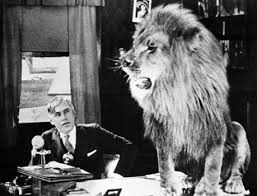
Sennett may have had to move over from his sole position as ‘king of comedy’. His standards of storytelling may have not been consistently up to Hal Roach’s, or have dated as well, but amidst the Sennett catalogue are classic films, and many brilliant, iconic gags that still entertain and surprise. His studio designed the template for silent comedy. Others may have taken it to greater heights, but the landscape would have been very different without its founding fathers. Let Chaplin be king of pantomime and Roach be the king of situation comedy, but we must not overlook Sennett as king of the anarchic gag. It’s great to see that Bristol’s Slapstick Festival is paying tribute to Sennett this year; in the meantime, here’s my pick of some of the best of Sennett…


A SMATTERING OF SENNETT…

I’ve chosen a handful of Sennett films that, I think, show Sennett’s studios at their mad, king of comedy peak. These aren’t necessarily the very best films to come out of the studio, but they are some of the ones that I think best exhibit elements of the Sennett house style. For that reason, there’s no Chaplin, Arbuckle etc, and only a smattering of Langdon…


THE DAREDEVIL (1923)
ben_turpin

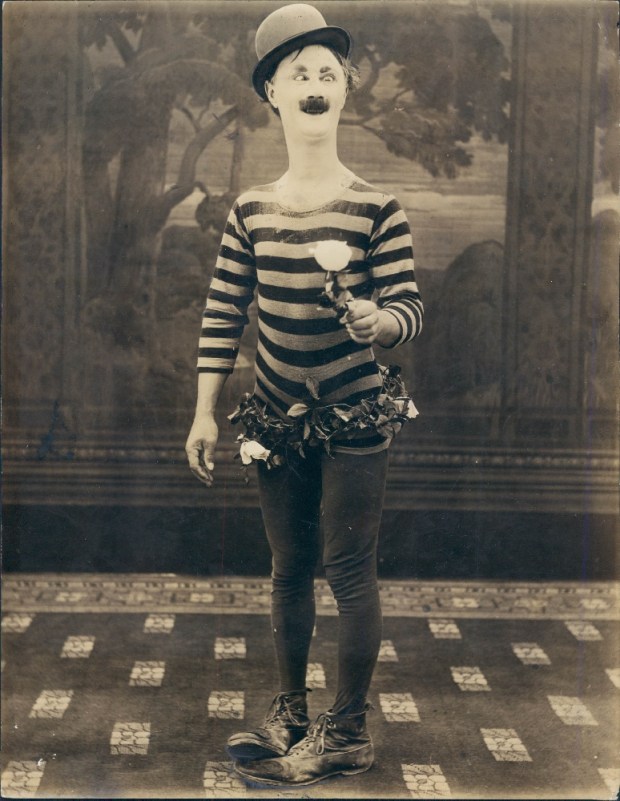
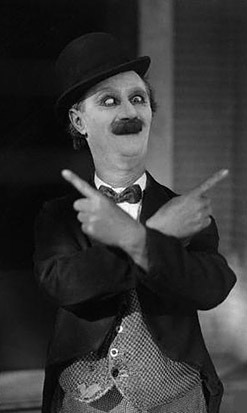
Ben Turpin is a physical embodiment of the Sennett style; zany, unbelievable and prone to extreme slapstick. The Sennett gag team used this to their advantage by casting him in melodramatic settings. To write a Ben Turpin scenario, all one really has to do is place him in a situation where he looks ridiculous (and of course, the beauty is that he looks ridiculous pretty much anywhere!). This reaches its apotheosis in ‘THE DAREDEVIL’ as he plays a stunt double in the movies… How could Ben Turpin double for anyone?! It’s a glorious joke, and with this premise in place, the Sennett gagwriters have a field day. Ben is constantly forgotten about in the middle of stunts by his careless film crew; cruel, surreal Sennett humour at its finest.

SUPER HOOPER DYNE LIZZIES (1925)


Another key ingredient in the Sennett cauldron of madness was the use of crazy car chases and gags. Director Del Lord made this his specialty, and here the subgenre reaches its zenith. This film contains the classic sequence where Billy Bevan pushes his broken down car up a hill, oblivious to the fact he has bumped into, and begun pushing, a whole line of parked cars. This film is let down by some standard scare comedy stuff (and a couple of extremely dubious racial gags) in the second reel, but the first reel is top notch stuff.

HIS MARRIAGE WOW (1925)

Harry Langdon’s work only really flourished when he managed to replace the Sennett style with his own brand of delicate pantomime. However, on occasion, the over the top madness actually formed an effective backdrop to Langdon’s style, making his quiet talent even more apparent. This film, while not his funniest, shows the stylistic contrasts meshing nicely. In a runaway car with Vernon Dent, this could have easily become another Del Lord gagfest, but Langdon shifts the focus of the scene from the chase itself to his helpless reactions.

WHISPERING WHISKERS (1926)
bevanclyde

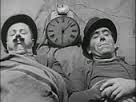
Some of the best and best-known Sennett films are the mid-20s series teaming his regulars Billy Bevan and Andy Clyde as a couple of hoboes. This one contains the classic gag where the pair are asleep on the railway tracks, but have set their alarm for the precise time where they need to roll over to avoid the oncoming express train. Plotwise, it falls into the standard “one title card to explain a complete change of location and plot” Sennett cliché, but the individual gags are of such high quality there’s not too much time to grouch.


FLIRTY FOURFLUSHERS (1927)

THE BEST MAN (1928)

Two films that show Sennett could adapt his style to the sophistication of the late 20s. The former features Billy Bevan and Madeline Hurlock as two everyday folk who pretend to be rich in order to hook themselves millionaires; of course, they end up wasting their time trying to chase each other! It’s a snappy proto-screwball comedy that relies on situation to pull it through, and the commitment to the new era is shown by the drastic step of removing Bevan’s prop moustache! Without it, his plump, partridge-like face is revealed, wearing a startled expression that befits a man who probably hadn’t seen his top lip in years…

‘THE BEST MAN’ is perhaps the best of the late 20s Sennetts. It has Bevan as hapless, obnoxious best man to nervous bridegroom Vernon Dent. Dent is an unsung hero of the Sennett films, and his underplayed frustration is a beautiful contrast to Bevan’s antics losing the ring, destroying Dent’s suit and setting fire to the bridal suite. The chaos in these scenes builds naturally, and is all the more funny for it; as Simon Louvish said ‘Stan Laurel couldn’t have done a better job’. Incidentally, the similarity to the Hal Roach style is carried further by the use of Culver City locations.

SPEED IN THE GAY 90s (1932)

Who says Sennett couldn’t do talkies? This Andy Clyde short revisits the Sennett car chases of yore, adding an extra humorous dimension by shifting the setting to the early days of motoring. There’s plenty of potential for gags based on the primitive cars, and there are some nice, bizarre extra touches, such as Andy designing a bird-man costume, and absentmindedly walking around still wearing it while going to meet the mayor. The period setting also helps to keep the film from seeming as dated as many other early talkies.


THE FATAL GLASS OF BEER (1933)

W.C. Fields’ four sound shorts are the best known of Sennett’s talkie shorts, and this faux-melodrama is the most off-the-wall. Sennett himself actually hated this short and tried to veto it being made, so you might think it an odd choice to include here. However, when you look closely, it actually dovetails nicely with the absurdist Sennett style. The studio’s comedies had a long, proud heritage of parodying melodrama that went right back to the Keystone era; this reached it’s apotheosis in the ridiculous Ben Turpin parodies. ‘THE FATAL GLASS OF BEER’ is a clear stylistic cousin of these films, especially Turpin’s frozen north parody ‘YUKON JAKE’.


Coming this weekend to Bristol’s Slapstick Festival…

Mack Sennett: King of Comedy. Bristol Watershed, Friday 22nd January at 11.30

David Robinson* film critic, author and Chaplin’s official biographer will be celebrating the mastermind of early slapstick comedy, the actor and producer, Mack Sennett. David will take you on a journey through his best comedy shorts from the 1910s and 1920’s featuring amongst others Charlie Chaplin, himself and the hilarious Keystone cops . With live accompaniment by John Sweeney on Piano.

With live accompaniment by John Sweeney on Piano.


Ben Turpin: improbable facts about Silent Film’s most improbable star


ben_turpin

Of all the silent comedians, none was more bizarre looking than Ben Turpin. The antithesis of Chaplin, Keaton and Lloyd’s realism, his equipment – crossed eyes, scrubbing brush moustache, and long neck with globular Adam’s apple – made him almost totemic for silent comedy’s wilder, more surreal side. In fact, when James Agee wrote the 1949 ‘Life’ magazine article that inspired the first serious silent comedy revival, it was Turpin’s mug that adorned the cover. That Turpin could not just become a star, but join the company of ‘Life’ cover stars including (at that point) Eisenhower, Rita Hayworth, Marshall Tito and Stalin is just one of the many improbabilities in his career. In fact, his whole screen career was based on unlikeliness: many of his funny films have him wonderfully out of place masquerading as Rudolph Valentino or Erich von Stroheim!

Here are  a few other unlikely truths about this living gargoyle..

1. Turpin was actually of French parents, although born in New Orleans. In his sound  films, you can detect the hint of an accent.

tumblr_lh24gnGSX81qa70eyo1_1280

2. His eyes were genuinely crossed. At the height of his fame, Turpin famously had his eyes insured by Lloyd’s of London as a publicity stunt.

3. Various stories circulated regarding the source of his miasma. The simple truth is much less exciting: after playing the cross-eyed character ‘Happy Hooligan’ in vaudeville several times a day, he found that one day, his right eye was stuck in position as a result of the repeated strain.

4.Turpin had an extremely restless spirit. He voluntarily became a hobo as a young man, choosing to ride boxcars in preference to finding a job. He did so for several years.

5.After finally settling with a variety of menial jobs, he played in vaudeville before being signed up by Essanay studios. Stardom? Well, not quite. Although he acted in films during the day, he was also required to sweep out the studio, collect props and box up films for shipment!

6.Ben allegedly took the first on-screen pie in the face, in 1909’s ‘Mr Flip’.


7. Behind his two-dimensional façade, it’s sometimes hard to recall his real life struggles: he dropped out of acting at the peak of his stardom to nurse his terminally ill wife, Carrie.

benturpin

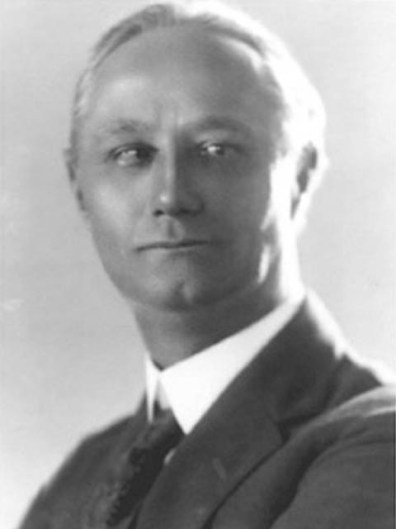
The offscreen Turpin. Almost dapper.


8. Well into his 60s, he was a master of the perilous ‘108 fall’, involving kicking a leg up into the air, turning a somersault and landing on the floor. He would apparently often do it in random places around Hollywood, often accompanied by a cry of “I’m Ben Turpin -earn 2,000 dollars a week!”. Fellow comic Lupino Lane once recalled seeing Turpin stop traffic in the middle of Hollywood Boulevard to do his trademark fall! You can see him do it (alongside Lane, coincidentally) a few minutes into this sketch from ‘The Show of Shows’:


You can catch Ben Turpin’s films at Bristol’s Slapstick festival next week.

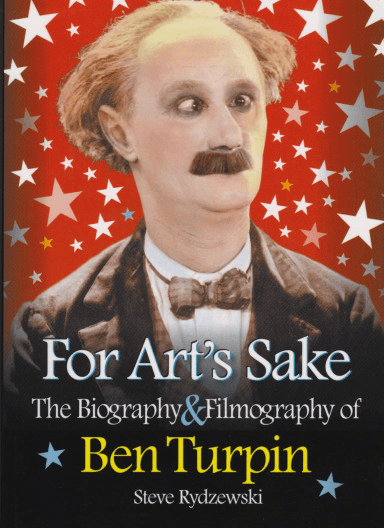
To find out more about his fascinating life, there’s also a great book available (click picture for link):

untitled

Harold Lloyd: in praise of ‘SPEEDY’

sppedy ad

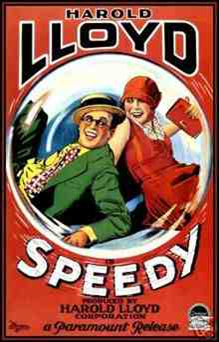
Harold Lloyd’s ‘SPEEDY’ is not an obscure or rare film, but one that manages to be consistently overlooked. It was Lloyd’s last silent film. As Harold ‘Speedy’ Swift, he’s a baseball fanatic who can’t keep his mind on his work long enough to stay in a job for more than a day at a time. Eventually, he gets work driving his girl’s grandfather’s horse-drawn tramcar, just as the big railroad company tries to force it out of business. The tram must run once a day to keep its franchise, and Speedy is charged with keeping the service running, despite all the big company’s attempts at sabotage. He manages to overcome all the obstacles to save the day, allowing Grandpappy to sell the line at a profit.  Alongside all his other classic silent features, it’s often overlooked. Alright; it probably isn’t his best film – there’s nothing as iconic as the building climb in ‘SAFETY LAST’ here, and the story isn’t as evenly sustained as in ‘THE KID BROTHER’, but personally, it’s my favourite of all Lloyd’s films.

So, what sets it apart for me? Well, first of all, SPEEDY has a rather different quality to many of his other films. Most of the other Lloyd features fall into two groups; the first, including ‘THE KID BROTHER’, ‘DR JACK’ and ‘GIRL SHY’ are based in small, rural towns. The other, more Metropolitan films, are comedies of jazz age city speed and thrills, like ‘SAFETY LAST’ or ‘FOR HEAVENS’ SAKE’. These all take place in the metropolis of Los Angeles, although it is never explicitly stated. ‘SPEEDY’ on the other hand, has a definite geographic setting, on the opposite coast. It specifically takes place in New York, with landmarks like the Yankee Stadium and Coney Island integral to the film’s plot. It even features real life baseball star Babe Ruth as himself. Neither before nor since in Lloyd’s career was the fantasy quite so inextricably linked with reality.

Picture1

Most unusually for Lloyd, his character has already won the girl before the film starts; he’s confident and self-assured, and so we get a change from the usual ‘weakling has to impress girl by making a man of himself’ plot. While Harold still gets to save the tramcar and succeed in making a fortune, the plot is a bet less contrived than in some of the others. In fact, his relationship with Ann Christy is probably the most realistic and genuine of any of his films, having a real, winsome charm to it.   Their scenes at Coney Island are one of the highpoints of the film, and there is a lovely little scene where they catch a lift back to town in a furniture van, setting up home and dreaming of the future during the ride back.

This charming quality applies to the film as a whole; the outdated streetcar is matched by the now-vanished Coney Island funfair scenes, always a highlight. From here, through backstreets of New York, to hot dogs, yellow taxi cabs and baseball, Lloyd celebrates icons of Americana. None of his other films reflect the title of his autobiography, “AN AMERICAN COMEDY”, quite so well. With the passing of time, this has taken on an even greater nostalgic quality. Indeed, the whole film is permeated by an atmosphere of celebrating the old ways as the modern world changes everything. Is it just a coincidence that this is the film that Lloyd was making as Sound technology threatened to change the movie industry and the careers of the silent comedians beyond all recognition? (As a footnote, It’s interesting that Keaton’s last independent silent, ‘STEAMBOAT BILL JR’, also celebrates an obsolete form of technology).

Truthfully, ‘SPEEDY’ is somewhat haphazardly constructed, but there are lots of high spots, with Harold’s continued failed attempts to hold down a job provide for plenty of good gag sequences. The best is probably his short-lived career as a taxi driver, which even includes a cameo by Babe Ruth! To top it all off, there’s a classic Lloyd chase through the streets of New York, as he races to the finish line, driving the streetcar like a chariot. Lloyd later recalled how an accident when he crashed the streetcar was worked into the film, a brilliant example of the fluidity and spontaneity of silent technique, soon to be lost with the crushing rigidity of the talkies.

SPEEDY is a real charmer, and a fine way to draw the curtain on the silent era. Lloyd’s next film, the talkie ‘WELCOME DANGER’ is best forgotten. I prefer to leave him at the high point of SPEEDY, racing his streetcar to the finish line.

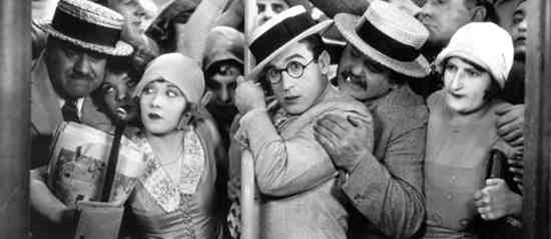
Here are a couple of my favourite scenes. First, Harold’s trip on the subway…

… and two icons of Americana together: Harold meets Babe Ruth…

DVD review: Captain Bill (1935

Another rare British comedy released by Network DVD…

image.jpg

CAPTAIN BILL.

Directed by RALPH CEDER. Starring LESLIE FULLER, with Georgie Harris and Hal Gordon.Released November 1935.

In the 30s class schism in comedy, rubber-faced Leslie Fuller found himself firmly on the working class side. Finding his fame in concert parties, especially in the seaside town of Margate where he made his home. His usual character, Bill, is well-meaning, if a bit gauche and clumsy, occasionally prone to gruffness and ready for a fight. In fact, he gives the impression of being an everyday Cockney bloke, the type who might spend his holidays at Margate, for instance. Perhaps no other performer better reflected his audience, and in holding up the mirror to them, Fuller won huge stardom. He was even described as “Elstree Studio’s answer to Clark Gable!”. That’s pushing it a bit, but there is certainly something charming and realistic about him, and while ‘Bill’ seems fairly effortless, I suspect he actually took much greater skill to play.

Much the same homespun, effortlessness went into his film career: Fuller churned out films in seemingly less time than it takes some people to digest meals. ‘Captain Bill’ was one of three comedies he made in 1935. Inevitably, it shows. It is the only Fuller film I’ve yet seen, although I reckon it’s fairly typical of his vehicles.

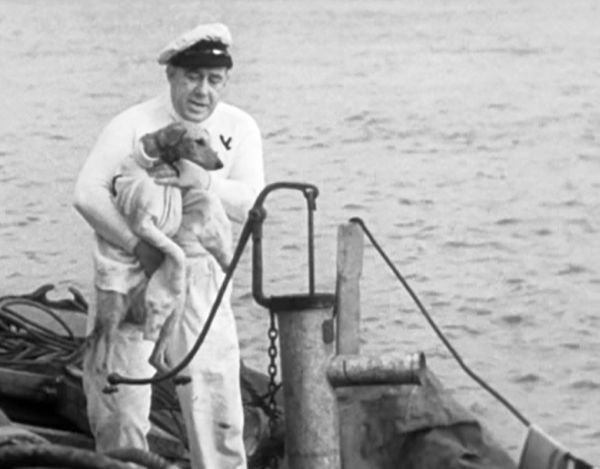
As the title suggests, Bill is plonked into a boat setting, running a barge on the Thames. Again, it’s something any of his audience could relate to – in his own way Fuller was as regionally minded as any of the Northern performers like Frank Randle. He has an inept crew of cabin boy Georgie Harris (a regular sidekick) and droopy old sad-sack D.J. Williams. In a way, the trio are a ragged foreshadow of the films soon to be made teaming Will Hay with Moore Marriott and Graham Moffatt. Although far less amusing, they certainly have their moments.

The first scenes are strung together with little consequence; few of them seem to take much responsibility for forwarding the plot. It’s more like a day in the life of Captain Bill, detailing the crew’s slapstick misadventures on board the ship, Fuller’s rivalry with fellow captain Hal Gordon, a fire on the barge, and a musical interlude. These scenes are all rather claustrophobic, taking place on the small barge with the camera struggling to take it all in. However, the location shooting adds quite a bit of charm to these seemingly off the cuff scenes. There’s something of a silent comedy feel here, especially in a good scene with the crew’s frantic efforts to bail out their sinking barge. Director Ralph Ceder was actually a Hal Roach veteran, who directed Snub Pollard, Charley Chase, Stan Laurel and Oliver Hardy (though only in separate films). Accordingly, the work-based slapstick routines here recall Laurel’s solo films like ‘The Noon Whistle’, ‘Oranges and Lemons’ or ‘Save the Ship’. Incidentally, the film is produced by Joe Rock, who had also produced solo films with Laurel.

The second half of the film involves Bill blagging a job as a yacht captain, and gets bogged down in a plot about gun-runners. Of course, all ends happily, but ‘Captain Bill’ never really lives up to its potential. With a less rushed production, stronger direction and some background music, it could have been a winner. As it is, it’s not without charm or humour, but doesn’t really inspire me to collect all of Fuller’s films.

DVD review: Aldwych Farces, vols 1 & 2

I’m working through a Christmas haul of DVDs, including several from Network DVD’s superb series, ‘The British Film’.


Long unavailable on VHS or DVD, the appearance of The Aldwych Farces is a much overdue treat. These were the first real comic successes of 30’s British cinema, based on a long-running series of comic plays written by playwright Ben Travers, and staged at the Aldwych theatre by Tom Walls. Beginning in 1930, they transferred to the screen and continued to be filmed through to the mid-30s, becoming a much-loved series. Most of the films nucleated around three comic actors. Tom Walls usually played a devious reprobate, well-to-do but sly and planning some kind of scheme. Ideal foils were provided by monocled silly-ass Ralph Lynn (pronounced Rafe Lynn), and bald, timid, bird-like Robertson Hare, who inevitably found himself mixed up in the middle of things, wailing “Oh Calamity!” In addition, many other regulars added to the fun: French Yvonne Arnaud, old harridan Mary Brough, or the superb, dithering Claude Hulbert.

Aldwych-Farces-Volume-1-37208_1

The core of the farces: Tom Walls, Robertson Hare and Ralph Lynn.

Unlike some of the surprisingly dynamic comedies in the British Film series, the Aldwych Farces wear their heart on their sleeve as stage adaptations. Tom Walls directed the films, and has been accused of directing the actors in a stage play and then pointing the camera at them. Some of the films certainly do suffer from this, and there are some rather long scenes that need a bit more pep, closer to the stodgy, theatrical style we tend to associate with 30s films. However, this is certainly not true of all of them, and in a way this is part of their charm.  In any case, the Aldwych films mostly survive their limitations to remain pleasant and entertaining examples of a bygone form of entertainment. The scripts contain many funny lines, wordplay and situations, and the performers have honed wonderful timing through their years of association. Their stock company of intrinsically British types are masterfully played, and the ensemble comedy points the way to Ealing Studios’ later comedies.

Thematically, this is very much the frothy pre-war world familiar to readers of P G Wodehouse; a world of country houses, suspicious wives and relatives. There’s nothing controversial and lots that is stereotypical, but it’s all in good fun. Even better, the films come two to the volume (one later effort, ‘STORMY WEATHER’ was also released singly a few years ago). So far, they are a mixture of some better known and lesser efforts. Hopefully, the most celebrated efforts ‘THARK’ and ‘TONS OF MONEY’ will also come along on future DVDs.

Volume 1 features ‘A CUCKOO IN THE NEST’ and ‘ TURKEY TIME’. ‘CUCKOO..’ centres around Ralph Lynn accidentally being forced to spend the night at a country inn with an old flame (Yvonne Arnaud) after they both miss their train, hire a car together and become stuck in the rain. To satisfy the suspicious, god-fearing harridan of a landlady (Mary Brough) they pose as a married couple. Unfortunately, Lynn’s wife has witnessed them going off together and followed, in tow with her dreadful mother and alcoholic old fruit of a father (Tom Walls). Naturally, Yvonne’s husband also turns up on the scene, leading to lots of awkward moments for Ralph. Lynn carries much of the comedy scenes, sneaking in and out to avoid the landlady, struggling to bed down on the floor, retrieving  a dog in the rain, or rehearsing his excuses. However, it’s Tom Walls’ drunken old reprobate who provides the best laughs, forever searching for a drink or a pretty girl before being beckoned by his wife’s call. As a director, Walls lives up to his reputation, though. ‘A CUCKOO IN THE NEST’ moves with the viscosity of treacle. With a bit more pep, it could have been a classic, but just misses the mark despite some funny moments.

‘TURKEY TIME’ boasts much better direction, including the interesting idea of giving each character a little vignette to introduce themselves in the opening credit sequence. It takes place at Christmas, with Walls and Lynn joined by Robertson Hare in the main nucleus of characters. Walls is a pugnacious chap, whose fights land him in bother, especially with his fiancé when he defends the honour of a showgirl on the pier. Lynn is a jolly chap who tags along with Walls, and has fallen in love with the showgirl . Their antics to help her out constantly land henpecked Robertson Hare in trouble with his wife. This one is lots of fun.

Volume 2 contains two of the best farces. ‘A CUP OF KINDNESS’  benefits from the additional  presence of Claude Hulbert, who I always find irresistible. It’s a modern day Romeo and Juliet story in suburbia:  neighbours, the pompous Walls and uptight Hare constantly do battle, while Ralph Lynn and Dorothy Hyson are their star-crossed offspring. Lynn and Hulbert are both hopeless at holding down jobsm but get mixed up in some dodgy shares that threaten to throw the family into disgrace. Things get a bit slow toward the end, but there are many funny sequences, including a dotty fantasy sequence that sends the whole cast back to the Stone Age.

Aldwych-Farces-Volume-3-37904_3

Robertson Hare, Gordon Harker and Ralph Lynn in DIRTY WORK.

DIRTY WORK stands slightly apart from the other farces in that Tom Walls doesn’t appear , though he still directs. In his place is the superb comic character Gordon Harker, who brings his rough-edged posh cockney (“Oh yerrrrrrs”) to the table. Harker is the doorman at Cecil Parker’s jewellery store, where Ralph Lynn and Robertson Hare also work. Thieves are targeting the store; Lynn and Harker attempt to set a trap for them, roping the reluctant Hare in to pose as a burglar. Meanwhile, the thieves have plans of their own to frame the trio for the robbery…

This one starts slowly, with lots of talk-heavy scenes in the jewellery store, but gets going at a good clip once the plans are hatched. The comic break-in scenes are excellent and this turns into maybe the funniest of all the films on the two discs. The highlight is undoubtedly Robertson Hare’s horror at being forced to shave his moustache and try on wigs to disguise himself as the burglar!

The Aldwych Farces are undeniably dated, and sometimes just a bit too polite. But, they offer plenty of smiles and even the odd belly laugh, and point a clear way to the later character ensembles of Ealing and the Boulting Brothers. As an influential part of British comedy cinemas, they’re more than worth revisiting.

Forgotten British Comedies: gems from Network DVD

Network DVD is currently releasing a magnificent series on DVD, ‘THE BRITISH FILM’. These long-forgotten comedies, dramas and thrillers have been unseen in decades, leaving their stars little more than nebulous names in history books.  There’s a tendency to think of 30s British films as all stodgy, talk-heavy films, or ramshackle music hall vehicles. Well, ok, there are a fair few that fall into those categories, but certainly not all. The lack of availability has led to a lazy blanket assessment of what was actually a very diverse, often entertaining and creative bunch of films.

Best of all, Network is having a sale for 2 more days on their British Film series; you can get 40% off most titles at networkonair.com until the 7th.

I’ve partaken myself, and I’ll be reviewing some of these forgotten gems as I work through my glut of purchases.

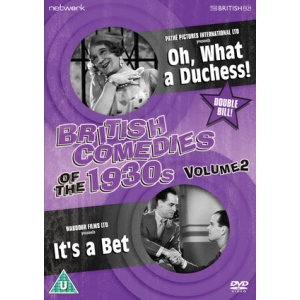
First up, one of a series, ‘BRITISH COMEDIES OF THE 1930S’. Vol 2 features two films, ‘OH! WHAT A DUCHESS!’ (1933) and ‘IT’S A BET!’ (1935).

british-comedies-of-the-1930s-vol-2-it-s-a-bet-oh-what-a-duchess

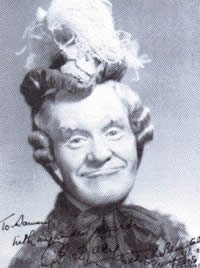
‘OH! WHAT A DUCHESS!’ boasts an interesting pedigree. George Lacy, the star, was the most celebrated pantomime dame of the era. The film was originally trumpeted as an adaptation of Fred Karno’s famous ‘show-within-a-show’ sketch ‘Mumming Birds’, which was Charlie Chaplin’s breakthrough stage role. Enlisted to direct was silent comedian Lupino Lane, who had made his own version of ‘Mumming Birds’ as the great silent short ‘ONLY ME’.

However, little of this is left in the finished product, beyond a vague resemblance in a sequence in which Lacy accidentally wrecks a show taking place on stage. If something of a let down for the Karno enthusiast,  ‘OH! WHAT A DUCHESS!’ actually stands up pretty well on its own. Lacy is incompetent lacky to a lousy theatre troupe, but dreams of becoming an actor. The troupe are invited to dinner by a butler at one of the audiences, who really has his eye on one of the actresses. With his employers, the Duke and Duchess of Stonehenge, away, the butler declares open house, but a  visiting American film producer demands to see the house, leading to Lacy impersonating the duchess.

Some reviewers of the time, perhaps expecting something more in the Mother Goose idiom, complained that “Lacy is given not much to do”. In fact, this is a fine film, rich in the music hall tradition, and snappily directed by Lane.  The slapstick of the stage-wrecking scenes is done well, if not terribly original. Performances in the film are good, too, especially that of Lacy. He is excellent both as his bumbling, enthusiastic character, and in drag as the ‘duchess’.  It’s easy to see why his dames were considered the best; as director Lane himself observed in his book, ‘HOW TO BE A COMEDIAN’, “this type of comedy looks fairly easy, but there is more to it than you would think. […] The stance of the female species is totally different to the male”.

Lacy is a master of this. He is able to remain convincingly feminine with just the right degree of eccentricity to be funny, but not  grotesque.  As with many music-hall based films, the momentum is lost as he replicates (presumably) a stage sketch, an eccentric song and dance version of ‘The Pipes of Pan’. It’s funny stuff though,  if unnecessary to the plot, and this film as a whole is great fun. On the basis of the evidence here, it’s curious that Lacy made no more films after this one. Lane always had the ambition of making a film version of a pantomime, and he could have fitted right in.

Nevertheless, Lacy’s career can hardly be said to have fizzled out. He went on playing Mother Goose on stage for another 50 years after completing this film, making his last performance in Southsea at the age of 80.

Lacy1


big_10056050_0_190-303

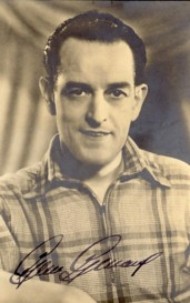
‘IT’S A BET!’  finds itself surprisingly topical; the setup is uncannily similar to recent TV series ‘THE HUNT’. If you haven’t seen that show, it involves several member s of the public going on the lam for a month to see if they can evade capture by the police and MI5 in our world of constant surveillance. Remove the modern CCTV technology, add in dapper stage star Gene Gerrard, and you essentially have this film. Gerrard looks rather like Harold Lloyd did when he removed his glasses, and that’s actually a pretty good analogy: he’s good looking and charming, but without any particular feature to make him stand out. Our star is a journalist who bets a friend he can go into hiding for a month and not be found by anyone. Things are complicated when his car is stolen and used In a robbery, with a result that the manhunt for him becomes a national race. It’s a good story that has more excitement than the usual kind of bland light comedies made by stars like Gerrard. The story also aids the pace of the film, which moves along smoothly. It also provides opportunity for lots of nice location work, including nice scenes of St Leonard’s Pier. The finished result is a film with a sunny atmosphere and a feeling of constant motion. It lacks any standout comic set pieces, but remains engaging all the way through as an amiable time-passer.

The two films on this disc very much belie the notion that British comedies of the 1930s are all stodgy, hoary old relics. Both seem fresh and entertaining, if undeniably dated. Both come in sparkling new transfers from original elements, and are well worth taking a look at.

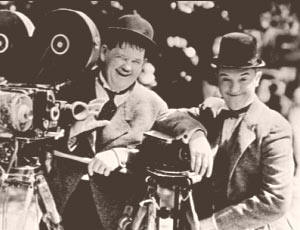
Laurel & Hardy: unfixing the filmography

laurel_hardy

On Tuesday, I went to see Laurel and Hardy at the cinema. Not at a special silent film event, or in a little indie cinema, but in an ordinary Vue multiplex. Thanks to L & H devotee Ross Owen, who has coordinated several batches of UK-wide Laurel & Hardy Roadshow cinema screenings this year, Stan and Babe took their place once again amongst all the other contemporary comedies, dramas and romances filling cinema screens. It’s been a terrific thing to see, and it got me thinking about the conditions under which these films were first seen.

This is the age of information. Unlike the nebulous facts available to the first waves of silent film historians, we have precise, accurate information at our fingertips. Take L & H, for instance. We know the exact order they filmed their shorts and features, even down to precise filming dates. We know all about scripts, working titles and the days on which the films were released. Thanks to books and the internet, much of this information is now in the public domain.

In recent years, the internet has even begun to play host to reproductions of film trade magazines and newspapers, all helping to build our understanding of the films’ context, production and release.

Paradoxically, the glut of information can sometimes undermine our neat and tidy filmographies. With UK cinema screenings in mind, I explored the British Newspaper Archive to see how the L & H films were first advertised and reviewed.

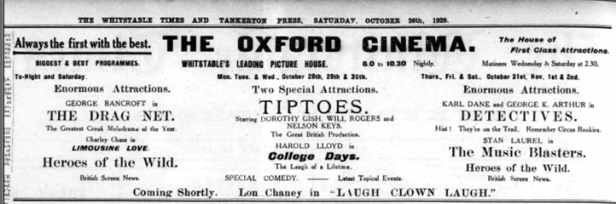
Now, if you’re an L & H buff, you know that their first films as a bona fide team were  ‘The Second Hundred Years’  and ‘Putting Pants on Philip’  released in late 1927. Most sources give a date of 8th October for ‘Second’ and 3rd December for ‘Philip’. Now, these were the dates they hit general release at the ‘first run’ cinemas; these were the most prestigious, big city film theatres. However, if you lived in Nowheresville, USA, or even worse, in the UK, you wouldn’t have had chance to see the films until they had completed their runs in all the first-run houses, and then the next most important cities and cinemas. I’ve not been able to trace any Uk release dates for those first two L and H’s as of yet, but at this time many regional cinemas were still playing Stan’s solo comedies from 2-3 years earlier! 1924’s ‘RUPERT OF HEE-HAW’ is being proudly exhibited as late as April 1927, for instance. This 2 year lag is standatd for much of the late 20s.

‘THE BATTLE OF THE CENTURY’ was released to first-run cinemas on Dec 31st, 1927. It was one of L & H’s first big hits to really launch them in the public consciousness (helped by a big promotional campaign).

According to local newspapers, ‘BATTLE’ didn’t reach small towns in the UK until May and June of 1929! This means that the L & H team were only just beginning to make an impact with audiences almost 2 years after they had done so in the US. Let’s not forget that L & H were snubbed by many critics; their real fans were, for the large part, the everyday people in these small towns and regional cities.

The UK press seemingly weren’t aware of the official teaming yet, either. In contrast to the barrage of publicity greeting ‘BATTLE’ in the US, here it was billed as merely ‘A Hal Roach comedy’.

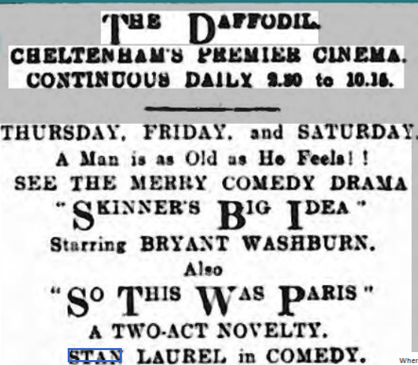
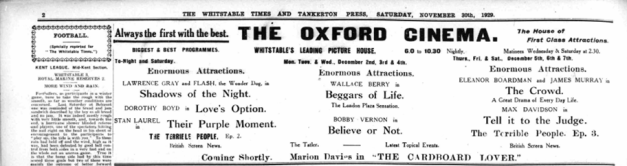
When the performers do start getting a mention, it’s like this:

music blastersPicture3their purple moment

Notice anything missing? The UK publicity dept. seem totally oblivious to Oliver Hardy and his role in the team. Was this partly due to Stan’s British origins taking precedent? The Glasgow newspapers sometimes refer to him proudly as ‘The Glasgow Comedian’.

Well into Stan and Babe’s mature partnership, films like ‘EARLY TO BED’ and ‘YOU’RE DARN TOOTIN’are being referred to as Stan Laurel comedies. In the US, the boys were making sound films by this time, and yet we were still seeing their early silents, apparently hardly being publicised as team efforts!

The other interesting thing you might notice above is the use of alternate titles for the UK market. I’ve heard ‘YOU’RE DARN TOOTIN” as ‘THE MUSIC BLASTERS’ before, but ‘THE WEDDING WRING’ is new to me. I presume this represents the blackmail plot of ‘SUGAR DADDIES’, it’s title a mysterious Americanism alien to the patrons of the Oxford Cinema, Whitstable. (The Oxford’s slogan: “Always the first with the best” seems a little ironic when showing this 2-year old film…). More trivial is the change of ‘SHOULD MARRIED MEN GO HOME?’, to ‘SHOULD HUSBANDS STAY HOME?’ in at least one source.

By late 1929, the boys are finally being billed as a team; ‘HABEAS CORPUS’, and ‘DOUBLE WHOOPEE’, for instance, are both billed as ‘Laurel and Hardy in…’. The introduction of sound probably heralded more publicity which helped to establish this, and also helped to close the time lag in film exhibition. York cinemas are showing ‘MEN O’ WAR’ by November of 1929, but the silents do continue straggling on into 1930 and even 1931. What I do find remarkable about all of this is that, given the time lag in establishing the team, how jubilant the reception was greeting them to the U.K. in 1932, a mere couple of years after they really seem to have established themselves as a team in the eyes of the everyday public here in the UK.

All of this might seem pretty trivial, but I find it quite fascinating. It just goes to show that our neat and precise filmographies are inaccurate. Film release dates and exhibition were fluid and overlapping, even down to the films’ titles. Viewing the L & H filmographies through the lens of local newspapers offers just another window on their fascinating and beloved partnership. And, if the recent cinema screenings show anything, it’s that they might have taken a while to get established, but the boys are here to stay!


A British Silent Film Comedian? YOU’D BE SURPRISED…

The influence of British comedians and their music hall heritage on silent comedy in Hollywood cannot be overstated. Chaplin and Laurel are just two of the comedians who made a huge impression on the scene. And, of course, as they reached huge popularity, their styles influenced other comedians. Then there were the hundreds of other comics, supporting actors, writers and directors all bringing their memories of the music hall and British sense of humour in to the huge melting pot of ideas: Lupino Lane, Andy Clyde, Syd Chaplin, James Finlayson, Billie Ritchie and Charlie Rogers to name a few.

But what about those who stayed behind in dear old Blighty? There are many primitive comedies from the 1900s. From the teens we have Fred Evans (‘Pimple’), Billy Merson and an early series of Lupino Lane films. WW1 certainly slowed the flow, but even as the industry picked itself up, comedy remained conspicuous by its absence. It was the golden age of comedy in America, and no-one seemed to want to compete with the flow of classic shorts and features.

No-one, except for Walter Forde.

Walter Forde 2

If Walter Forde is remembered at all today, it is primarily as a very good director of British comedies and thrillers in the 1930s (ROME EXPRESS, THE GHOST TRAIN, BULLDOG JACK, SAILORS THREE). Before this, though, he was Britain’s premier silent film comedian. Indeed he was sometimes billed as “Britain’s ONLY comedian”. A little hubristic, perhaps, but he was certainly the only comedian appearing in comedies styled after American films.

London-born, Forde was a musical prodigy and music hall performer from a child. His father, Tom Seymour, was also a music-hall performer, and wrote Walter into his sketches. In 1921 they decided to enter film production together, writing and directing the films. These independent films, such as ‘WALTER MAKES A MOVIE’, show them learning the ropes. Walter’s character is at this point very Chaplin-esque in action and movement, without being nearly as loveable. Unlike many of the Chaplin fanciers though, he wears a costume of his own. The straw hat, blazer and Oxford ‘bags’ (a kind of trouser then in fashion in 1920s England) marked him as an Englishman. This home-grown quality helped the films do well enough for him to try his luck in Hollywood.

in 1923, he made a couple of long-vanished shorts for Universal, ‘GOOD DEEDS’ and ‘RADIO ROMEO’. The latter features  a rather bizarre concept for a silent film; Walter is a romantic poet whose readings on the wireless send housewives into a frenzy, and soon all the husbands are after him. Neither film set the world on fire, and he was let go, becoming a house painter for a while.

In 1925 he returned to the U.K., and for a while found it hard to break back into the industry. In 1926, though, he made another series of shorts, a great improvement on the first. This time, he was without the assistance of his father, who stayed on as a gag man, apparently at Hal Roach studios.

Films like ‘WALTER THE SLEUTH’ and ‘WALTER’S DAY OUT’ showed Forde developing a more subtle, less Chaplin-esque character.  They also show him gaining a greater hold on his film-making and gag construction abilities. Off the back of these he was able to bluff his way into making a feature.

001a

The result, ‘WAIT AND SEE’ is a very respectable first effort, if sometimes derivative of other comics. The storyline and final chase are clearly influenced by Lloyd, and  W.C. Fields’ famous golf routine is lifted wholesale. Part of the reason for this surely lies in the lack of industry geared towards comedy film-making. Unlike Lloyd and Keaton, with their teams of gag man to support and refine their ideas, Forde had no such experienced film gag men around him.

However, he took steps forward with ‘WHAT NEXT?’, a comedy thriller, and ‘WOULD YOU BELIEVE IT?’, which is generally believed to be where he hit his stride. (You can see this one at the Leeds Film Festival next week!)

‘WOULD YOU BELIEVE IT’ won great praise from reviewers in the UK, feted as a comedy to finally rival the American stars. It smashed box office records, being held over at the London Pavilion for 22 weeks. However, the film was obsolete as it was released. A contemporary advert, from March 1930, for the Preston Palladium cinema tells all. While encouraging patrons to “See this laugh riot and then you will believe it!”, it adds an ominous footnote: “After this week we go definitely over to talkies, regretting that we can no longer accede to our patrons’ requests for silents.”

All this brings us to Forde’s last starring film, ‘YOU’D BE SURPRISED’. Long thought lost, it turned out to have been lurking in the depths of the BFI, and was shown, for the first time in 84 years, as the highlight of Kennington Bioscope’s ‘Silent Laughter Saturday’.

I’ve been writing several other posts about the films shown on the day (here, here and here). However, I realise I’ve been amiss in not acknowledging the contribution made by the musicians accompanying the films. Nothing made me realise this more than seeing ‘YOU’D BE SURPRISED’, which benefited from a truly heroic effort on the part of pianist John Sweeney and a few other helping hands. It’s a tale that deserves telling in full.  As the talkies beckoned, Forde made this film as a part-talkie: mainly silent with synchronised music and sound effects, but also with some full sound sequences.

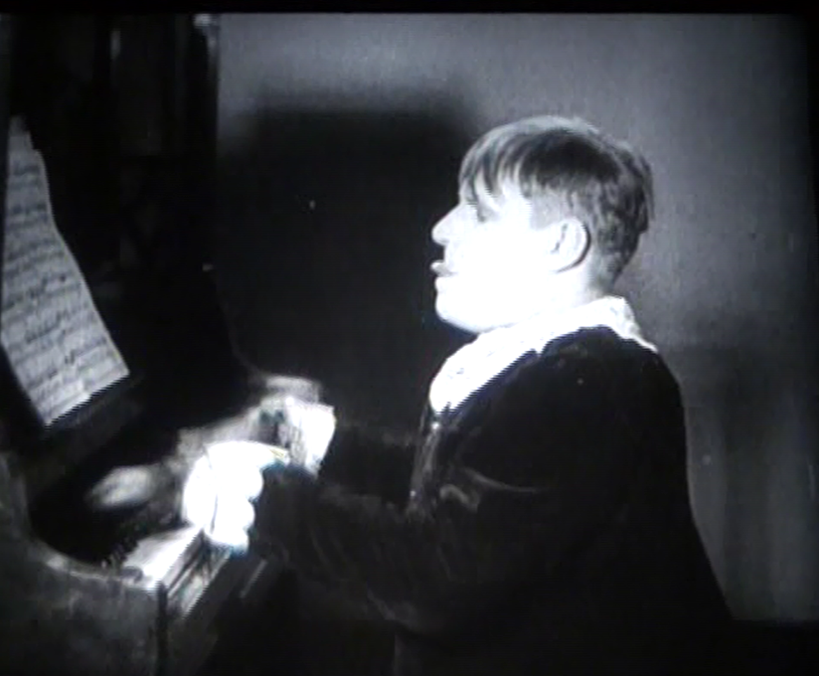
In fact, the whole film centres around sound. Walter, as in real life, has been passionate about music since birth. This is shown in some flashbacks to him to him as a toddler, and then a small boy struggling to play an enormous piano. Moving forward to 1930, he is an aspiring songwriter, seen playing his latest song at a piano. However, he hasn’t quite made it yet, and in a great camera ‘reveal’ gag, we see he is actually playing the piano in the back of a moving van. Writing songs might be his dream, but moving pianos pays the bills!

Surprised 1

The next two reels of the film deal with his attempts to get his song heard by a publisher, including sound sequences… Unfortunately, the accompanying sound track had long since vanished. Normally, this wouldn’t be too much of a loss, but the whole film centres around music, and some of the key comedy sequences involve various noises interrupting him as he tries to sing it! The day’s organisers were suddenly thrown into a bit of a panic… how  could the film be shown without sound when it was so explicitly designed for it?

The solution, with a herculean effort from all concerned, was to recreate a live soundtrack to match the original as closely as possible. This involved John Sweeney finding the original song music in the British library and transcribing it. Next, a vocalist was found to sing the song live. Sound effects – wind, thunder, aeroplanes, etc –  were located to run at key points in the film. Best of all were the effects used in the film’s funniest and most charming sequences. In the first, Forde attempts to sing the song at a piano in an Impresario’s office. Gradually, various noises and interruptions overcome his efforts: a typist chewing gum, legions of typewriters, doors slamming, telephones, a clock being wound. As the sequence goes on these become more improbable – a tap dancer, for instance – culminating in the typist’s chewing gum becoming stuck all over the keyboard and Walter’s hands. All this was matched by some great live sound effects courtesy of Dave Wyatt and Susan Cygan, the highlight of which was Susan’s tap dancing in time to the film!

“The only instrument he’ll listen to is a telephone,” concludes Walter glumly. This give him an idea…

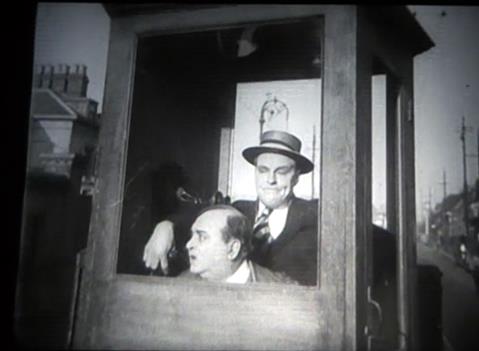
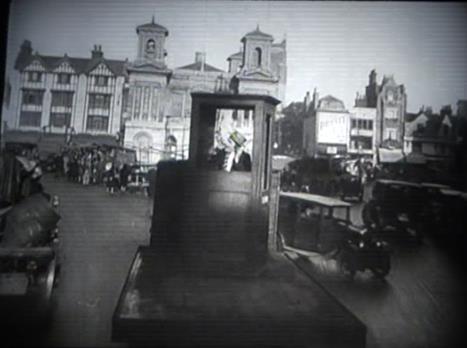
Fade in on Walter singing down the phone… Unfortunately, the box is disconnected and carried away on the back of a lorry, right across the town before he notices! Back to the old drawing board.

surprised 3surprised 2

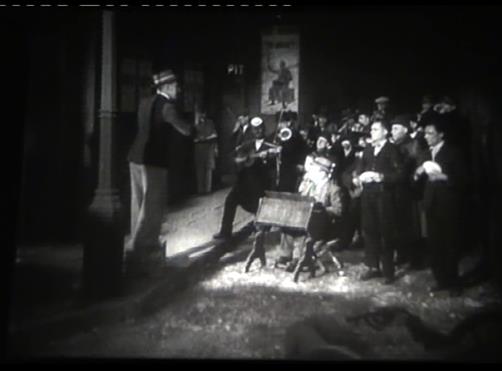
Next up, Walter decides to sing the song outside the impresario’s window. Unfortunately, at this moment, legions of buskers playing all kinds of improbable instruments arrive on the scene! Walter makes the best of it, and corrals them into joining in with his song. At the cinema museum, the  live accompaniment now continued, not with just piano and vocal, but with an army of buskers! A gang of us grabbed musical instruments -trumpets, ukuleles, accordion, tambourine, and harmonica – and emulated the cacophony of the buskers. Then, a strange thing happened. We found ourselves, led by Cyrus’ great accordion abilities, actually joining in with the rhythm and tune of the song, matching the action on-screen of the buskers.

surprised 4

I absolutely loved joining in with this (despite my limited musical skill!), and it was more amazing still that the harmonica I picked happened to be in the right key! I now have an even greater respect for  the amazing skills of the accompanists on the day, John Sweeney, Cyrus Gabrysch and Lillian Henley. Never have I seen a silent film benefit more from its accompaniment than ‘YOU’D BE SURPRISED’, and it was a privilege to be a very small part of that.

The rest of the film took a bit of a detour, as the young songwriter is mistaken for a convict and handcuffed to a murderer making his escape. Nevertheless, it remained light and entertaining, if not up to his best standards. This turned out to be Walter Forde’s last starring film. By all accounts a very shy man, possibly he tired of being in the limelight. Certainly, ‘YOU’D BE SURPRISED’ shows a real flair for direction, and he already had two dramatic pictures to his credit. Many of the later films he made are well-known and loved, but his own certainly need more appreciation and screening. I’ve been inspired to seek more of them out and research his life and work. Hopefully I’ll post more of my findings here in due course.

A late Hallowe’en Treat from Max Linder & Abel Gance

Yesterday was not only Halloween, but also the 90th anniversary of Max Linder’s tragic death. It’s hard to believe that the films he made are almost (and in some cases, more than) a century old. They still remain fresh, innovative and funny to this day.

In Linder’s last years, his illnesses made it hard for him to summon the strength to complete films. After returning from his attempts to make films in America, he made only a couple more films. Both AU SECOURS (1923) and ‘KING OF THE CIRCUS’ (1925) exist, but have remained in obscurity. A shame, as they’re both worthy films.

AU SECOURS! is especially interesting, as it was directed by Abel Gance, the young film-maker who would soon make NAPOLEON, one of the most celebrated silent features. Gance’s interest in working with Linder shows the high regard Max was held in as a performer and film-maker. The two collaborated on the script, with Gance taking director credit. The cameraman, ‘Specht’ also deserves a good deal of credit.

This short film (3 reels) is an example of that tired genre, the horror comedy. But, far from the usual haunted clichés, it is one of the few such examples that succeeds as both comedy and horror. Gance uses the film as a showcase for lots of bizarre and disturbing camera effects, making the image turn negative, or making the whole picture vibrate. In fact, if anything AU SECOURS! is more successful a spooky film than a comic one. Max, for his part, turns in his usual excellent performance; few other comics would have been so restrained in the circumstances.

I’d seen this film before, but only in grainy VHS. This print is much nicer to look at, and with an excellent live score

Now, dim the lights and enjoy a bizarre and sinister meeting of two masters…