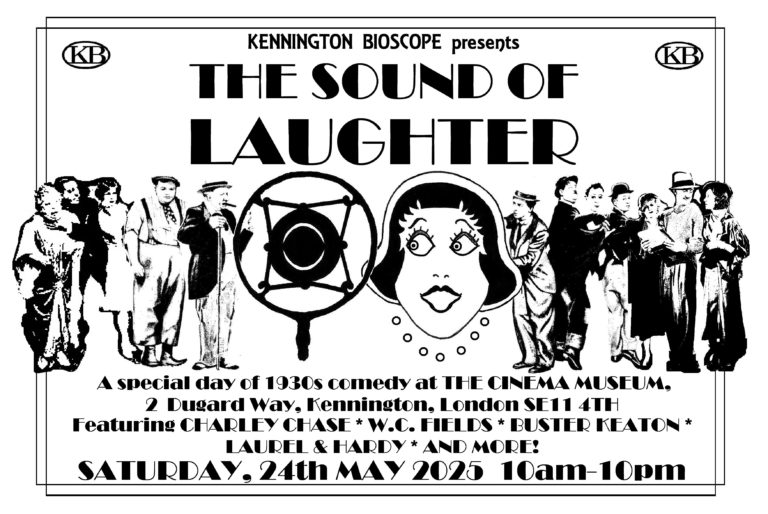
Coming next month at The Cinema Museum! After years of celebrating silent comedy, we thought it was high time we did a spin-off event to celebrate the best sound comedy. From favourites like Laurel & Hardy, Charley Chase and W.C. Fields, to forgotten funnies like Harry Gribbon, Lloyd Hamilton and Tom Walls, we think we’ve got a great programme. But it’s your laughter that will bring the films to life… so we hope to see you there.
Here’s the link to the event page, and to buy tickets. You can also find the full programme below, but this great little video by Dave Glass gives a nice flavour of what it’s all about…
—
Kennington Bioscope present a fun-packed day of vintage film comedies from the 1930s, on the big screen. A spin-off from the ever-popular Silent Laughter events, this all-dayer will feature some of the very best talking comedians in a hilarious selection of shorts, features and rarities. We’ll also be spotlighting the work of silent comedians who transitioned to sound, with classic shorts from Laurel & Hardy, Charley Chase and W.C. Fields, plus the rare chance to see a fantastic Buster Keaton feature that captures the essence of his silent work. All this, plus some choice rarities from the British Film Institute, Library of Congress and private collections. Introductions and presentations by film comedy experts will spotlight the work of key performers and studios, and there will be plenty of screenings on celluloid! So come along and enjoy the sound of laughter as we celebrate one of film comedy’s greatest decades. The full programme is below. All films subject to confirmation.
10.00 SOUND BEGINNINGS
The coming of sound brought new opportunities in cinema for comedians specialising in verbal humour, nonsense patter and musical comedy. From the zany antics of the Marx Brothers and The Three Stooges to the sly humour of Mae West, or songs and patter of Eddie Cantor, there was a dazzling array of fresh talent. This programme will showcase the best of the new guard, through short films and excerpts. Among the gems we’ll be showing complete are Robert Benchley’s witty, Academy Award winning How To Sleep and The Druggist’s Dilemma, featuring the hilarious comedy team Clark & McCullough with James Finlayson. Presented by Matthew Ross.
11.30 ROOKERY NOOK (1930)
Ben Travers’ series of Aldwych Farces were some of the most popular British films of the 30s. Featuring the wonderful dynamic between disreputable Tom Walls, silly-ass Ralph Lynn and nervous Robertson Hare, the films set a benchmark for situation comedy. The first of the farces to be filmed, Rookery Nook was voted the best comedy of 1930, but has rarely been screened since. This is a rare chance to see the farceurs at the top of their game in one of their classic films. Rookery Nook will be screened on 35mm, in a copy from the BFI National Archive and introduced by film historian Geoff Brown.
14.00 THE TALKIE FUN FACTORIES
The comedy two-reeler was a mainstay of cinema programmes throughout the 1930, and here we spotlight the efforts from specialist comedy studios. From the Mack Sennett Studios comes a terrific spoof of early musicals, A Hollywood Theme Song, with Harry Gribbon; we’ll be screening this on 16mm. The same studio also made some of W.C. Fields’ funniest films, including The Dentist, which we’ll be showing in its rarely seen, complete and uncensored version! Other films include a very rare – and very funny – RKO short starring Harry Sweet, Firehouse Honeymoon. Presented by Glenn Mitchell and Dave Glass.
15.30 LE ROI DES CHAMPS-ÉLYSÉES (1934)
Legend has it that Buster Keaton’s sound films are all horrors that allowed him no creative control, but that’s not completely true. While MGM may have mis-used his talents, independent studios gave him much better opportunities – albeit on a low-budget. In 1934, Keaton travelled to France to make this indie feature for producer Max Nosseck. Within the story of an amateur actor who gets mixed up with gangsters, Keaton creates new silent comedy routines and shows off his acting chops in a dual role – all set against great location backdrops of Paris in the 1930s. A rare chance to see this charming and funny film on the big screen. In French, with English subtitles. Introduced by Keaton expert David MacLeod.
17.00 SILENT SURVIVORS
Another film comedy myth is that the lion’s share of silent comedians were out of work when sound came in. Actually, many of them remained busy and continued to produce some great comedy. Glenn Mitchell and Matthew Ross present a selection of the funniest and most fascinating sound appearances by silent comics, including excerpts featuring Harold Lloyd, Roscoe Arbuckle and Lupino Lane. The programme will also feature complete screenings of Lloyd Hamilton’s Good Morning Sheriff (courtesy of The Library of Congress), Harry Langdon’s charming A Dog-Gone Mix-Up and Laurel & Hardy’s Our Wife, in which the duo meet silent comics Babe London and Ben Turpin! The last two of these films will be screened on 16mm.
20.00 THE LOT OF FUN: LAUREL & HARDY & CO
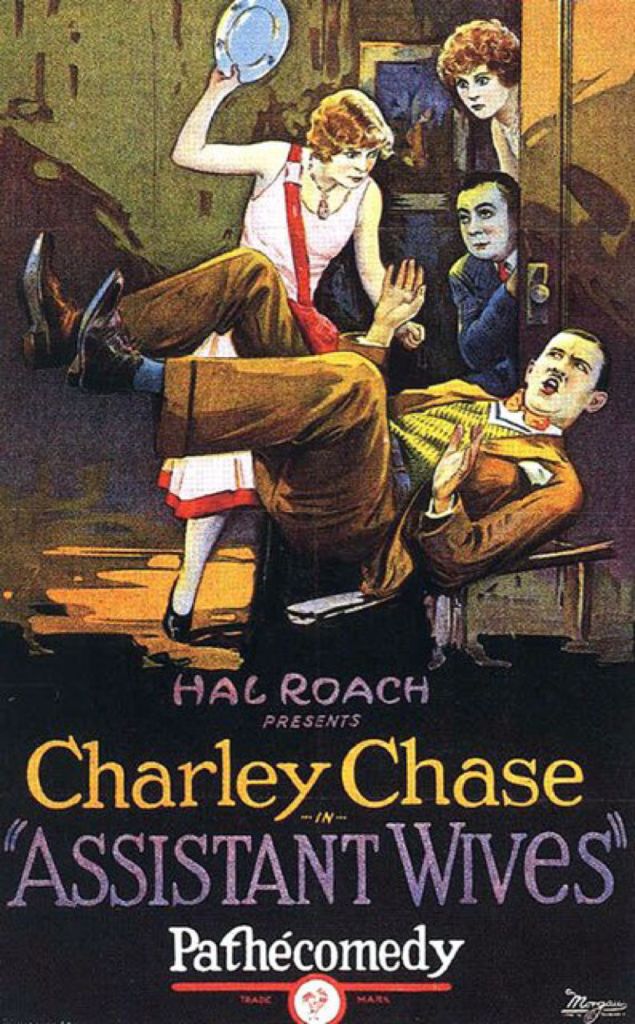
The Hal Roach studios were the gold standard for comedy studios in the 1930s, turning out wonderful and charming short films. This programme will show some of the finest comedies made on ‘The Lot of Fun’! The female comedy team of Thelma Todd & Zasu Pitts crash society in The Pajama Party, while Charley Chase brings his talent for farce into the sound era in Looser Than Loose. The programme will conclude with Laurel & Hardy’s Academy Award winning classic The Music Box (the one with the piano!), which will be shown on 35mm. A fitting end to a day filled with the sound of laughter!
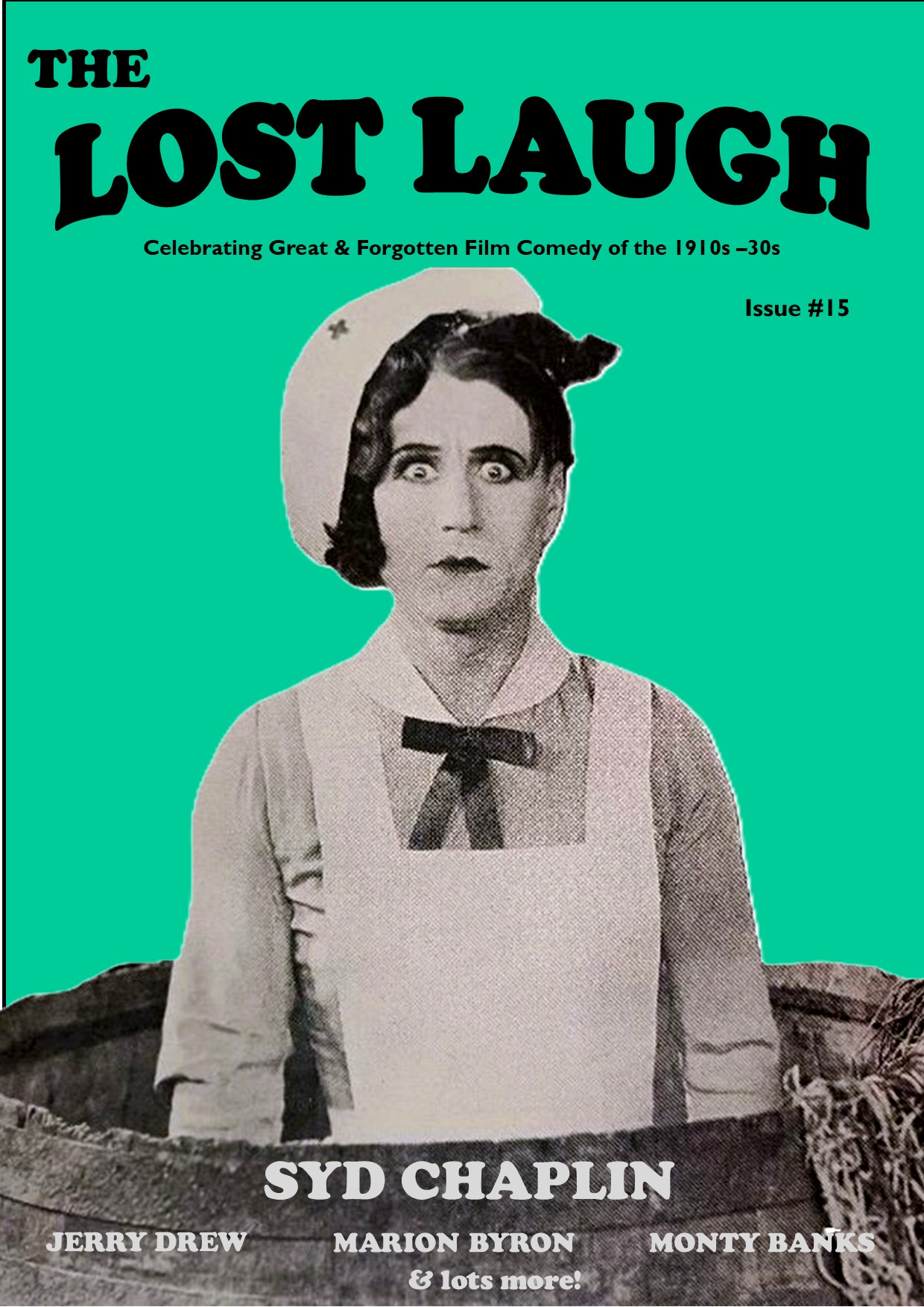
Where does the time go? Somehow, It’s just over three years since the last issue of The Lost Laugh appeared. Well, finally I’ve been cracking on with a new one, and though life has thrown a few delays in the way, I hope it will be out by the end of March.
This time round, I’m really thrilled to be featuring contributions from silent comedy experts Steve Massa, Lisa Stein Haven, Holly Foskett & Matthew Lydick, and have enjoyed researching some corners of silent film comedy that were new to me. Here’s a teaser of some of the contents:
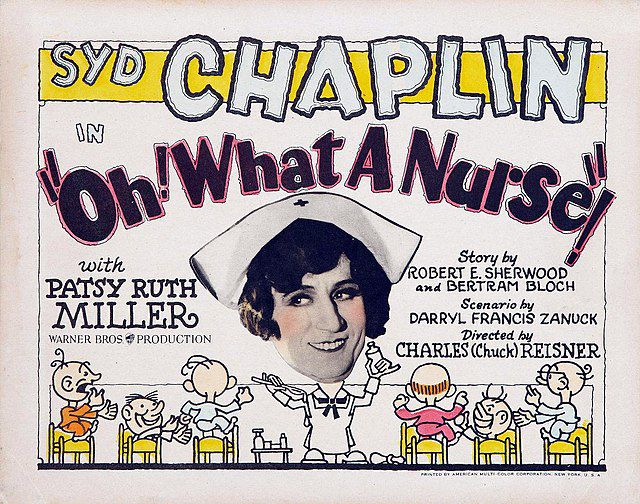
Syd Chaplin. As Syd’s newly restored feature Oh!What a Nurse! is restored and re-premiered, it’s the perfect opportunity to revisit his neglected comedy career. Syd’s biographer and Charlie Chaplin expert/author Lisa Stein Haven has very kindly agreed to a Q & A about the brothers.
Monty Banks: his career in short films, from supporting actor to star comic.
Steve Massa provides an insight into the early years of Hal Roach‘s studio – Rolin, and fills us in on his exciting new book project
Jerry Drew: aka Clem Beauchamp, Educational’s corner on the sophisticated comedy market of the late 1920s. But there’s more to Drew than that; he was also a writer, director, stunt pilot, husband of Anita Garvin… and an Oscar winner!
Charley Rogers:Holly Foskett and Matthew Lydick shine a light on Stan Laurel’s right hand man, a talented gagman, director and performer whose career has been under-researched… until now.
A celebration of Marion Byron: one of Buster Keaton’s best leading ladies, and a very talented comedian.
A Charley Chase feature film is a sadly rare thing, but 1929’s Modern Love still exists and provides some vintage Chase comedy!
news of exciting new Kickstarter projects, film festivals, DVD/BluRay releases, plus reviews…
It’s not too late to add something, if you’d like to! Contributions are always welcomed, and if you have a project you’d like to plug, then please do get in touch. I’m always happy to help spread the word. Drop me a line in the comments section, or at movienightmag [AT] gmail .com if I can help!
Here’s the cover of the issue. I thought I’d try a simpler, cleaner look this time. What do you think?
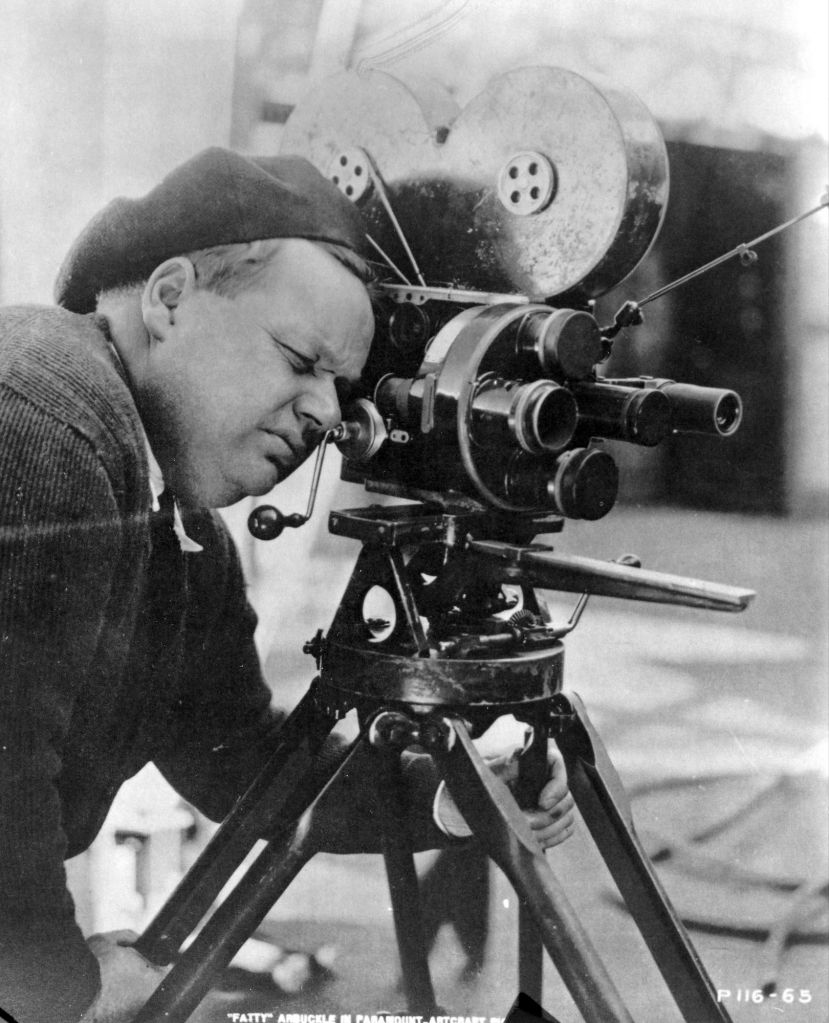
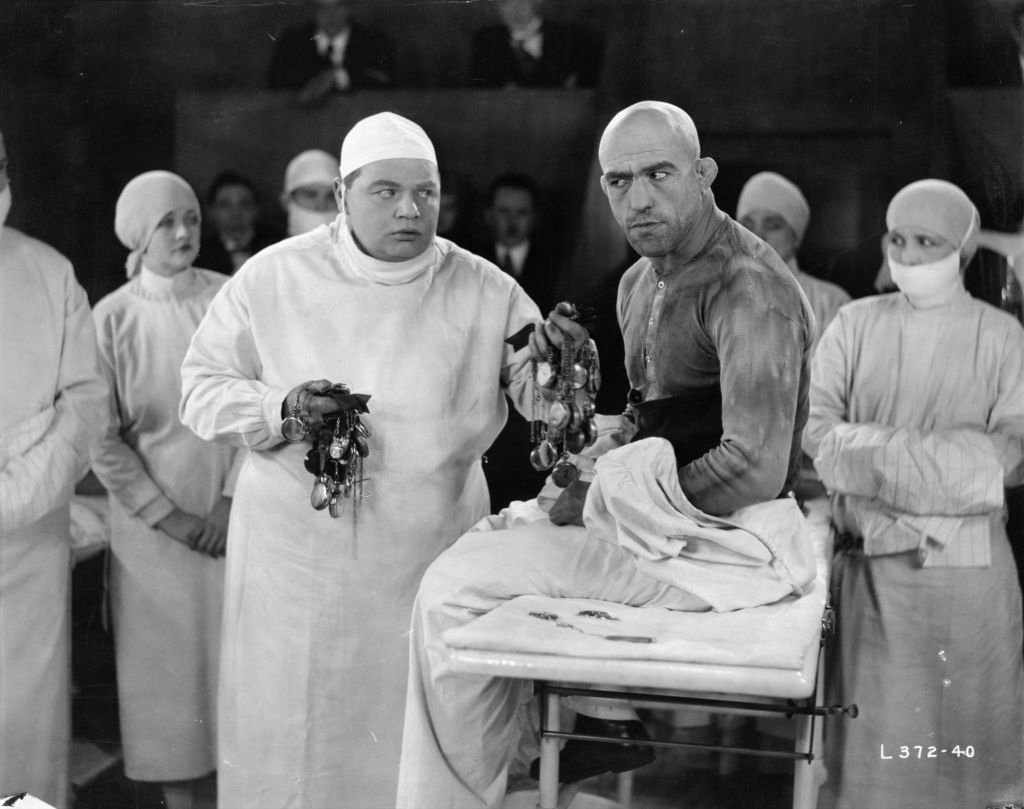
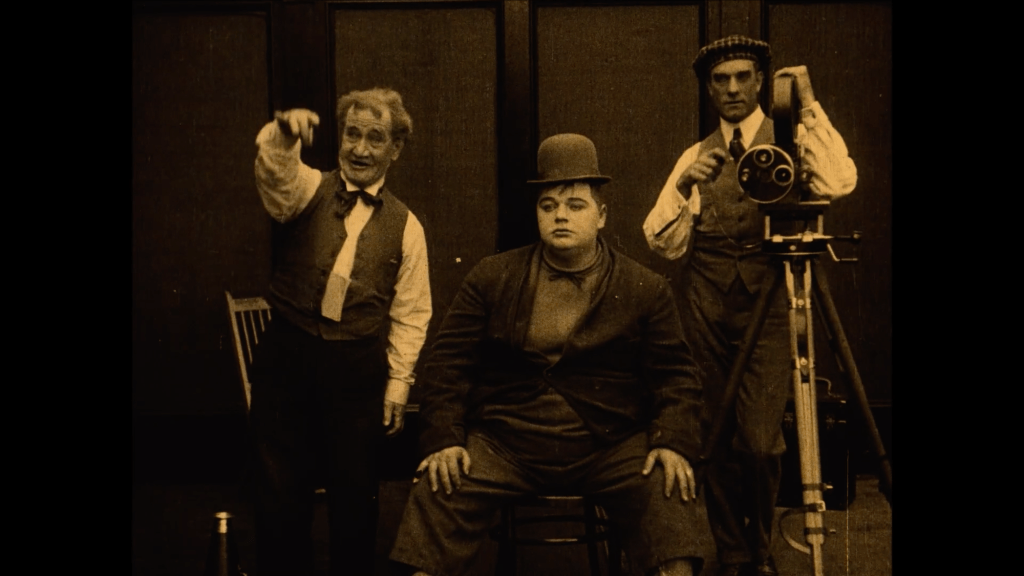
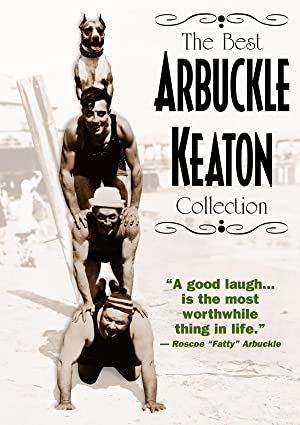
For over twenty years, Roscoe Arbuckle made enormous contributions to screen comedy, in front of and behind the camera. This is a man who not only mentored Buster Keaton, but also gave valuable help to both Charlie and Syd Chaplin in their early careers, as well as many other comedians like Charley Chase and Al St John. Later, he was instrumental in directing films for St John, Lloyd Hamilton, Lupino Lane and many others. As a performer, he inspired a wave of ‘jolly fat man’ performers: Babe Hardy, Hughie Mack, Walter Hiers, ‘The Ton of Fun’.
Yet for all that, Arbuckle often seems slightly taken for granted. His image is so sewn up with Keystone slapstick that his broader achievements in gentle situation comedy, farce and feature length comedies and as a director, are overlooked.
It’s hard to believe that it’s now twenty years since the definitive DVD set, ‘ The Forgotten Films of Roscoe ‘Fatty’ Arbuckle’. This was the first set to really illuminate Roscoe’s wider achievements, and set a high bar. In the years since then, crowdfunding projects, access to Archives and digital technology have advanced, and the time is ripe to showcase some of the previously unseen and newly restored Arbuckle gems out there.
Among the highlights culled from Archives and private collections around the world are Arbuckle’s first Keystone THE GANGSTERS, THE SEA NYMPHS with Mabel Normand, rarely seen feature CRAZY TO MARRY, the Al St John shorts DYNAMITE DOGGIE and NEVER AGAIN and loads more! Overall, it’s a terrific sampler of silent comedy gold from one of tits finest talents. The Kickstarter campaign runs til Feb 14th and provides your opportunity to help bring these films to new audiences.
Crazy to Marry
Behind the Kickstarter campaign are silent comedy expert and author of ‘Rediscovering Roscoe’, Steve Massa, and producer Crystal Kui, with the new project being distributed through Ben Model’s Undercrank Productions.
Steve and Crystal very kindly offered to talk us through the new project, and some of the highlights it features. Read on for more…
This new Kickstarter release features a wealth of restored and reconstructed films, sourced from a range of archives and private collections. What are some of the logistical challenges in pulling all these disparate sources together?
Crystal Kui: In this Arbuckle release will be 11 shorts plus a feature sourced from seven different archives and two private collectors. Logistically, it will be quite a challenge to keep track of the shipping, scanning and restoration on all these films. We’re very fortunate that all of the participating archives were keen to provide access to their prints and are supportive of our efforts to share these treasures with the public. Thanks to Steve’s enthusiasm and deep knowledge of the films, we have been able to work with the archives on our side. After we draw up contracts with the participating archives, the next step is to coordinate the shipping or scanning of the film prints. A few archives have facilities on site to scan and restore the films, while for others we are able to ship the prints either to the Library of Congress for scanning on the east coast or to USC on the west coast. We have a team of digital restorers and color graders who are archive conscious and work diligently to bring the end result as close as possible to the original viewing experience. Not all films are complete, but we work with the best surviving or only surviving copies. My favorite aspect of working on this project is doing the research to reconstruct the missing parts or titles, finding out whether there was tinting and how it was used, and comparing foreign versions or reissues to the original domestic releases.
Were there any particular technical challenges involved in working with such rare and precious film elements?
CK: Several films in our release are sourced from foreign release prints including Crazy to Marry (1921) with Russian titles, The Sea Nymphs (1914) with Danish titles, and Fatty and the Broadway Stars with Norwegian titles. Instead of simply translating the titles into English, we tried to source scripts and censorship records in an attempt to reconstruct the titles as they were written originally in English. This requires a lot of close scrutiny and comparison. In studying the scripts, we also learned that Crazy to Marry had three tinting colors: yellow, blue and amber, which are detailed by reel, and will be recreated digitally by our graders Chris Crouse and Graham Brown, using original tinting samples from the early 1920s. Our regular collaborator, Jesse Pierce, an expert at recreating the intertitles, will design titles that faithfully match the original style of a Paramount feature, Keystone Comedy or Triangle release, for example.
Is therea particular restoration effort on this set that you’re most proud of?
CK: Perhaps ask me this in a year; the real in-depth restoration work is only beginning now that the Kickstarter has met its initial goals. We have a lot of work ahead of us!
Steve, this set comes on the heels of your book, ‘Rediscovering Roscoe’. Championing Arbuckle is clearly a passion project for you. What is it about him and his comedy style that speaks to you?
Steve Massa: I grew up hooked on silent comedy, and although I got a steady diet of Chaplin, Keaton, and Laurel & Hardy there was almost no Arbuckle to be seen. This was probably due to left over stigma from the scandal. My first real look at Roscoe was thanks to film historian William K. Everson. In a 1983 all-Arbuckle evening at New York’s Collective for Living Cinema, Professor Everson showed The Waiter’s Ball (1916), his feature Leap Year (made in 1921), and the comeback sound short Buzzin’ Around (1933). Seeing the comedian from his first full flowering to his last hurrah was an eye opening experience and inspired me to try and get as much of his work seen as possible. Since then I’ve taken every opportunity I could to present his films – at places like The Museum of Modern Art and Library of Congress, on DVD, and in print.
The fact that Arbuckle made feature films is often overlooked. ‘Crazy to Marry’ shows him mixing polite comedy plots with slapstick. Where do you think his comedy style might have headed in the 20s, if fate had not intervened?
SM: Mabel Normand and Roscoe were the first stars of slapstick shorts to move into feature films. Their type of comedy shorts, while loved by audiences, didn’t get much respect in the film industry itself, where they were often treated like poor step-children. To be taken seriously they had to appear in more serious fare and be “legitimized” as feature stars. Roscoe’s first feature was the dramatic western The Round Up (1920). The films that immediately followed, such as The Life of the Party (1920) and Brewster’s Millions (1921), were polite drawing room comedies based on popular stories, novels or plays, and were very plot heavy.
Unfortunately we don’t have access to all of his features, but by the time of Crazy to Marry and Leap Year he moved to farce comedy – which was better suited to his talents and gave him more situations to react to and opportunity to work in more helpings of slapstick. At the time of his banishment from the screen Paramount had very similar properties lined up for his next projects, so it seems likely that he would have stayed in that style.
It’s great to see Arbuckle’s directorial career represented as well. What led you to choose the particular films featured here? ( ‘Dynamite Doggie’, ‘Home cured’, ‘Never Again’, ‘Stupid But Brave’, ‘Honeymoon Trio’)
SM: The particular directorial films chosen for the set were picked for their excellence as well as their rarity and unavailability. In all of them Roscoe uses a very restrained and low-key approach that has the slapstick growing logically out of the situations. He gets very natural performances from the actors, with wonderful close-ups and reaction shots. His early sound short Honeymoon Trio (1931) will be a surprise to many people. It’s Roscoe’s “road film” – a black comic version of Detour (1946) and The Hitch-Hiker (1953), as Al St John and Dorothy Grainger head off on their honeymoon motor trip with Al’s former rival Walter Catlett in tow. Powerless to thwart or even shut up the obnoxious Catlett, Al is symbolically cuckolded as he’s caught in a never-ending honeymoon from hell.
Do you each have a favourite film or gag from the set?
SM: One of my favorite films on the set is The Gangsters (1913). This was Roscoe’s very first film for Mack Sennett, it’s amazing to see how he hit the ground running. Besides being very funny he pulls the focus whenever he’s on screen, and his “Fatty” character is already developed at this early date. When this was made Roscoe was already a well-seasoned performer, having spent a decade touring with various stock companies around the U.S. and Asia. His film experience before this had been very limited – brief sojourns for Selig and Nestor, but he instinctively seemed to understand the intimacy of the movie camera. Understanding it, he used that intimacy extremely well and quickly became an audience favorite around the world.
CK: These films are so rare, I won’t have a chance to see the films until the scans have come in from the archives. We received our first film last week, The Sea Nymphs (1914) from the Danish Film Institute, and it was so much fun to watch, with extended scenes shot on Catalina Island.
What do you hope viewers will take away from this set? Is there a particular facet of Arbuckle’s talents you’d like them to have a new appreciation for?
SM: I’d like viewers to get a full picture of what an excellent overall comedy creator Roscoe was. He’s best remembered for his on screen persona, but his work behind the camera gets taken for granted. He was a very sophisticated writer and director – even as early as 1915 his sure hand can be seen in films like That Little Band of Gold, Fatty and Mabel Adrift (1916), and He Did and He Didn’t (1916). That’s why after the scandal he was able to transition so easily to just writing and directing. He was already a pro, and turned out excellent shorts with comics such as Al St John, Lloyd Hamilton, Lupino Lane and Johnny Arthur.
So there you have it: a fantastic set rammed full of rarities featuring one of the true comic pioneers. I’m sure you won’t want to miss out on this chance to rediscover Roscoe! Here’s the link to the Kickstarter, and the full planned contents:
The Gangsters(1913) – 10 min, Museum of Modern Art Roscoe had been making sporadic appearances for Selig and Nestor since 1909. The Gangsters is his very first film for Keystone, where he shares the picture with Fred Mace and becomes an overnight Mack Sennett star.
A Noise From the Deep (1913) – 10 min, Museum of Modern Art The earliest surviving film of Roscoe with his frequent co-star Mabel Normand. It is also considered to have the first use of a thrown Keystone pie.
An Incompetent Hero (1914) – 12 min, Library of Congress Roscoe is a victim of circumstances in this rarely seen comedy, which also highlights Edgar Kennedy, Minta Durfee, Al St John, and Roscoe’s tight rope walking skills.
The Sea Nymphs (1914) – 25 min, Restored by the Danish Film Institute Mabel, Roscoe and a seal have fun in the surf at Catalina, in a new scan made from the only known surviving print.
Crazy to Marry (1921) – 40 min, Restored by Cinematek (Brussels) This was the sixth of Roscoe’s starring features, and was only in theatres for about a week before being yanked out of distribution and vanishing. This rare survivor illustrates how Roscoe was taking polite comedy plots and working in more and more of his signature physical gags and slapstick.
Bonus: New reconstruction of Fatty and the Broadway Stars (1916) – 7 mins, Nationalbiblioteket (Oslo) & Private collection / Restored by theUSC HMH Foundation Moving Image Archive Only a few 35mm and 9.5mm chunks are all that’s known to exist today of this short. The Triangle Film Corp. had hired famous stage stars like Weber & Fields and William Collier to give prestige to their films, and used Roscoe to introduce some of these stage personalities to movie audiences.
Disc Two
Never Again (1924) – 12 min, Lobster/Blackhawk Roscoe here reworks the plots of Fatty at San Diego (1913) and A Reckless Romeo (1917) for his nephew Al St John. Scanned from the only surviving print.
Stupid but Brave (1924) – 21 min, Private collection / Restored by the USC HMH Foundation Moving Image Archive Having been banned from the screen, Roscoe focused on writing and directing, creating excellent comedies with Ned Sparks, Poodles Hanneford and Al St John.
Dynamite Doggie (1925) – 24 min, Lobster/Blackhawk Al St John co-stars with Pete the Pup in this rarity that reworks material from Love (1919) and Sherlock Jr. (1924), as well as early films that featured Roscoe’s dog Luke.
Home Cured (1926) – 10 min, Library of Congress Roscoe launched the series of Tuxedo Comedies for Educational Pictures which starred the fairly new screen comic Johnny Arthur. Scanned from the only known 35mm material, Johnny is a hypochondriac whose wife has had enough.
Honeymoon Trio (1931) – 12 min, Library of Congress This early sound short is Roscoe’s “road film,” a black comic version of Detour (1946) or The Hitchhiker (1953) that details Al St John on a never-ending honeymoon from hell.
Bonus: Video essay on Roscoe Arbuckle’s life and career.
Huge thanks to Steve and Crystal for giving their time to answer my questions, and for their efforts in making this project happen. I’m really excited for this set!
It’s back! Mark your diaries for giggles, chuckles and belly laughs! On November 9th & 10th, Kennington Bioscope present another Silent Laughter Weekend: two days of live silent cinema showcasing the cream of silent comedy films.
This year features one of our most packed programmes ever, a wide-ranging and eclectic selection of the funniest, rarest and most unusual gems from comedy’s greatest era. From the best-loved comedians to the most obscure; from wild slapstick to the subtle and sophisticated; from surreal stop-motion animation to European clowns, there’s a smorgasbord of silent hilarity spread over twelve programmes.
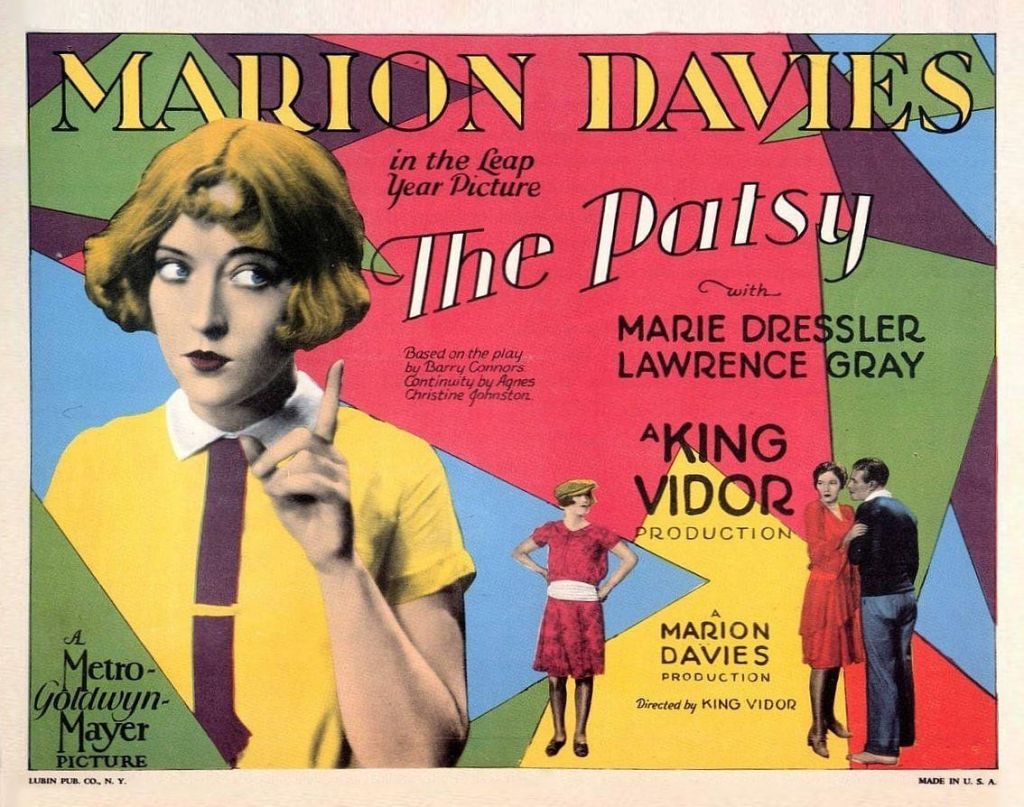
You’ll find plenty of familiar favourites, including classic shorts starring Charlie Chaplin, Buster Keaton, Harold Lloyd and Laurel & Hardy. But there’s so much more to silent comedy than the well-known stars, and as always we also spotlight the undeservedly forgotten comedy talents, such as Marion Davies (in The Patsy), Danish comedy team Pat & Patachon, Richard Dix, Charlie Murray and Charley Chase.
Regular attendees will know that we always pull some real rarities out of the hat. This year is no exception, as we’ll be hosting the U.K. premieres of several recently rediscovered films. On Saturday evening, Charlie Chaplin’s brother Syd stars in Oh! What a Nurse! one of the big hits of last year’s Pordenone, it hasn’t been seen in this country for almost 100 years! We’re also thrilled to be showing the newly rediscovered spooky comedy thriller The Gorilla, starring comedy stalwart Charlie Murray. Murray also features alongside Clara Bow in another previously lost film, The Pill-Pounder. Bioscope favourite Charley Chase will feature in a programme of newly restored short comedies that have been unseen in many, many years and we’ll also be showing some incredibly rare films starring the likes of Monty Banks, Harold Lloyd and Dorothy Devore.
There is also a spotlight on the iconic Keystone Kops, as well as the work of Vitagraph Studios. An ‘Animations and Illusions’ programme will feature camera trickery, from Meliés’ experiments to the mind-blowing madness of Charley Bowers. You won’t want to miss a very special presentation of 9.5mm rarities by Christopher Bird, shown on film using amazing vintage projectors. Bioscope favourite Charley Chase will feature in some of his rarest comedies, newly restored and presented by Hal Roach expert Richard M Roberts.
We’ve even got a silent film appearance of a Marx Brother! There’s a rare screening of Too Many Kisses, a 1925 comedy featuring a supporting role from none other than Harpo Marx.
Every programme features live musical accompaniment from London’s finest silent film pianists. A roll call of comedy film authors, enthusiasts and collectors will contextualise the films, and share stories of the filmmakers. And it all takes place in the wonderful surroundings of London’s Cinema Museum. Oh, and it’s just £30 for the whole weekend!
So come and join us on the 9th-10th November for a lafftastic weekend of live silent cinema. It’s the best selection of rare and classic silent comedy you’ll find anywhere!
Here’s the link to the full programme, and to buy tickets:
Great news for silent comedy fans in the U.K.: Kennington Bioscope’s Silent Laughter Weekend is returning to London’s Cinema Museum on November 4th – 5th. Once again there’s a fantastic programme of rare and classic shorts and features, with live accompaniments and guest introductions.
We’ve got films that haven’t been seen anywhere for almost a century, and premieres of recent restorations, including two classic Charley Chase comedies you won’t have seen before! There’s also an exclusive bit of ‘new’ Laurel & Hardy footage alongside some of their classic shorts, and the premiere of Dave Glass’ brand new restoration of Monty Banks’ PLAY SAFE! There are rarities that only survive via small gauge prints, plus wonderful and rarely screened features starring Edward Everett Horton, Mabel Normand and Max Linder.
Present via video introductions and presentations will be some of the most knowledgeable silent comedy experts in the world: Steve Massa and Richard M Roberts. We’ve also got plenty of surprises waiting…
Amidst all this fun and excitement, there is a bittersweet note as this will be the first Silent Laughter without its founding father, David Wyatt, who passed away last October. As well as one of the most knowledgeable film historians, DW was always generous with sharing rarities from his connection and passionately believed in making opportunities for silent comedies to be seen the way they were intended. He was a big supporter of The Lost Laugh, and a great friend. It was his enthusiasm that drove the Silent Laughter weekends, and the continuation of this happy, joy-filled event is one of his great legacies. We’ll be doing our best to honour that legacy, including a special tribute programme including his favourite clips and some of his own work.
Come and join us! Tickets on sale now – £30 for the whole weekend. With 12 shows in the programme, that’s just £2.50 per screening, an absolute steal! (there are also day and evening tickets available too)
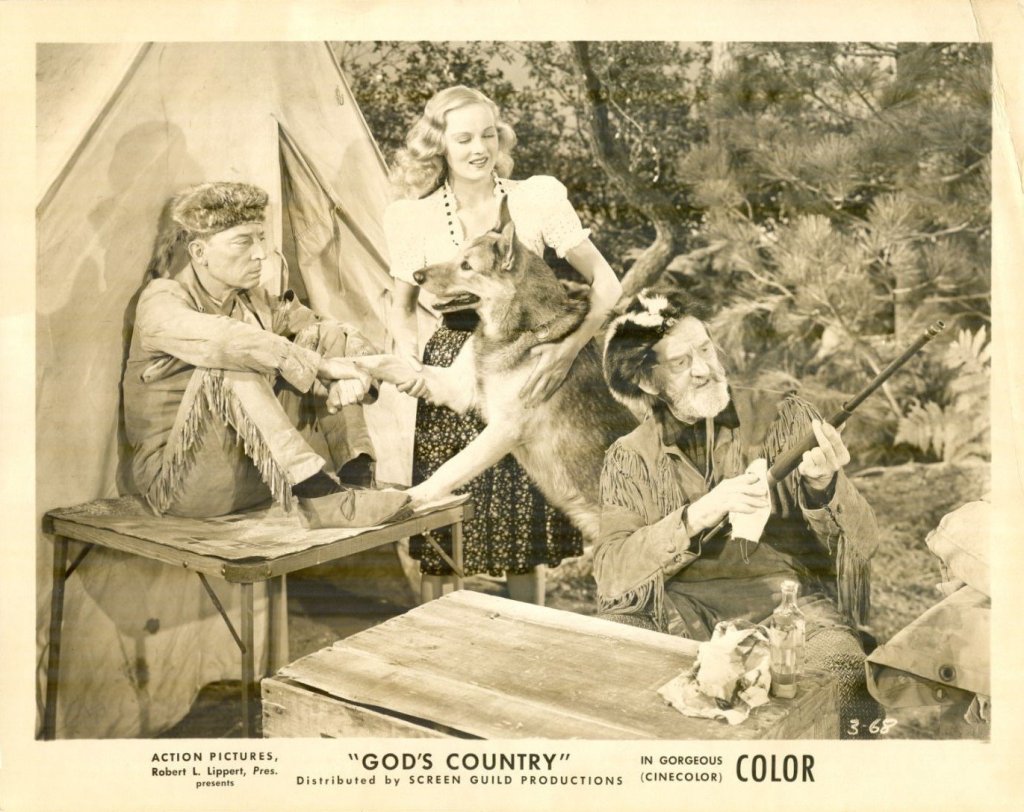
The mid-late 1940s are an interesting time in Buster Keaton’s career. The comedy short market was pretty much dead in the water, but he hadn’t yet made his television debut. In the middle ground between these two fields, he made several supporting roles in feature films. Some, like FOREVER & A DAY or SAN DIEGO, I LOVE YOU, were quite prestigious, but there were several more obscure ones that are seldom seen today. GOD’S COUNTRY is one of the most obscure of all.
Released in April 1946, this feature was a low-profile B-Western/outdoor adventure film starring Robert Lowery and Helen Gilbert. It was directed by Robert Emmett Tansey, a veteran of the genre. The main plot concerns Lowery hiding out in the backwoods of the NorthWest when he is wrongly accused of murder. Adding a little light to this heavy plot, Keaton plays “Old Tarp”, a coonskin wearing bumbler. Though many silent comedians – among them Snub Pollard, Andy Clyde and Keaton’s old buddy Al St John – had often essayed the comic Western sidekick role, this is a rare diversion into the genre for Buster.
Sadly, he doesn’t get much to do, but does get one comedy routine to himself, attempting to making a Chilli while being interrupted by a raven, squirrel and raccoon. It’s hardly a classic Keaton routine, and he’s further stymied by Tansey’s direction, but it does have some amusing moments. It’s always nice to see Buster doing his thing, and here there’s the extra bonus of seeing him do it in Cinecolor. Enjoy!
The lucky 13th issue of The Lost Laugh magazine is here, and available to download below!
At over 50 pages, it’s the most packed issue yet. There are articles on Snub Pollard, Walter Forde, Lupino Lane, forgotten female comedian Wanda Wiley, Buster Keaton and lots more! There are also some great guest contributions from silent comedy experts David Glass and David Wyatt, plus the usual news and reviews.
Working on this issue has certainly kept me entertained through the latest lockdown. I hope it gives you some entertainment too.
Here are the full contents:
Snub Pollard, a career overview and a focus on the Laurel & Hardy-style films he made with Marvin Loback.
The career of forgotten female comedian Wanda Wiley, who gave many of the male slapstick comics a run for their money. Also includes a full filmography, with synopses of each film.
The second part of our article on Walter Forde, detailing his silent comedy features, and including never-before published research.
An exclusive article on newly rediscovered Lloyd Hamilton footage by film historian David Wyatt!
Lupino Lane – details on the new BluRay/DVD set, including insights into the restoration process from David Glass. Also a look at Lane’s fascinating book “How to Become a Comedian”.
Buster Keaton’s last film, THE SCRIBE
Two long-unseen films starring Harry Langdon
A review of a very rare, previously lost Johnny Hines comedy, THE WRIGHT IDEA
Plus news and reviews of books, DVDs, Blu-Rays and streaming events.
— As always, please do get in touch with comments, constructive criticisms and ideas for future issues, and please do share on social media etc.
Finally, The Lost Laugh will always be free, but if you enjoy reading the magazine & site, and are in a position to contribute a little to site running costs, then you can buy me a virtual coffee on Ko-Fi: https://ko-fi.com/thelostlaugh Thanks! 🙂
LA FIESTA DE SANTA BARBARA is an unusual 1935 short film. MGM turned out quite a lot of these little colour novelties in the 1930s, featuring a mixture of celebrities contributing bit parts, musical numbers and comic routines. This one capitalises on the celebs attending the annual Santa Barbara Fiesta. For comedy fans, it’s chiefly of interest today for containing a good hunk o’ Buster Keaton, in colour.
I just found an old digital file of this film that I’d forgotten I had. I also forgot quite how much Buster there is in it. In my cloudy memory it was a one-shot gag appearance but actually he gets a couple of cross-talk routines with Andy Devine, as well as refereeing an amusingly daft bullfight with an atrociously fake bull! His His scenes are intercut with lots of song and dance numbers, but I’ve edited them together for this video. As a bonus, there’s also Harpo Marx’s very brief appearance tagged on at the beginning!
This was Keaton’s first appearance in a MGM film since his firing in 1933. Louis Lewy, who produced the colour novelties, was married to Buster’s leading lady from THE GENERAL, Marion Mack, so maybe that helped get him the footage. Though he certainly seems better off than in his last MGM film WHAT! NO BEER?, Buster was still in a bad way in 1935 and sounds a bit hungover here.. Still, his scenes are a fun obscurity and it’s nice to see him in colour, if not quite in his prime. The narrator is Pete Smith, by the way.
LA FIESTA DE SANTA BARBERA was nominated for an Academy Award at the 9th Academy Awards in 1936 for Best Colour Short Subject. Much as I love him, Buster’s attempt at a Spanish accent certainly wasn’t behind the nomination… Anyway, here it is. Sorry that the image quality isn’t the best, but enjoy!
To coincide with a showing of the very rare Roscoe Arbuckle short CAMPING OUT on The Silent Comedy Watch Party, here’s a run-down of the overlooked shorts Arbuckle made in 1918 & 1919… the ones that don’t feature Buster Keaton in the cast!
Roscoe Arbuckle’s series of shorts made for the Comique film corporation and released through Paramount in 1917-20, are among his best-known work. Certainly, they are the best represented on DVD. This is almost entirely due to the Keaton factor – the presence of a young Buster in most of the films. This bias is confirmed by the obscurity of the films in which Buster does not appear, made during his military service in 1918-19.
You won’t find these films on any of the Arbuckle-Keaton DVD sets!
When Keaton was drafted, the Comique series continued with Arbuckle and his regular foil, Al St John. While the popularity of Keaton has ensured that all but one of the Arbuckle-Keatons are now accounted for, the survival rate drops much further for the shorts made in his absence. Only a couple are known to exist, and only one has been restored and released. Details of many of the films are sparse, with a couple remaining mysteries.
Ever since critics first took an interest in Keaton, Arbuckle has always been in his shadow. At worst, the lazy critical opinion is that Arbuckle’s style was crude and unsophisticated, and that the only merit in the films came from Keaton’s input. Silent comedy aficianados know better, of course; nevertheless, an unfortunate legacy of this view is the lack of interest in this bunch of films. Along with their unavailability, this remains in stark contrast to those that came on either side of them.
Let’s take a look at this neglected group of films, hopefully waiting to be rediscovered. Here they are, in order of release:
THE SHERIFF (24th November 1918)
In late 1917, the Arbuckle company had moved to California from the East Coast, partly enticed by the better backgrounds on offer. The desert settings of the west were seen to good advantage in the first film after moving, OUT WEST, and Arbuckle reused the theme in this short. Arbuckle plays a Sheriff enamoured of the movie heroics of Douglas Fairbanks and William S Hart. After falling asleep and dreaming a dramatic rescue in a Mexican town where He gets the chance to try a real heroic rescue, when his schoolteacher girlfriend Betty is kidnapped by bandit Al. THE SHERIFF is possibly the most intriguing of all these films, and sounds like it was an amusing little gem. Arbuckle surely got good comic contrast from impersonating Fairbanks and Hart, and THE SHERIFF is perhaps similar to the clever, cliché spoofing Arbuckle-Keaton short MOONSHINE. While OUT WEST had been an exercise in comic savagery, reviews of the time commented that THE SHERIFF was rather more subtle and sophisticated. Here’s a review from Motion Picture News of November 23, 1918:
THE SHERIFF is better by far than anything contributed to the Arbuckle Paramount program. For one thing, it is free from vulgarity & sloppiness. The classic kick shines by its absence. For another, the situations have been developed logically, producing maximum fun out of minimum action.
One of the common misconceptions about Arbuckle is that any sophistication in his films came from Keaton’s input. While there’s no denying that Keaton had big creative input into the films, Arbuckle, rather like Charley Chase, liked to play with different styles and could happily jump from wild gags and slapstick to gentle situation comedy. Some of his earlier Sennett films, made with Mabel Normand, like HE DID AND HE DIDN’T, show a gentle and sophisticated side to Roscoe before Keaton ever appeared on the scene.
Nevertheless, Arbuckle definitely felt the loss of Keaton in his supporting cast, and hired another diminutive comic to take his place: Mario Bianchi (the future Monty Banks). His leading lady in this film is also notable; Betty Compson would become a star in features, her career getting a boost the following year when she appeared with Lon Chaney in THE MIRACLE MAN.
Incidentally, spoofing William S Hart came up again in Keaton’s later short THE FROZEN NORTH. It was an idea contributed by a writer who remained uncredited… Roscoe Arbuckle! In the short, Keaton made a mockery of Hart’s tendency to always have a scene where he cried in his films. Roscoe apparently did the same in THE SHERIFF.
SCRAPS OF PAPER (aka A SCRAP OF PAPER – Autumn 1918)
part of the regular series but made at the same time, this is Arbuckle’s equivalent of Chaplin’s THE BOND. Like that film, it is a propaganda effort designed to promote the Canadian War Bond fundraising effort. As well as each making a promotional film, Chaplin and Arbuckle made public appearances together to promote the loan drive, and newsreel footage of one of these events still exists. Like THE BOND, SCRAPS OF PAPER features our hero coming face to face with the Kaiser (Glen Cavender) and the ‘clown quince’ (Al St John). After mocking the goose-step marching of the Kaiser’s soldiers (one of whom is Monty Banks), Arbuckle tells him that there’s one thing he hasn’t considered, and unleashes a snowstorm of Liberty Bonds which engulf the Germans. Roscoe addresses the audience directly (via intertitle) telling them to do their bit and invest in the Liberty Loan Drive. Not much of a comedy, but an effective piece of propaganda and an interesting historical curio.
CAMPING OUT (5th January 1919)
CAMPING OUT is a rare survivor from this group of films, existing from two incomplete nitrate sources (one Italian print and one from the Netherlands). A composite print has received a number of screenings (most recently on the Silent Comedy Watch Party) and is held at the EYE film institute. Arbuckle again took advantage of the West Coast climate and locations, filming the short on Catalina Island in November 1918. If THE SHERIFF showcased a more subtle side of Arbuckle, then this film returned to the cruder slapstick milieu of films like THE BUTCHER BOY and THE ROUGH HOUSE. Within the first five minutes alone, there are jokes about vomiting, spitting and seagull droppings!
The basic premise of CAMPING OUT recalls FATTY AT CONEY ISLAND, a tale of Arbuckle playing hookey from his wife, and enjoying the freedom by flirting with other men’s wives. Unable to stomach his wife’s dreadful cooking, he escapes for a while, taking the ferry to Catalina for a camping trip. En route, he (inevitably) meets Al St John, and his pretty wife Alice Lake. In the the ensuing tussle Roscoe throws Al overboard. Fatty and Al’s wife proceed to the campsite, where the grizzled, one-legged camp owner is also played by St John. The highlight of the film follows as Roscoe indulges in some of his trademark food preparation gags. Here he demonstrates novel ways of shaving potatoes, and making doughnuts and mashed potatoes with the aid of St John’s wooden leg! Another highlight is his plan to filch food from grocer Monty Banks.
Inevitably, Roscoe’s chickens come to roost as his wife (armed with guns and knives!), Al and Monty all show up for a slapstick battle royale to round out the short.
Though CAMPING OUT is far from Roscoe’s most sophisticated effort, it’s a ton of fun, and the sunny location shooting around Catalina Island and the streets of Avalon only add to the summery, freewheeling tone of the film. Watch the film as part of the Silent Comedy Watch Party live stream here:
THE PULLMAN PORTER (? unfinished/unreleased film)
THE PULLMAN PORTER is a curiosity, an elusive mystery film. The Arbuckle shorts were popular and well publicised, with Paramount often placing full-page ads in the trade papers for them. For THE SHERIFF, we can piece together lots of information, for instance. But for this film, the trail runs cold. So far, I’ve found no reports of the production, no stills, no reviews… nuthin. Nada. Zilch. But, it does have a cited release date, Feb 16. It does seem strange that an Arbuckle short released at this time would receive next to no coverage in the trades.
There has been confusion between releases in the series before, for instance the earlier short A RECKLESS ROMEO was actually filmed earlier for Keystone, but bought and released by Paramount. There also seemed to be various other reisues of earlier Arbuckle shorts occurring at this time, so could THE PULLMAN PORTER fall into one of these categories? It seems most likely that it a tentative idea, scrapped and replaced during filming.
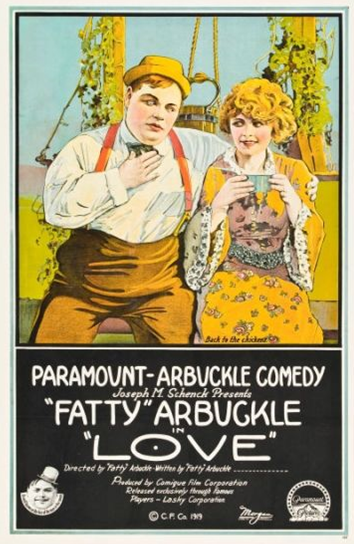
LOVE (2nd March 1919)
LOVE is a wonderful little short that survives complete. The film was preserved just in time, and issued on Laughsmith Entertainment’s terrific 2005 DVD set THE FORGOTTEN FILMS OF FATTY ARBUCKLE. The short is in the classic rural barnyard slapstick mould, one of Arbuckle’s favourite motifs. However, LOVE is way more sophisticated than the earlier Keystone shorts, Arbuckle had come as a comedian and director since those times. While the knockabout is still rough, it is developed into some terrific, well-developed set pieces . Roscoe makes one of his best entrances, riding on a country road in his “economy model” Ford (a glorified go-kart) and using a pair of bellows to blow away huge boulders in his path. He is courting farmer Frank Hayes’ daughter (Winifred Westover), but Hayes has plans to marry her off to local boy Al St John in return for some land. Among the comic set pieces around the farm yard is a scene where Hayes falls down a well, and Roscoe and Monty Banks try to winch him up; each time something goes wrong, sending Hayes plummeting down the well again and again. Then, we’re into a classic version of the ’broom-bashing’ routine memorably used in THE WAITER’S BALL. (Of course, the routine was originally pinched from The Three Keatons’ vaudeville act, so Buster does have a little influence over this film after all. It would be nice to think its inclusion here was a tribute from Arbuckle to his absent friend). This version is even better, turning into a nice four-handed version with Roscoe, Monty, Frank and Al St John.
Roscoe tries to elope with Winifred, but is foiled when his ladder breaks, catapulting him into the house, and leaving Winifired dangling from a first floor window. (Poor Winifred Westover takes quite a lot of punishment in this short—no wonder it was her only film with Arbuckle!)
Though there are occasional lapses in taste (like the scene mentioned above) where the slapstick maybe gets a bit too violent, the comedy scenes in the first half of LOVE are some of the best in the whole Comique series. The second half of the short involves Roscoe’s plan to sneak into the house and sneak Winifred away from the wedding. Sneaking soap into the cook’s stew to get her fired, he dresses in drag and takes her place. Suggesting that they stage a rehearsal ceremony with the preacher, Roscoe takes the groom’s place. Once they have said “I do”, Monty pulls strings attached to Roscoe’s dress and wig, revealing his true identity. LOVE contains several of Roscoe’s pet routines, and is a thoroughly enjoyable two reels, brim-full of exuberant gags. As a farewell to the barnyard setting, it was a high note to go out on.
THE BANK CLERK (? Unfinished/unreleased film)
Like THE PULLMAN PORTER, details about THE BANK CLERK are sparse. Initial reports in the trades that Arbuckle had embarked on a film of this title, in which he works as a window cleaner in the bank, but (excuse the pun) climbs the ladder to a career in finance. However, in April 1919, Film Daily reported that filming had to be abandoned due to both weather conditions in L.A., and for Arbuckle to make revisions to the story. It seems that his solution to both inclement weather and an unsatisfying story was to scrap it and head back to the desert to make another Western film. Like THE PULLMAN PORTER, THE BANK CLERK was probably never finished. That the two films were never released is supported by adverts for later reissues of the Comique films, which list all but this pair of titles.
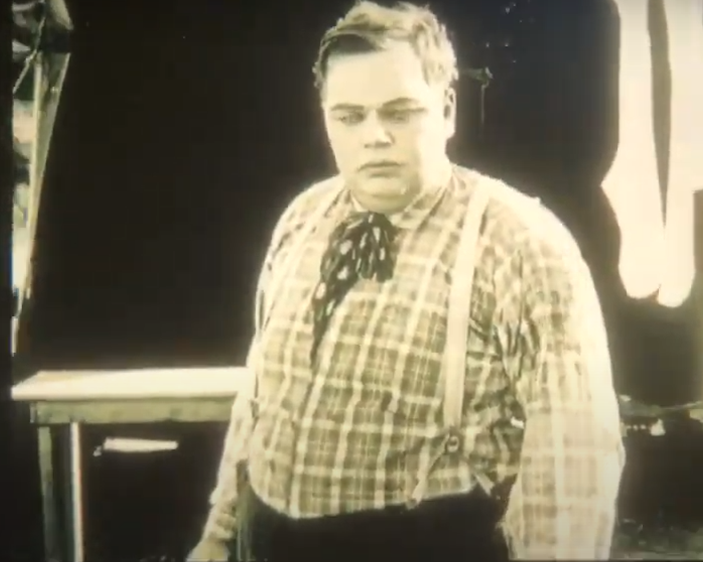
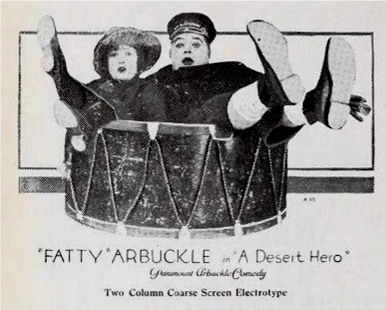
A DESERT HERO ( 15th June 1919)
Arbuckle was obviously very fond of Western settings at this point in his career; this is third film in just over a year to play on the genre. Down the years, this has meant confusion for Arbuckle & Keaton scholars, with the three films (OUT WEST, THE SHERIFF and A DESERT HERO) often being mixed up, especially when they turned up in prints without main titles. As late as the 1970s, A DESERT HERO often found its way into Keaton filmographies, with stills from OUT WEST being attributed to this film instead.
It’s not surprising, as there is a strong overlap between the all three films. In OUT WEST, Alice Lake had a prominent role as a Salvation Army girl; here, Molly Malone takes on a similar part. Arbuckle’s burlesque of William S Hart from THE SHERIFF is also revisited in this short. The long-faced, wiry Hart played solemn tough guys, and Roscoe plays on this for comic effect here. An opening title introduces “a gaunt, thin boned stranger from the desert”, before cutting to the very non-gaunt Roscoe! Arbuckle carried on spoofing Hart through the film, as the press books tell us: “He’s the toughest, hardest, roughest Western cuss that ever lived, in “A Desert Hero”! He eats ’em alive ! Breaks rocks with his teeth he’s so ornery!”
Roscoe reforms when he meets Molly and joins her in the salvation army. Surviving stills show lots of comic business with brass band instruments, before Molly is kidnapped by Al St John and Roscoe has to rescue her. Molly continued with Roscoe for the remainder of the series. Though A DESERT HERO was his last Western short, Arbuckle would return to the genre one last time, for his debut feature THE ROUND UP the following year.
Keaton’s war service in France was over in early 1919, and after a hospital stay, he rejoined Arbuckle in May. The Arbuckle-Keaton partnership returned to the screen for three more shorts, BACK STAGE, THE HAYSEED and THE GARAGE, before Arbuckle moved to features. Many of the Arbuckle-Keaton shorts are deservedly well-regarded, but we shouldn’t neglect the films Roscoe made without Buster. As a comic creator, he was at the top of his game, as evidenced by LOVE. Hopefully one day, THE SHERIFF and A DESERT HERO will be available for us to enjoy again, too.
A version of this article originally appeared in issue 12 of The Lost Laugh magazine, published May 2020. (c) Matthew Ross.
Thanks to Ben Model & Steve Massa from the Silent Comedy Watch Party, and to Elif from the Eye Filmmuseum for making CAMPING OUT available for us to enjoy again!
Recently, a whole load of colourised silent films have been appearing on YouTube. I won’t wade into the colourisation debate here (let’s save that for tedious flame wars on Internet forums) but it did get me thinking about genuine colour footage of silent comedians. Unsurprisingly, there’s not much about, as a) the use of colour was limited in the era and b) lots of early colour footage has decomposed. Still, there are some examples out there…
In the silent era, colour was mainly used in small doses to add some prestige to feature films. Harry Langdon filmed a fantasy sequence for LONG PANTS (now sadly lost) and Buster Keaton created a colour prologue for SEVEN CHANCES. Happily, this does exist and has been restored to current copies. It must be said that the faded 2-strip Technicolor isn’t exactly vivid, having faded to more of a sepia effect, but it’s still nice to have it, and if you squint hard enough you can imagine Buster in living colour.
Keaton’s long career kept him working to the point where colour was much more widespread in the film and TV industry. As a result, there is lots of nice colour footage of him in his later years, but to see him looking more like the Buster we know from his classic silents, the best bet is HOLLYWOOD CAVALCADE. This 1939 feature was a vague retelling of the Mack Sennett story and Buster appears in an on-set pie throwing sequence (thus perpetrating the myth that he was another Keystone clown). It’s beautiful vivid colour, and there are even some lovely outtakes from the film showing Buster throwing pies and laughing. Sadly, neither film nor outtakes appear to be on YouTube, but there’s a brief snippet at 9:15 in this episode of the wonderful Keaton documentary A HARD ACT TO FOLLOW.
Charlie Chaplin didn’t make a colour film until 1967’s A COUNTESS FROM HONG KONG, but his brother Syd (always the less parsimonious Chaplin brother!) took some remarkable colour home movies on the set of THE GREAT DICTATOR that capture Charlie at work. There are scenes from the battlefields, ghettos and ballrooms of the film represented, as well as the iconic final speech. The vividly coloured uniforms of the soldiers make the viewer wish the film had been made in colour!
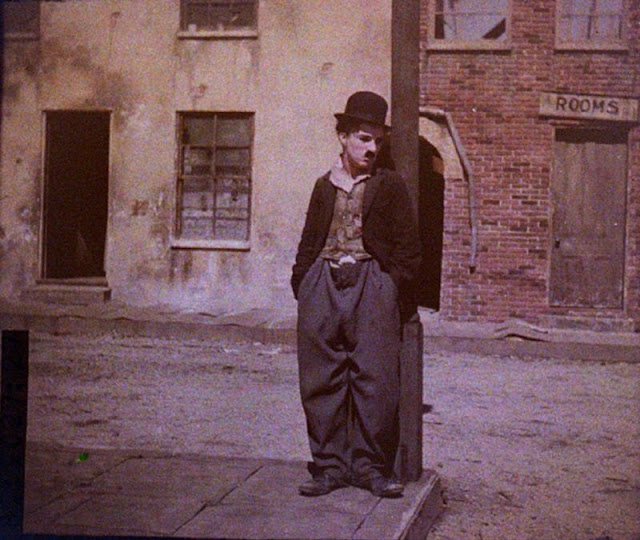
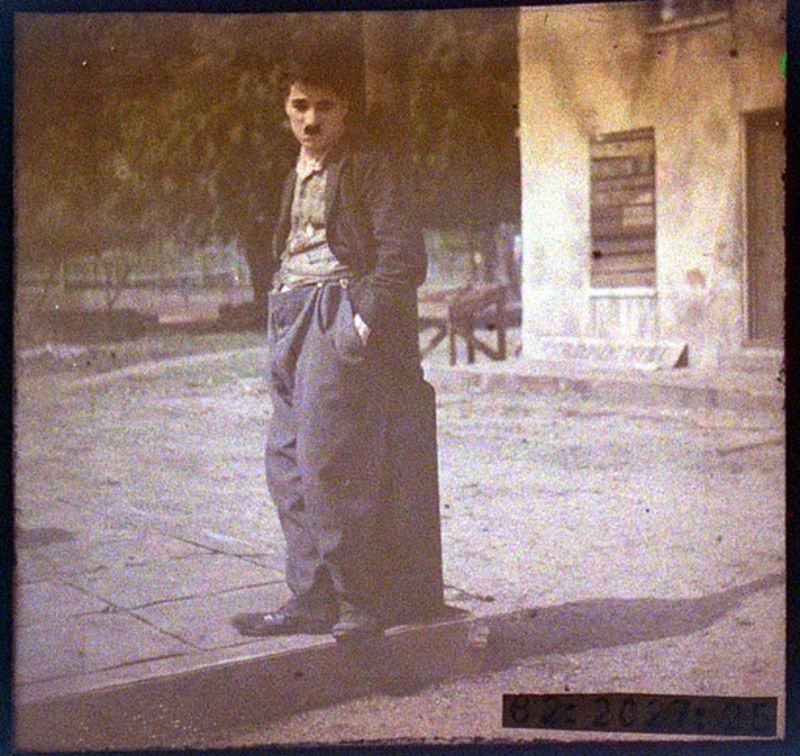
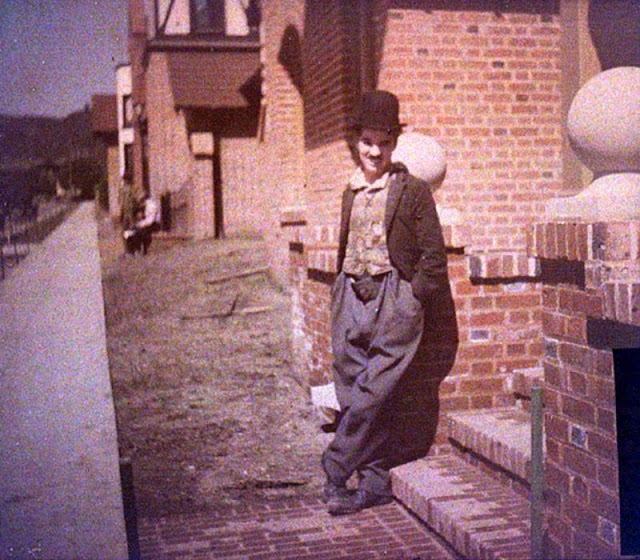
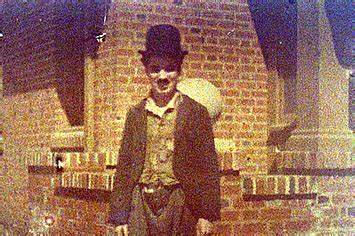
Though there is no colour footage of Chaplin from the silent era, there are a set of remarkable colour photographs taken by Charles C Zoller in 1918. These show Chaplin on the steps of his new studio and on the set of A DOG’S LIFE:
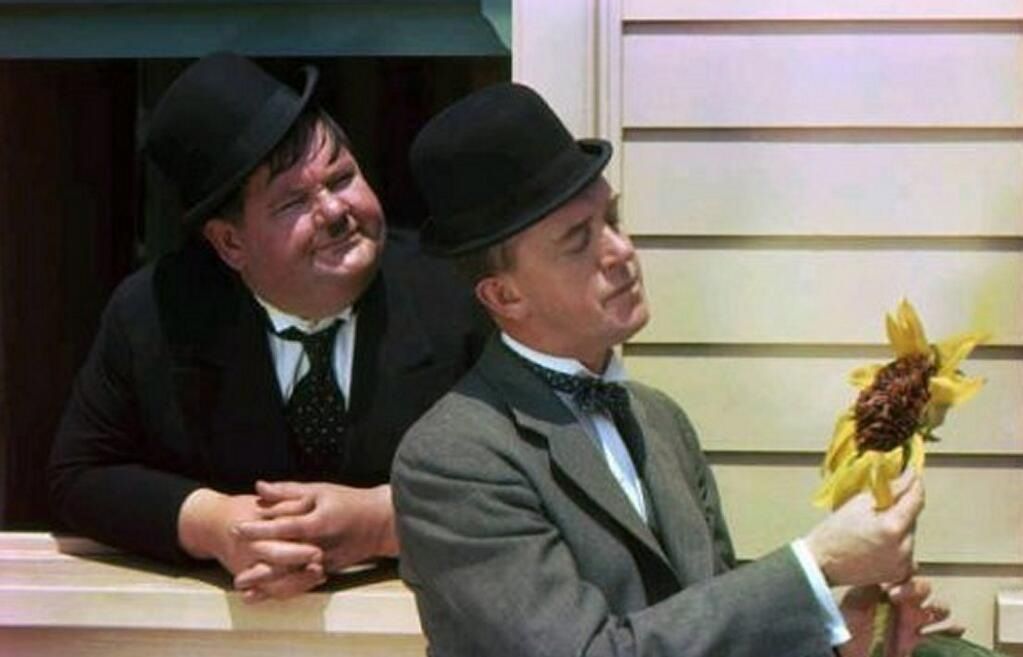
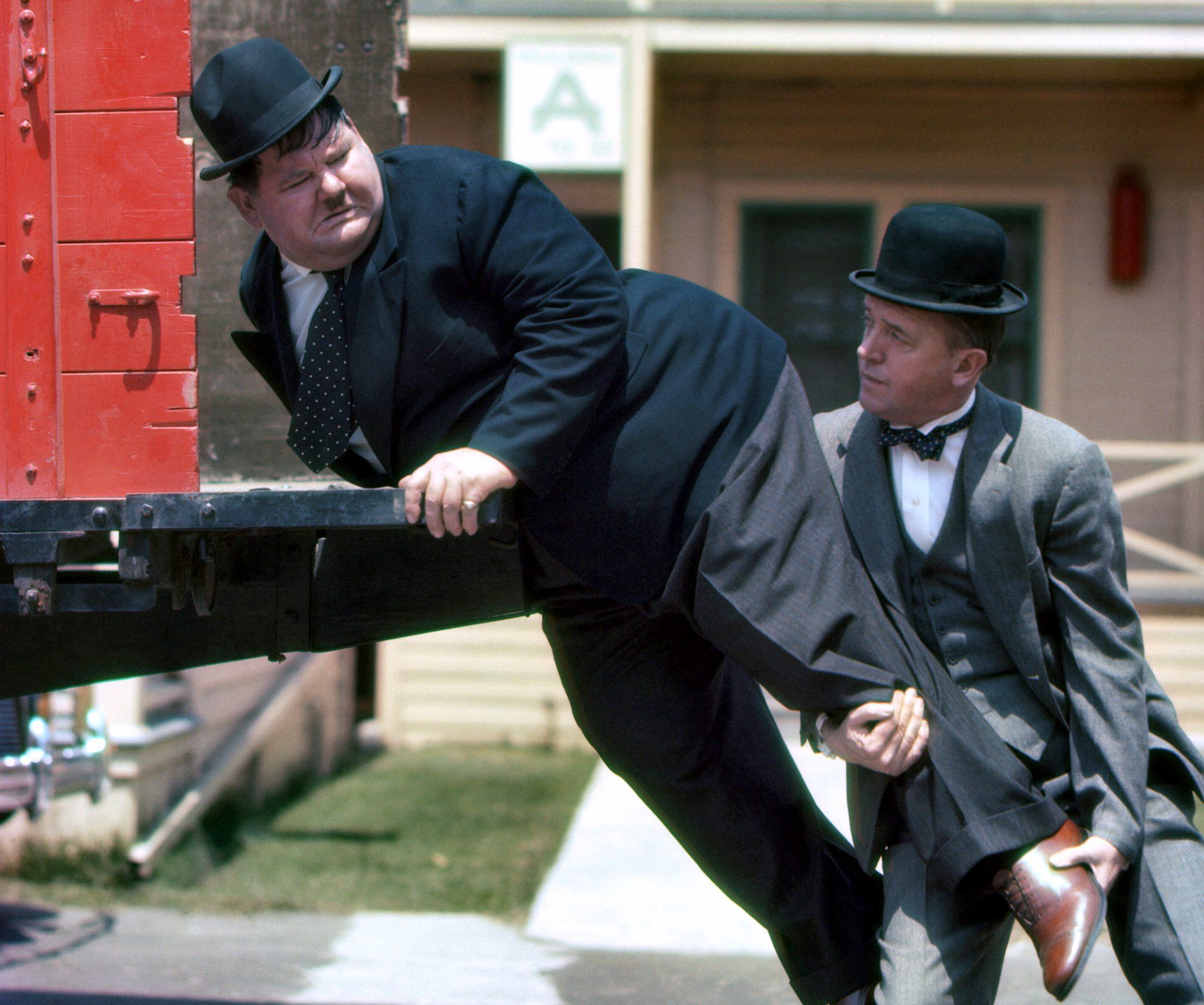
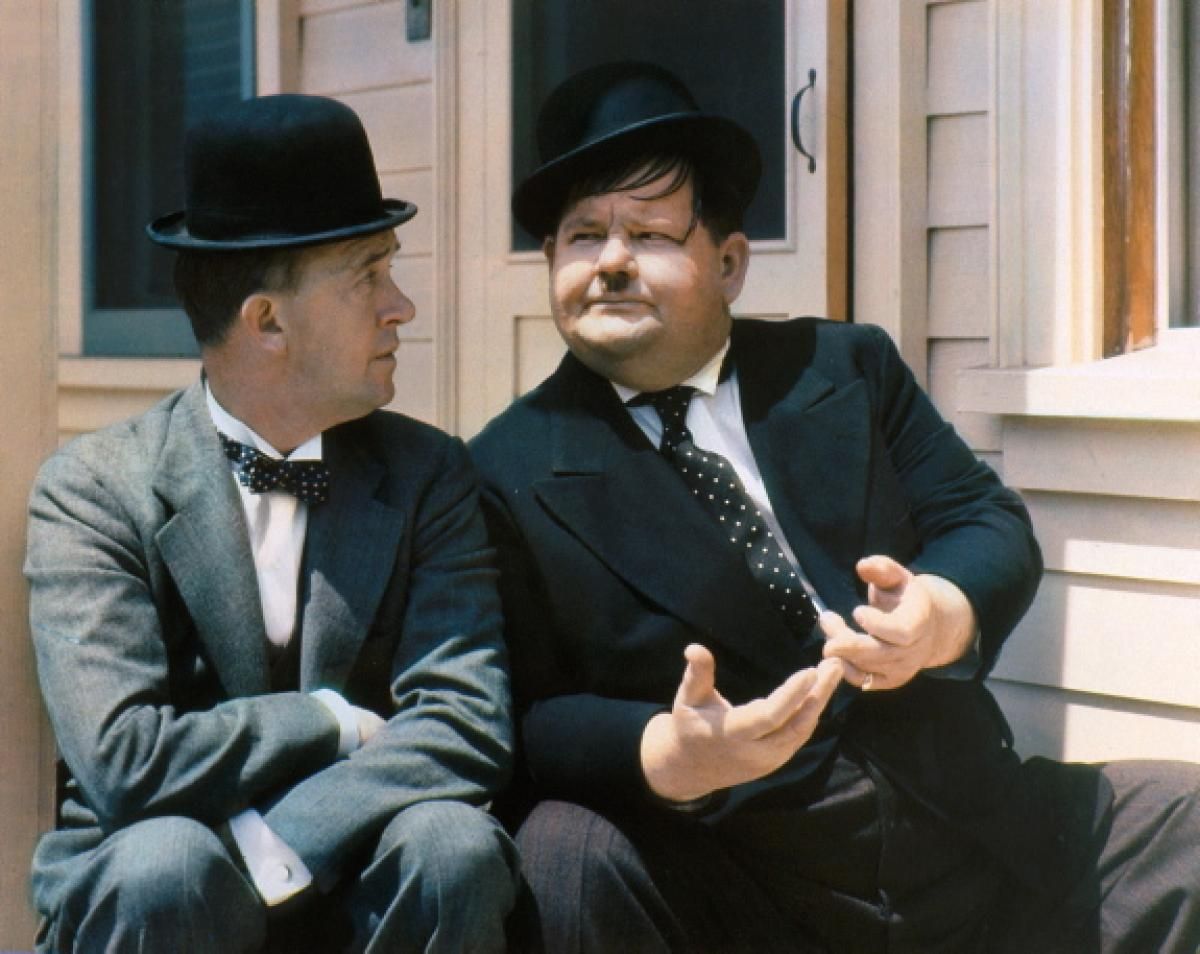
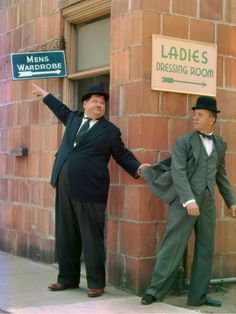
Similar in spirit are these shots of Laurel & Hardy horsing around on the Hal Roach lot in 1938:
The most famous Laurel & Hardy colour footage is the 1940s public information short THE TREE IN A TEST TUBE, which features some mute film of them clowning around with wood products. Their first colour film was actually made over a decade earlier; THE ROGUE SONG was an MGM musical starring Lawrence Tibbett, with the boys added for some comic relief. Alas, this is another early colour film that has decomposed, but a small fragment of the boys’ footage does remain. Murphy’s law of course dictates that the existing scene takes place almost in a dark cave so there’s not much colour to be had! Here’s the clip, which ends with that famous stage direction, “exit, pursued by bear!”
Another comedy team, another clip from 1930; here’s a behind the scenes glimpse of the Marx Brothers on the set of ANIMAL CRACKERS:
It wasn’t just the highest profile stars who made some colour appearances. Here’s Lupino Lane singing a tune in 1930’s GOLDEN DAWN. It’s one of the few bright spots in this turgid and dated drama of Africa; not one that stands up to repeated viewings these days.
And to finish off with here’s Charley Chase as ‘Charley Chan Chase’, host of the oriental themed MGM novelty, HOLLYWOOD PARTY (1937) . Maybe another one that doesn’t stad much chance of being revived today… nice Technicolor, though!



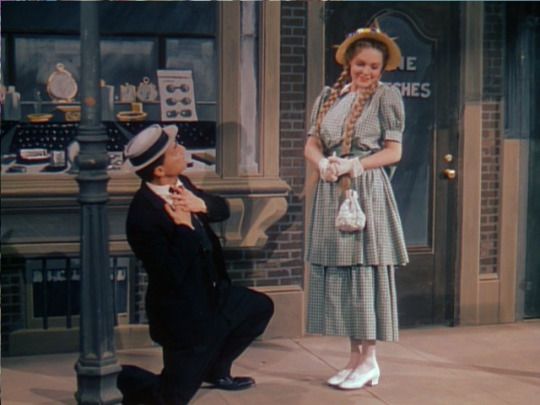 Keaton’s long career kept him working to the point where colour was much more widespread in the film and TV industry. As a result, there is lots of nice colour footage of him in his later years, but to see him looking more like the Buster we know from his classic silents, the best bet is HOLLYWOOD CAVALCADE. This 1939 feature was a vague retelling of the Mack Sennett story and Buster appears in an on-set pie throwing sequence (thus perpetrating the myth that he was another Keystone clown). It’s beautiful vivid colour, and there are even some lovely outtakes from the film showing Buster throwing pies and laughing. Sadly, neither film nor outtakes appear to be on YouTube, but there’s a brief snippet at 9:15 in this episode of the wonderful Keaton documentary A HARD ACT TO FOLLOW.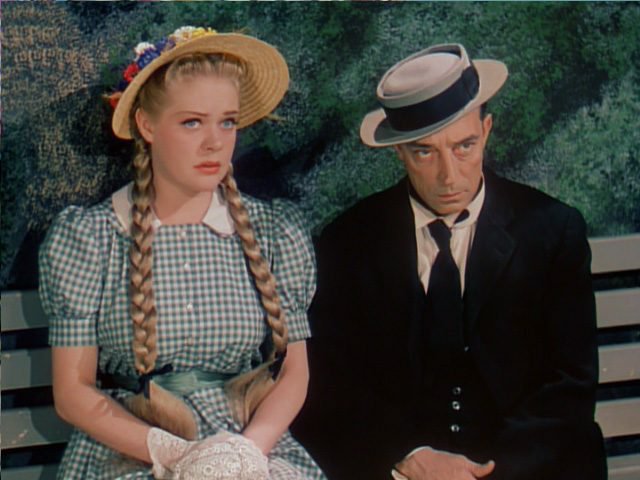
 The Lost Laugh