Well, it’s been a while, but the new issue is done.
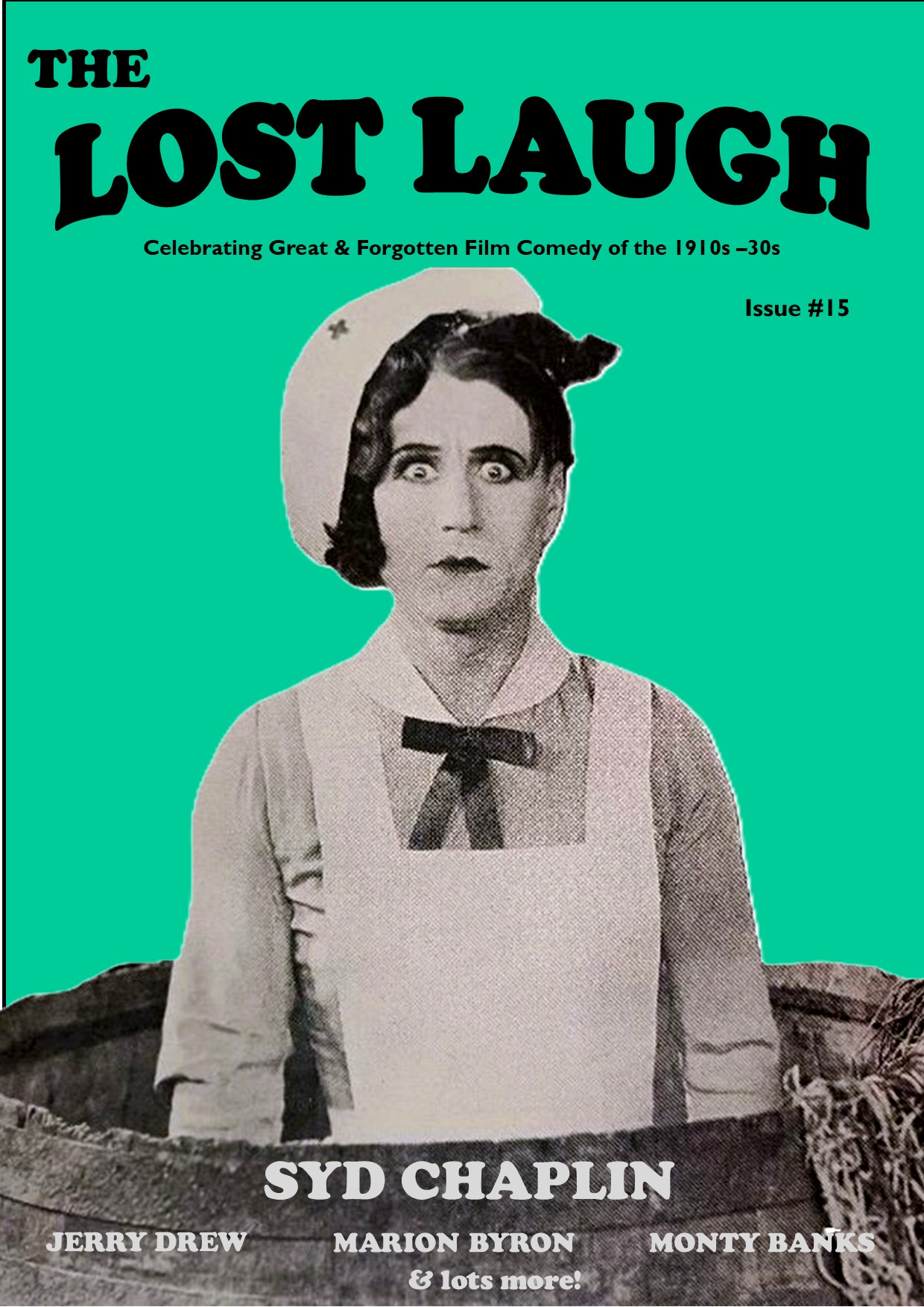
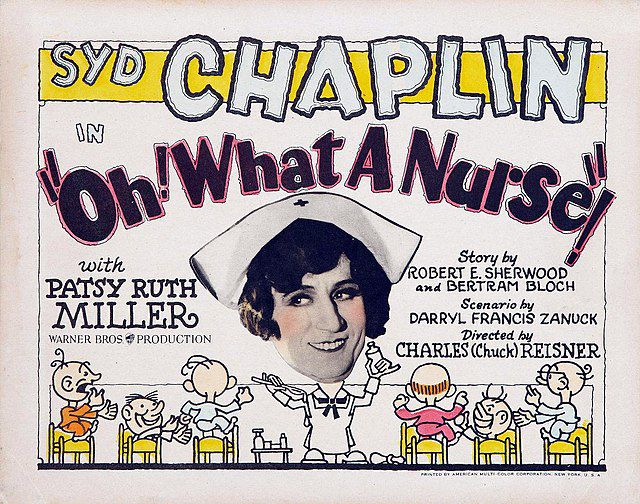
At 60 pages, this is the longest one yet, and I’m proud to feature some fantastic guest contributors this time. Syd Chaplin’s biographer Lisa Stein Haven has provided some great insights into our cover star, as well as his more famous little brother… There are also some details on the newly restored Syd feature, Oh! What a Nurse!.
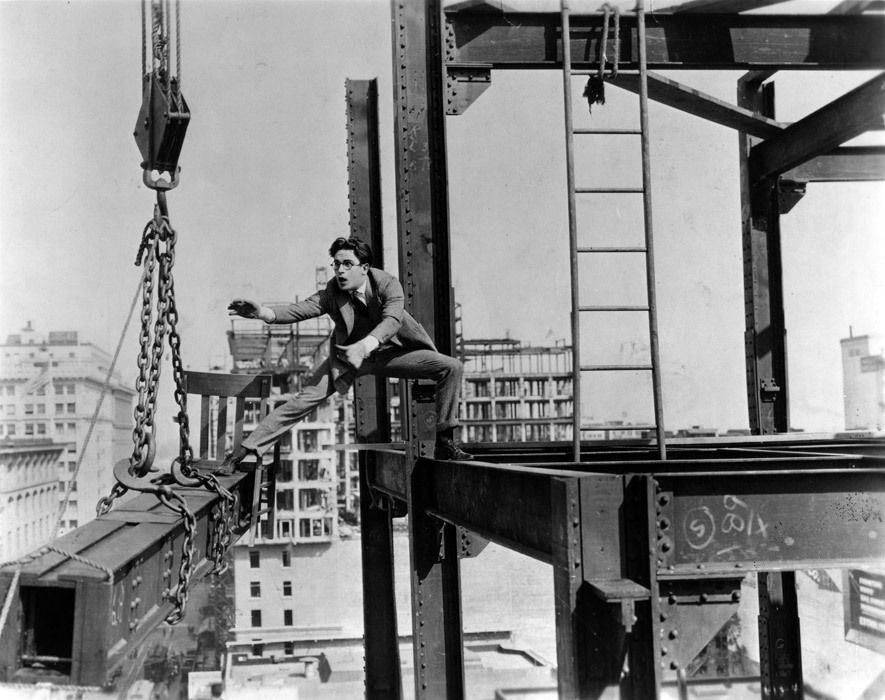
I’m absolutely thrilled to be able to publish an exclusive excerpt from Steve Massa’s new book about Harold Lloyd’s Lonesome Luke films, and the early years of the Hal Roach studios – available soon from Split-Reel. There’s also a very informative Q & A with Steve about the new book.
There are also articles about Jerry Drew, Marion Byron, Monty Banks and a piece about gagman extraordinaire Charles Rogers, by Holly Foskett and Matthew Lydick from A Lot of Fun Writers. Plus, a transcript of an interview with Al St John, film and BluRay reviews and lots more.
I really hope you enjoy this issue. I hope it won’t take as long for #16 to come along! If you’d like to contribute an article, plug a project you’re working on, or take part in a Q & A for the next issue, please do get in touch – either in the comments section here, or by emailing movienightmag [AT] gmail.com
And finally… The magazine is totally free. However if, you do enjoy reading the issues and would like to make a donation to support site running costs, software etc then these would be gratefully received! If you would like to donate, you can buy me a coffee on Ko-Fi. Thanks!
Where does the time go? Somehow, It’s just over three years since the last issue of The Lost Laugh appeared. Well, finally I’ve been cracking on with a new one, and though life has thrown a few delays in the way, I hope it will be out by the end of March.
This time round, I’m really thrilled to be featuring contributions from silent comedy experts Steve Massa, Lisa Stein Haven, Holly Foskett & Matthew Lydick, and have enjoyed researching some corners of silent film comedy that were new to me. Here’s a teaser of some of the contents:
Syd Chaplin. As Syd’s newly restored feature Oh!What a Nurse! is restored and re-premiered, it’s the perfect opportunity to revisit his neglected comedy career. Syd’s biographer and Charlie Chaplin expert/author Lisa Stein Haven has very kindly agreed to a Q & A about the brothers.
Monty Banks: his career in short films, from supporting actor to star comic.
Steve Massa provides an insight into the early years of Hal Roach‘s studio – Rolin, and fills us in on his exciting new book project
Jerry Drew: aka Clem Beauchamp, Educational’s corner on the sophisticated comedy market of the late 1920s. But there’s more to Drew than that; he was also a writer, director, stunt pilot, husband of Anita Garvin… and an Oscar winner!
Charley Rogers:Holly Foskett and Matthew Lydick shine a light on Stan Laurel’s right hand man, a talented gagman, director and performer whose career has been under-researched… until now.
A celebration of Marion Byron: one of Buster Keaton’s best leading ladies, and a very talented comedian.
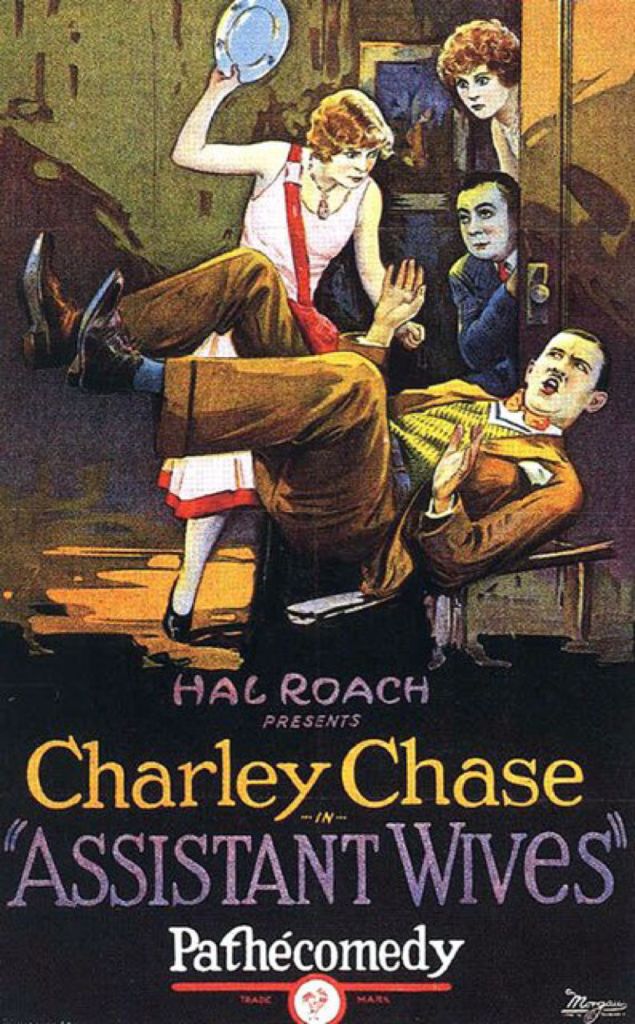
A Charley Chase feature film is a sadly rare thing, but 1929’s Modern Love still exists and provides some vintage Chase comedy!
news of exciting new Kickstarter projects, film festivals, DVD/BluRay releases, plus reviews…
It’s not too late to add something, if you’d like to! Contributions are always welcomed, and if you have a project you’d like to plug, then please do get in touch. I’m always happy to help spread the word. Drop me a line in the comments section, or at movienightmag [AT] gmail .com if I can help!
Here’s the cover of the issue. I thought I’d try a simpler, cleaner look this time. What do you think?
It’s back! Mark your diaries for giggles, chuckles and belly laughs! On November 9th & 10th, Kennington Bioscope present another Silent Laughter Weekend: two days of live silent cinema showcasing the cream of silent comedy films.
This year features one of our most packed programmes ever, a wide-ranging and eclectic selection of the funniest, rarest and most unusual gems from comedy’s greatest era. From the best-loved comedians to the most obscure; from wild slapstick to the subtle and sophisticated; from surreal stop-motion animation to European clowns, there’s a smorgasbord of silent hilarity spread over twelve programmes.
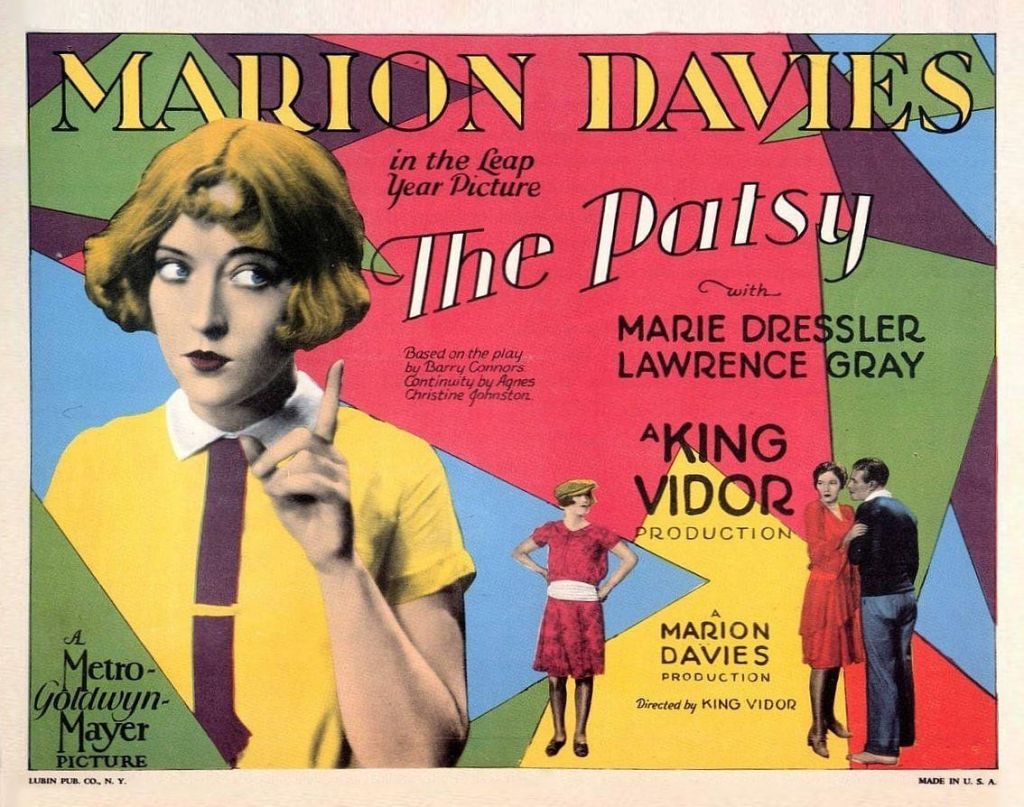
You’ll find plenty of familiar favourites, including classic shorts starring Charlie Chaplin, Buster Keaton, Harold Lloyd and Laurel & Hardy. But there’s so much more to silent comedy than the well-known stars, and as always we also spotlight the undeservedly forgotten comedy talents, such as Marion Davies (in The Patsy), Danish comedy team Pat & Patachon, Richard Dix, Charlie Murray and Charley Chase.
Regular attendees will know that we always pull some real rarities out of the hat. This year is no exception, as we’ll be hosting the U.K. premieres of several recently rediscovered films. On Saturday evening, Charlie Chaplin’s brother Syd stars in Oh! What a Nurse! one of the big hits of last year’s Pordenone, it hasn’t been seen in this country for almost 100 years! We’re also thrilled to be showing the newly rediscovered spooky comedy thriller The Gorilla, starring comedy stalwart Charlie Murray. Murray also features alongside Clara Bow in another previously lost film, The Pill-Pounder. Bioscope favourite Charley Chase will feature in a programme of newly restored short comedies that have been unseen in many, many years and we’ll also be showing some incredibly rare films starring the likes of Monty Banks, Harold Lloyd and Dorothy Devore.
There is also a spotlight on the iconic Keystone Kops, as well as the work of Vitagraph Studios. An ‘Animations and Illusions’ programme will feature camera trickery, from Meliés’ experiments to the mind-blowing madness of Charley Bowers. You won’t want to miss a very special presentation of 9.5mm rarities by Christopher Bird, shown on film using amazing vintage projectors. Bioscope favourite Charley Chase will feature in some of his rarest comedies, newly restored and presented by Hal Roach expert Richard M Roberts.
We’ve even got a silent film appearance of a Marx Brother! There’s a rare screening of Too Many Kisses, a 1925 comedy featuring a supporting role from none other than Harpo Marx.
Every programme features live musical accompaniment from London’s finest silent film pianists. A roll call of comedy film authors, enthusiasts and collectors will contextualise the films, and share stories of the filmmakers. And it all takes place in the wonderful surroundings of London’s Cinema Museum. Oh, and it’s just £30 for the whole weekend!
So come and join us on the 9th-10th November for a lafftastic weekend of live silent cinema. It’s the best selection of rare and classic silent comedy you’ll find anywhere!
Here’s the link to the full programme, and to buy tickets:
Recently, a whole load of colourised silent films have been appearing on YouTube. I won’t wade into the colourisation debate here (let’s save that for tedious flame wars on Internet forums) but it did get me thinking about genuine colour footage of silent comedians. Unsurprisingly, there’s not much about, as a) the use of colour was limited in the era and b) lots of early colour footage has decomposed. Still, there are some examples out there…
In the silent era, colour was mainly used in small doses to add some prestige to feature films. Harry Langdon filmed a fantasy sequence for LONG PANTS (now sadly lost) and Buster Keaton created a colour prologue for SEVEN CHANCES. Happily, this does exist and has been restored to current copies. It must be said that the faded 2-strip Technicolor isn’t exactly vivid, having faded to more of a sepia effect, but it’s still nice to have it, and if you squint hard enough you can imagine Buster in living colour.
Keaton’s long career kept him working to the point where colour was much more widespread in the film and TV industry. As a result, there is lots of nice colour footage of him in his later years, but to see him looking more like the Buster we know from his classic silents, the best bet is HOLLYWOOD CAVALCADE. This 1939 feature was a vague retelling of the Mack Sennett story and Buster appears in an on-set pie throwing sequence (thus perpetrating the myth that he was another Keystone clown). It’s beautiful vivid colour, and there are even some lovely outtakes from the film showing Buster throwing pies and laughing. Sadly, neither film nor outtakes appear to be on YouTube, but there’s a brief snippet at 9:15 in this episode of the wonderful Keaton documentary A HARD ACT TO FOLLOW.
Charlie Chaplin didn’t make a colour film until 1967’s A COUNTESS FROM HONG KONG, but his brother Syd (always the less parsimonious Chaplin brother!) took some remarkable colour home movies on the set of THE GREAT DICTATOR that capture Charlie at work. There are scenes from the battlefields, ghettos and ballrooms of the film represented, as well as the iconic final speech. The vividly coloured uniforms of the soldiers make the viewer wish the film had been made in colour!
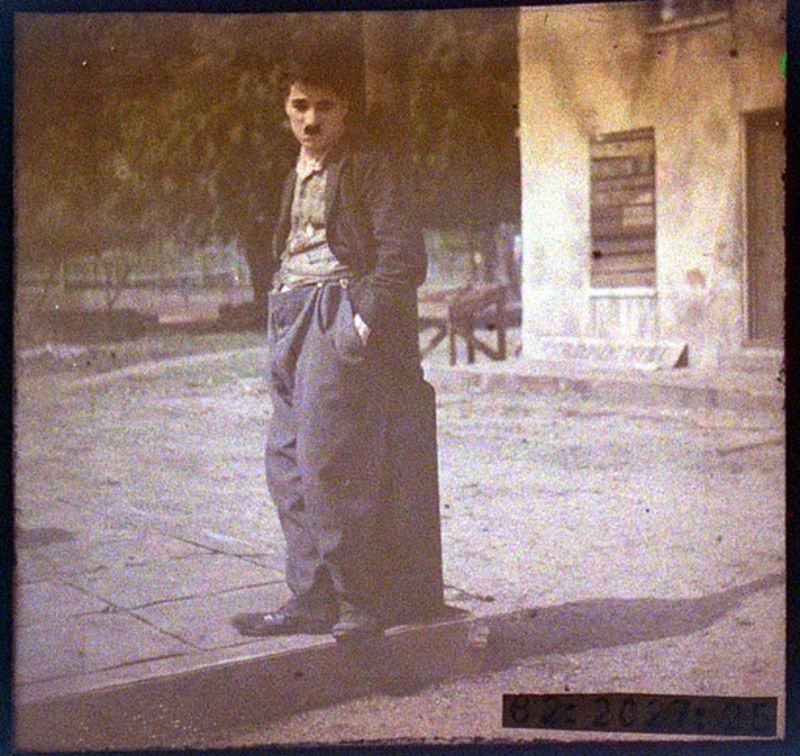
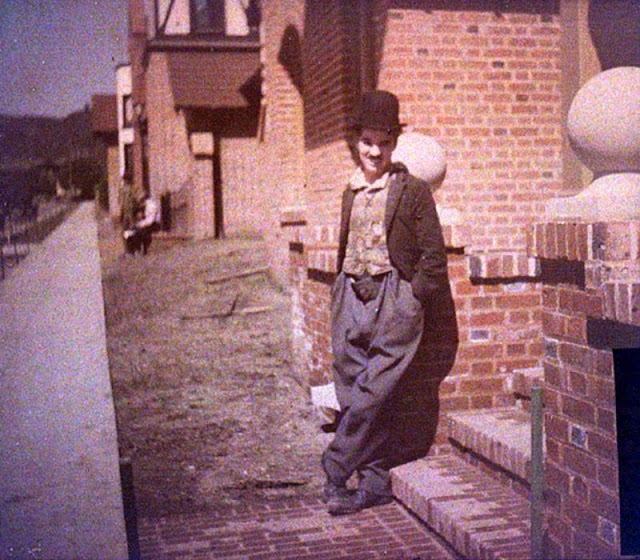
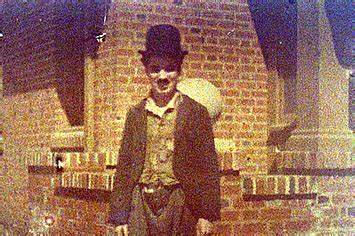
Though there is no colour footage of Chaplin from the silent era, there are a set of remarkable colour photographs taken by Charles C Zoller in 1918. These show Chaplin on the steps of his new studio and on the set of A DOG’S LIFE:
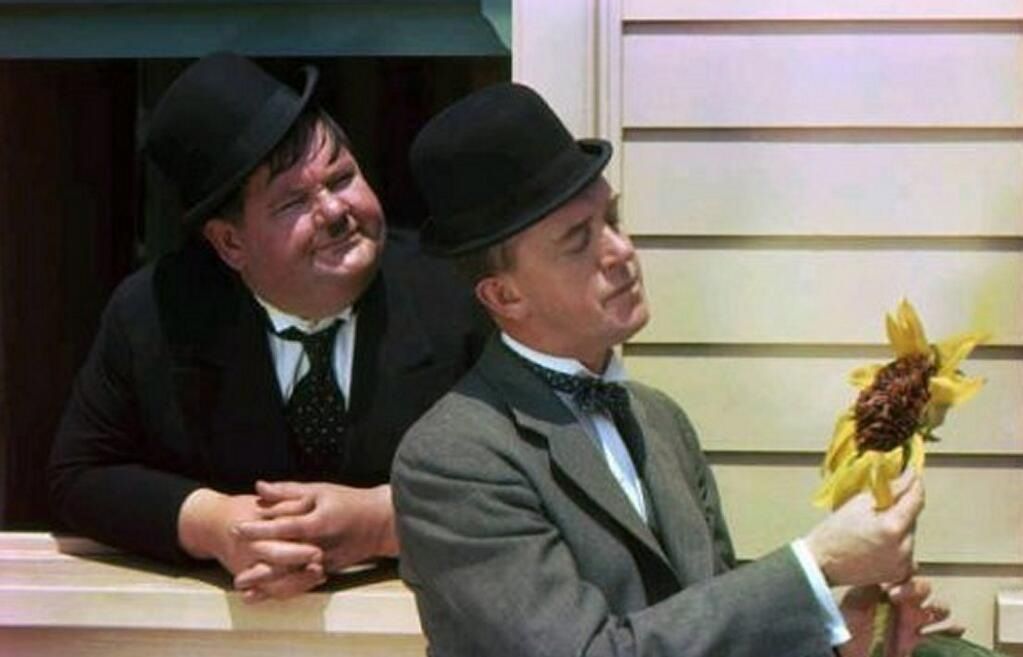
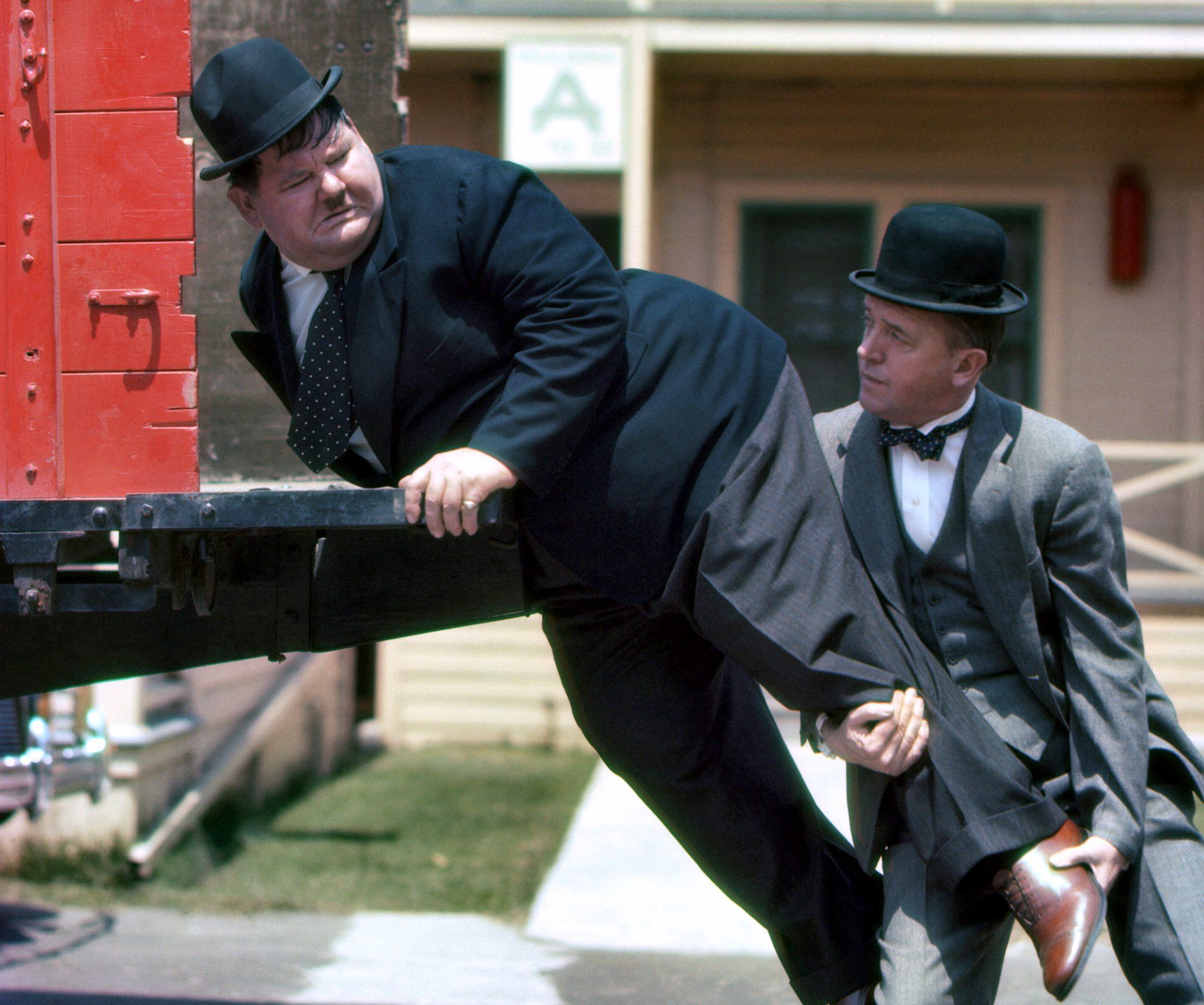
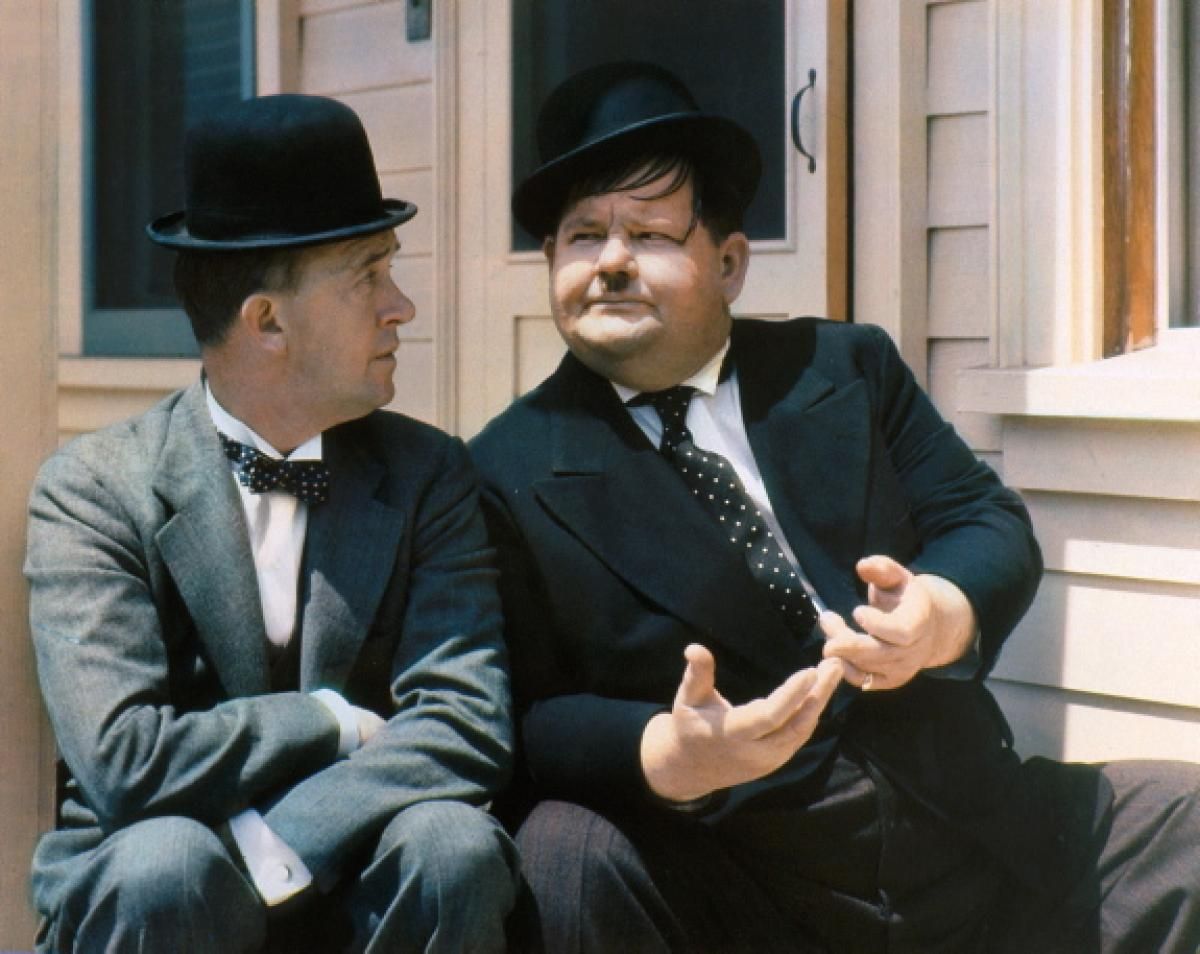
Similar in spirit are these shots of Laurel & Hardy horsing around on the Hal Roach lot in 1938:
The most famous Laurel & Hardy colour footage is the 1940s public information short THE TREE IN A TEST TUBE, which features some mute film of them clowning around with wood products. Their first colour film was actually made over a decade earlier; THE ROGUE SONG was an MGM musical starring Lawrence Tibbett, with the boys added for some comic relief. Alas, this is another early colour film that has decomposed, but a small fragment of the boys’ footage does remain. Murphy’s law of course dictates that the existing scene takes place almost in a dark cave so there’s not much colour to be had! Here’s the clip, which ends with that famous stage direction, “exit, pursued by bear!”
Another comedy team, another clip from 1930; here’s a behind the scenes glimpse of the Marx Brothers on the set of ANIMAL CRACKERS:
It wasn’t just the highest profile stars who made some colour appearances. Here’s Lupino Lane singing a tune in 1930’s GOLDEN DAWN. It’s one of the few bright spots in this turgid and dated drama of Africa; not one that stands up to repeated viewings these days.
And to finish off with here’s Charley Chase as ‘Charley Chan Chase’, host of the oriental themed MGM novelty, HOLLYWOOD PARTY (1937) . Maybe another one that doesn’t stad much chance of being revived today… nice Technicolor, though!
I just stumbled across some screening notes I wrote for a programme of ‘imitation Chaplin’ comedies at last year’s Silent Laughter Weekend. I’ve reproduced them here, adapted slightly to incorporate some video links. Hope you enjoy!
Charlie Chaplin’s phenomenal popularity in the mid-teens was dubbed ‘The Chaplin Craze’ or ‘Chaplinitis’ by the press. His rise to fame had been made possible by a huge boom in mass-amusement culture, beginning at the end of the Victorian era. Additionally, the new technology of silent cinema enabled a universal recognition for performers beyond previously insurmountable language and travel barriers. With his instantly recognisable image, Chaplin arrived on screen just in time to act as a kind of divining rod for these forces.
Chaplin’s was celebrity on a scale never seen before. He was as astonished as anyone, later remarking, “I knew I was famous but didn’t know what fame meant.”
He was soon to find out. Puppets, dolls, toothbrushes, sweets… all kinds of merchandise imaginable soon bore the familiar image of the tramp. There were Charlie Chaplin songs, dances, fancy dress parties and lookalike competitions (the oft-told story of Chaplin entering one such contest and coming second is now believed to be apocryphal, however!)
Some took their impersonations a step further and turned it into their own act. Among the legions ‘doing Chaplin’ were some future stars: Bert Wheeler and Walter Forde both started on the stage in this way, for instance. Stan Laurel, previously Chaplin’s understudy in Fred Karno days, also included an ersatz Mabel Normand and Chester Conklin in his act “The Keystone Trio”. British comedian Frank Randle was chased away from Blackpool Pier after busking his act there, and his contemporary Sid Field was also a Chaplin street performer.
Within the film industry, desire for Chaplin product outstripped the speed with which the increasingly methodical comedian could turn it out. Many of his earlier films would be repackaged and reissued (Essanay studios, in particular, excelled themselves at milking leftover scraps of Chaplin footage, expanding ‘A BURLESQUE ON CARMEN’ to twice its original length, and making an entirely new film, ‘TRIPLE TROUBLE’ from scenes Chaplin had discarded). Even these efforts did not fulfil public desire, and it was inevitable that other companies would attempt to get a piece of the pie.
A series of ‘Charley’ cartoons made by Otto Messmer are an early example. These actually received a helping hand from Chaplin himself, who provided a series of portraits in various poses to assist Messmer’s drawings. The cartoonist would later incorporate a considerable Chaplin influence into his most famous character, Felix the Cat.
Cartoons were one thing, but screen imitators provided a direct threat of competition. Practically all film comedians of the late teens took some influence from Chaplin, but some did so more blatantly than others. Devoted to redefining the word ‘blatant’ was Billy West, whose deception extended to sleeping with his hair in curlers, and learning to play the violin left-handed! He also poached Chaplin’s Essanay co-star Leo White to add to the illusion in a series of films for the King Bee corporation. West’s impersonation attracted derision from some quarters at the time, and he is still often dismissed outright. However, he was a capable comedian and his Chaplin imitations provide some good laughs. He also got a big helping hand from some other comic minds; Oliver Hardy was his heavy, made up to resemble Chaplin’s ‘Goliath’, Eric Campbell. His director was also a gifted comedy craftsman: Charles Parrott, the future Charley Chase.
Billy West, with Babe Hardy on the left.
Here’s a prime example of the West-Hardy-Parrott triple-threat: ‘HIS DAY OUT’, from 1918
And here’s THE CANDY KID (1917), directed by Arvid E Gillstrom before Parrott joined the series,
Charles Parrott would later work with another Chaplin impersonator, Harry Mann in films like ‘THE FLIRTS’ (featured on the ‘Becoming Charley Chase’ DVD set) and ‘DON’T PARK THERE’.
Billy Ritchie is one of the most interesting Chaplin lookalikes, gaining a certain notoriety for claiming that Chaplin actually copied him. Glaswegian Ritchie claimed that he had been wearing a similar costume for years on stage before Chaplin used it. There is probably some legitimacy to his claim (not to mention a strong possibility that Chaplin & Ritchie were actually related) but truthfully the bowler, cane and moustache were all fairly standard parts of the music hall comic’s attire.
It’s clear that Ritchie’s take on the tramp was a very different animal. While the early Chaplin was given to bouts of violence, Ritchie can be downright hostile! His default expression is a scowl, and he’s generally given to cruder body language, sticking his rear out as he walks. Chaplin’s tramp may have been anti-authoritarian, but Ritchie was an anarchist!
To this day, he has some fierce defenders who feel he was robbed. No doubt, he hasn’t received his due as an original comedian in his own right, but he was never really going to be a timeless performer. Unlike Ritchie, Chaplin developed his character to be not just a suit of funny clothes, but a real human. As a knockabout comedian, Ritchie could be excellent, but he was probably never going to make ‘THE KID’. He certainly wasn’t going to while working in fast-paced, violent comedies for L-KO under the direction of Henry Lehrman.
Lehrman’s penchant for savage knockabout was to be Ritchie’s undoing – one film, POOR POLICY, saw him bizarrely savaged by ostriches, setting off a bout of ill-health ending with his death from stomach cancer in 1921. (I’ve seen this film, and the way he treats the ostriches, I’m not surprised they bit back!)
Here’s Billy in happier times, in ‘ALMOST A SCANDAL’ (1915)
L-KO were also responsible for another Chaplin spin-off. Chai Hong, billed as “The Chinese Charlie Chaplin”, was actually Korean. While it was his Chaplin impersonation in ‘PLAYING MOVIES’ that brought him to attention, this was a one-off. His other films had him playing his own, if stereotypically ‘oriental’ character. He starred in several shorts before disappearing from the screen in the early 20s. Hong later became valet to actor Lew Cody.
While these are examples of outright Chaplin copies, many other performers evoked Chaplin in essence. Monty Banks’ early appearances are extremely Chaplinesque, and Harold Lloyd’s ‘Lonesome Luke’ character was a self-admitted inversion of the Chaplin costume. Crucially, the really gifted comedians realised that imitation proved a blind alley and would forge their own paths into the 1920s.
Even for those not copying Chaplin’s appearance or behaviour, his genius routines and plots would be re-used by many other comics. A few examples among the multitudes: Buster Keaton’s ‘THE ELECTRIC HOUSE’ features a central escalator surely inspired by that in THE FLOORWALKER, Monty Banks revisits ‘EASY STREET’ in ‘PEACEFUL ALLEY’ and Laurel & Hardy rework ‘LAUGHING GAS’ for ‘LEAVE ‘EM LAUGHING’. While these examples all took the material to a new place, sometimes the ‘borrowing’ of ideas was downright brazen. The BFI holds a rare Educational Pictures one-reeler called ‘CUT LOOSE’ (1924) that mimics ONE AM right down to its bizarre selection of stuffed animal props! The star is Phil Dunham, another British comedian, and allegedly a Cambridge graduate. Dunham remained busy at Educational, and in small parts elsewhere well into the sound era.
Today it’s easy to sneer at the unoriginality of the copycats in the shadows of Chaplin’s genius, but the picture was more complex than this. For struggling vaudeville and film performers, money had to take precedence over artistic integrity and a good Chaplin impersonation meant money. There were many good comedians among the impersonators, many of them still funny today. If nothing else, they provide a fascinating sidelight to Chaplin’s story, and remind us just how special the man himself was.
It’s back! Kennington Bioscope presents another weekend of classic & rare silent comedy at the historic cinema museum. Lots to enjoy in a packed programme, including classics like Chaplin’s ‘THE GOLD RUSH’ and Lloyd’s ‘GRANDMA’S BOY’, plus rarely seen films starring Marion Davies, Gloria Swanson, W.C. Fields & more. There’s also a chance to see Laurel & Hardy’s recently rediscovered ‘THE BATTLE OF THE CENTURY’, and I’m looking forward to presenting some of Charley Chase’s finest silent shorts.
As always, films will be accompanied by the cream of silent film accompanists. Best of all, it’s only £30 for a weekend pass! Don’t miss it – tickets available at www.kenningtonbioscope.com
Here’s a wonderful BBC interview with Charlie Chaplin (I believe it’s actually from late 1952) discussing both his then current film, LIMELIGHT, and various aspects of his career and life. Chaplin is sometimes given an unfair reputation of being a bit of an overly serious bore in his later years, but actually, he comes across as a very engaging speaker. Cerebral, yes, but also lighthearted and surprisingly modest. In reference to doing everything himself on his films, for example: “I know lots of people could do it, but it’s just a matter of having the money to be able to afford it” . There’s extra interest in the panel of filmmakers he is interviewed by, including Sir Michael Balcon and John Mills. Overall, a great and illuminating listen.

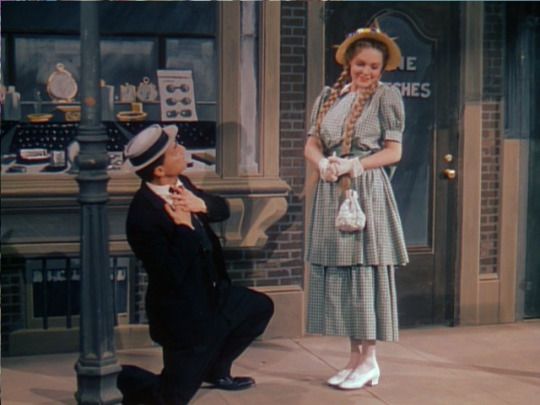 Keaton’s long career kept him working to the point where colour was much more widespread in the film and TV industry. As a result, there is lots of nice colour footage of him in his later years, but to see him looking more like the Buster we know from his classic silents, the best bet is HOLLYWOOD CAVALCADE. This 1939 feature was a vague retelling of the Mack Sennett story and Buster appears in an on-set pie throwing sequence (thus perpetrating the myth that he was another Keystone clown). It’s beautiful vivid colour, and there are even some lovely outtakes from the film showing Buster throwing pies and laughing. Sadly, neither film nor outtakes appear to be on YouTube, but there’s a brief snippet at 9:15 in this episode of the wonderful Keaton documentary A HARD ACT TO FOLLOW.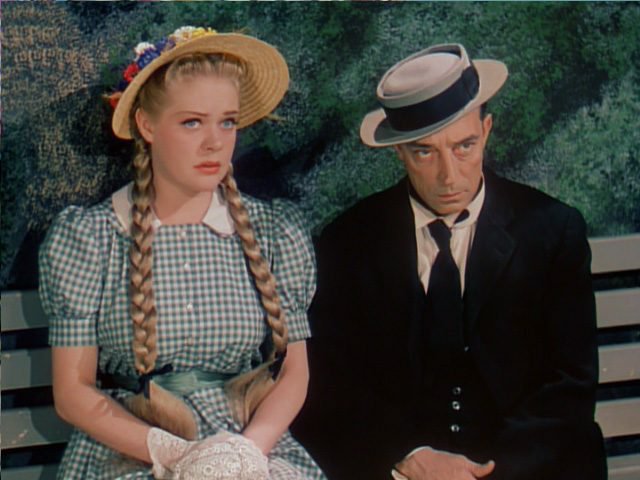
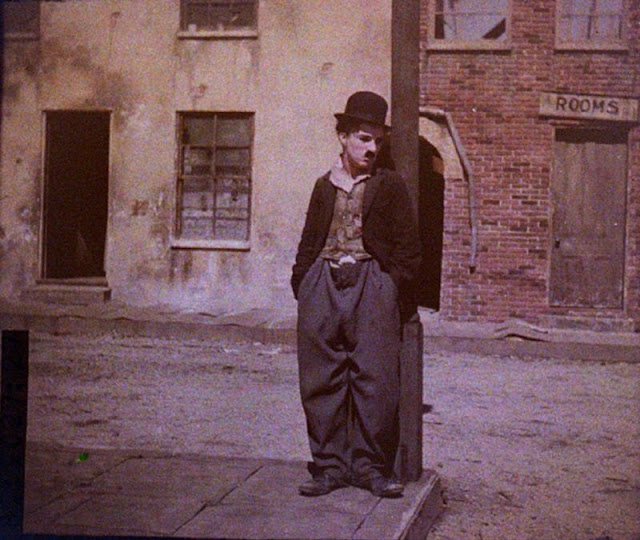
 Charlie Chaplin’s phenomenal popularity in the mid-teens was dubbed ‘The Chaplin Craze’ or ‘Chaplinitis’ by the press. His rise to fame had been made possible by a huge boom in mass-amusement culture, beginning at the end of the Victorian era. Additionally, the new technology of silent cinema enabled a universal recognition for performers beyond previously insurmountable language and travel barriers. With his instantly recognisable image, Chaplin arrived on screen just in time to act as a kind of divining rod for these forces.

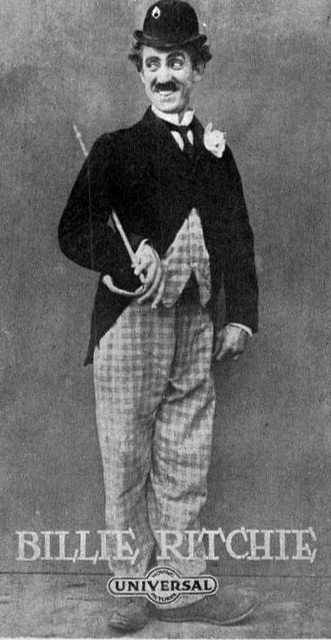 Billy Ritchie is one of the most interesting Chaplin lookalikes, gaining a certain notoriety for claiming that Chaplin actually copied him. Glaswegian Ritchie claimed that he had been wearing a similar costume for years on stage before Chaplin used it. There is probably some legitimacy to his claim (not to mention a strong possibility that Chaplin & Ritchie were actually related) but truthfully the bowler, cane and moustache were all fairly standard parts of the music hall comic’s attire.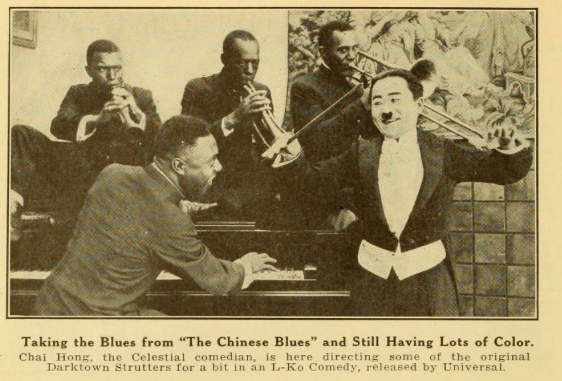

 The Lost Laugh